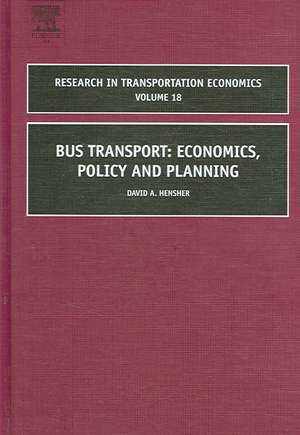
Bus Transport: Economics, Policy and Planning: Research in Transportation Economics, cartea 18
Autor David A. Hensheren Limba Engleză Hardback – 30 ian 2007


Preț: 589.84 lei
Preț vechi: 766.03 lei
-23%
Puncte Express: 885
Carte tipărită la comandă
Livrare prin curier în România Termenul estimat este afișat lângă disponibilitate.
Transport gratuit pentru acest produs Plată online sau ramburs, în funcție de opțiunile comenzii.
Retur gratuit în 14 zile Comandă securizată și suport în română.
Specificații
ISBN-13: 9780762314089
ISBN-10: 0762314087
Pagini: 538
Ilustrații: Approx. 110 illustrations
Dimensiuni: 152 x 229 x 43 mm
Greutate: 0.92 kg
Editura: ELSEVIER SCIENCE
Seria Research in Transportation Economics
ISBN-10: 0762314087
Pagini: 538
Ilustrații: Approx. 110 illustrations
Dimensiuni: 152 x 229 x 43 mm
Greutate: 0.92 kg
Editura: ELSEVIER SCIENCE
Seria Research in Transportation Economics
V-ar putea interesa
-
 Integrated Land–Use and Transportation Models – Behavioural FoundationsMartin Lee–gosselin-23%Preț: 914.33 lei1187.44 lei
 -
 London OrbitalIain SinclairPreț: 95.76 lei
 -
 -23%Preț: 278.54 lei362.33 lei
 -
 Regional and Local Economic DevelopmentCliff HaguePreț: 294.41 lei
 -
 Spatial Planning and Governance: Understanding UK PlanningMark Tewdwr-Jones-25%Preț: 294.41 lei390.40 lei
 -
 The Urban and Regional Planning ReaderEugénie Birch-15%Preț: 694.54 lei817.10 lei
 -
 Modelling Transport 4eJ Ortuzar-8%Preț: 554.00 lei602.18 lei
 -
 Stated Choice MethodsJordan J. Louviere-11%Preț: 547.07 lei614.70 lei
 -
 Intermodal Freight TransportDavid Lowe-61%Preț: 431.17 lei1108.42 lei
 -
 The SAGE Handbook of Transport StudiesJean-Paul Rodrigue-18%Preț: 1237.52 lei1509.17 lei
Public țintă
Academics and researchers in city planning, transportation, economics, and the social sciencesCuprins
Chapter 1: Introduction
Chapter 2: Organisation and ownership of public transport service
Chapter 3: User needs and impact on public transport
Chapter 4: Contracting options
Chapter 5: Contract areas and service quality issues in public transit provision: some thoughts on the european and australian context
Chapter 6: Performance-based quality contracts in bus service provision
Chapter 7: Performance-based quality contracts for the bus sector: Delivering social and commercial value for money
Chapter 8: Delivering value for money to government through efficient and effective public transit service continuity: Some thoughts
Chapter 9: Melbourne's Public Transport Franchising: Lessons for PPPs
Chapter 10: Establishing a Fare Elasticity Regime for Urban Passenger Transport
Chapter 11: Preserving the symmetry of estimated commuter travel elasticities
Chapter 12: TRESIS (Transport and Environmental Strategy Impact Simulator): A Case Study
Chapter 13: Productivity Measurement in the Urban Bus Sector
Chapter 14: A service quality index for area-wide contract performance assessment
Chapter 15: Developing a service quality index (SQI) in the provision of commercial bus contracts
Chapter 16: Non-commercial contract reimbursement: the institute of transport studies (ITS) model
Chapter 17: A bus-based transitway or light rail? Continuing the saga on choice versus blind commitment
Chapter 18: The future of exclusive busways: the Brazilian experience
Chapter 19: The imbalance between car and public transport use in urban Australia: why does it exist?
Chapter 20: Urban public transport delivery in Australia: issues and challenges in retaining and growing patronage
Chapter 21: Urban public transport agendas and challenges
References
Subject Index
Chapter 2: Organisation and ownership of public transport service
Chapter 3: User needs and impact on public transport
Chapter 4: Contracting options
Chapter 5: Contract areas and service quality issues in public transit provision: some thoughts on the european and australian context
Chapter 6: Performance-based quality contracts in bus service provision
Chapter 7: Performance-based quality contracts for the bus sector: Delivering social and commercial value for money
Chapter 8: Delivering value for money to government through efficient and effective public transit service continuity: Some thoughts
Chapter 9: Melbourne's Public Transport Franchising: Lessons for PPPs
Chapter 10: Establishing a Fare Elasticity Regime for Urban Passenger Transport
Chapter 11: Preserving the symmetry of estimated commuter travel elasticities
Chapter 12: TRESIS (Transport and Environmental Strategy Impact Simulator): A Case Study
Chapter 13: Productivity Measurement in the Urban Bus Sector
Chapter 14: A service quality index for area-wide contract performance assessment
Chapter 15: Developing a service quality index (SQI) in the provision of commercial bus contracts
Chapter 16: Non-commercial contract reimbursement: the institute of transport studies (ITS) model
Chapter 17: A bus-based transitway or light rail? Continuing the saga on choice versus blind commitment
Chapter 18: The future of exclusive busways: the Brazilian experience
Chapter 19: The imbalance between car and public transport use in urban Australia: why does it exist?
Chapter 20: Urban public transport delivery in Australia: issues and challenges in retaining and growing patronage
Chapter 21: Urban public transport agendas and challenges
References
Subject Index