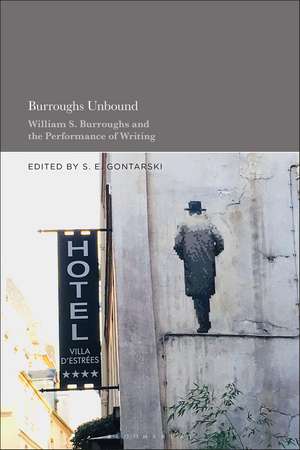
Burroughs Unbound: William S. Burroughs and the Performance of Writing
Editat de Professor S. E. Gontarskien Limba Engleză Hardback – 16 dec 2021
These questions about the archive concern not only the literary medium. In the 1960s and 1970s Burroughs collaborated with filmmakers, sound technicians, and musicians, who helped re-contextualized his writings in other media. Burroughs Unbound examines these collaborations and explores how such multiple authorship complicates the authority of the archive as a final or complete repository of an author's work. It takes Burroughs seriously as a radical theorist and practitioner who critiqued drug laws, sexual practice, censorship, and what we today call a society of control. More broadly, his work continues to challenge our common assumptions about language, authorship, textual stability, and the archive in its broadest definition.
Preț: 667.05 lei
Preț vechi: 978.61 lei
-32%
Puncte Express: 1001
Carte tipărită la comandă
Livrare economică 30 noiembrie-14 decembrie
Livrare prin curier în România Termenul estimat este afișat lângă disponibilitate.
Transport gratuit pentru acest produs Plată online sau ramburs, în funcție de opțiunile comenzii.
Retur gratuit în 14 zile Comandă securizată și suport în română.
Specificații
ISBN-13: 9781501362187
ISBN-10: 1501362186
Pagini: 456
Dimensiuni: 158 x 232 x 30 mm
Greutate: 0.77 kg
Editura: Bloomsbury Publishing
Colecția Bloomsbury Academic
Locul publicării:New York, United States
ISBN-10: 1501362186
Pagini: 456
Dimensiuni: 158 x 232 x 30 mm
Greutate: 0.77 kg
Editura: Bloomsbury Publishing
Colecția Bloomsbury Academic
Locul publicării:New York, United States
Cuprins
Acknowledgments
Contributors
Burroughs Unbound: An Atrophied Introduction
S. E. Gontarski, Florida State University, USA
Part 1: Theory
1. Weaponized Aesthetics and Dystopian Modernism: Cut-ups, Playbacks, Pick-ups and the "Limits of Control" from Burroughs to Deleuze
S. E. Gontarski, Florida State University, USA
2. Pay It All Back: Writing Paranoia-Paranoid Writing
Nathan Moore, School of Law, Birkbeck College, London, UK
3. The Tension of Possibility: Reading Closure in Ah Pook through the Sum of the Multiframe
Ash Connell-Gonzalez, University of Oregon, USA
4. Fluidity and Fixity in William S. Burroughs' Writing
Allen Hibbard, Middle Tennessee State University, USA
Part 2: Texts
5. Making Dead Fingers Talk
Oliver Harris, Keele University, UK
6. *Whale Drek: The Lost Footnotes of the Olympia Press Naked Lunch
Jed Birmingham, Contributing Editor, Reality Studio
7. "There are no typographical errors in this edition": Burroughs's Textual Infection of the New York School
Nick Sturm, Georgia Institute of Technology, USA
8. "I spent months in the morgue": William S. Burroughs' appropriation of TIME magazine
Tomasz Stompor, Göttingen State and University Library, Germany
9. Digitizing the Word Hoard: Remediating Counter-Cultural Archives after the American Century
Alex Wermer-Colan, Temple University (Digital Scholarship Center), USA
10. Mess, Taste, and Gastric Criticism: Digesting Naked Lunch
Rona Cran, University of Birmingham, UK
Part 3: Performance
11. Performance in the Work of William S. Burroughs
John M. Bennett, The Ohio State University, USA
12. Burroughs, Bowie, and the Reshaping of the Counterculture
Barry Faulk, Florida State University, USA
13. The Alternative Press is News
Blake Stricklin, University of Houston, Victoria, USA
Appendix A: Evergreen on the Air: Barney Rosset on Censorship and Publishing Naked Lunch [Transcript of 1962, WNYC radio broadcast], Barney Rosset, Publisher, Grove Press, 1951-1986
Appendix B: "Lectures on the Virus," selections from Burroughs's lectures at CCNY, 1974
Appendix C: Burroughs Manifest, the "lost, found and lost again" Burroughs Archive at Florida State University, 12 September 1980 purchase
Appendix D: Supplemental Bucher purchases, 12 December, 1990
Appendix E: Burroughs and Bucher, letters and notes 1978-9, 1984
Appendix F: "A 30-year wait. A 16-mile journey." The story of the "lost" Burroughs Archive at Florida State University
Index
Contributors
Burroughs Unbound: An Atrophied Introduction
S. E. Gontarski, Florida State University, USA
Part 1: Theory
1. Weaponized Aesthetics and Dystopian Modernism: Cut-ups, Playbacks, Pick-ups and the "Limits of Control" from Burroughs to Deleuze
S. E. Gontarski, Florida State University, USA
2. Pay It All Back: Writing Paranoia-Paranoid Writing
Nathan Moore, School of Law, Birkbeck College, London, UK
3. The Tension of Possibility: Reading Closure in Ah Pook through the Sum of the Multiframe
Ash Connell-Gonzalez, University of Oregon, USA
4. Fluidity and Fixity in William S. Burroughs' Writing
Allen Hibbard, Middle Tennessee State University, USA
Part 2: Texts
5. Making Dead Fingers Talk
Oliver Harris, Keele University, UK
6. *Whale Drek: The Lost Footnotes of the Olympia Press Naked Lunch
Jed Birmingham, Contributing Editor, Reality Studio
7. "There are no typographical errors in this edition": Burroughs's Textual Infection of the New York School
Nick Sturm, Georgia Institute of Technology, USA
8. "I spent months in the morgue": William S. Burroughs' appropriation of TIME magazine
Tomasz Stompor, Göttingen State and University Library, Germany
9. Digitizing the Word Hoard: Remediating Counter-Cultural Archives after the American Century
Alex Wermer-Colan, Temple University (Digital Scholarship Center), USA
10. Mess, Taste, and Gastric Criticism: Digesting Naked Lunch
Rona Cran, University of Birmingham, UK
Part 3: Performance
11. Performance in the Work of William S. Burroughs
John M. Bennett, The Ohio State University, USA
12. Burroughs, Bowie, and the Reshaping of the Counterculture
Barry Faulk, Florida State University, USA
13. The Alternative Press is News
Blake Stricklin, University of Houston, Victoria, USA
Appendix A: Evergreen on the Air: Barney Rosset on Censorship and Publishing Naked Lunch [Transcript of 1962, WNYC radio broadcast], Barney Rosset, Publisher, Grove Press, 1951-1986
Appendix B: "Lectures on the Virus," selections from Burroughs's lectures at CCNY, 1974
Appendix C: Burroughs Manifest, the "lost, found and lost again" Burroughs Archive at Florida State University, 12 September 1980 purchase
Appendix D: Supplemental Bucher purchases, 12 December, 1990
Appendix E: Burroughs and Bucher, letters and notes 1978-9, 1984
Appendix F: "A 30-year wait. A 16-mile journey." The story of the "lost" Burroughs Archive at Florida State University
Index
Recenzii
[F]or the general Burroughs/Beat enthusiast, the book is a welcome and valuable addition to the rapidly expanding number of studies placing Burroughs at the leading edge of contemporary literary, social and political theory.
This exciting collection breaks new ground for Burroughs scholarship through its emphasis on the variety and multimodal nature of his creative work.
Burroughs Unbound gives a cross-section of current Burroughsian scholarship, extensively sourced and footnoted. The inclusion of the original archival materials and transcripts makes the volume of extra interest to Burroughs fans and researchers. Like Burroughs's expansive and heterogenous published material, spreading out like a riotous and startling rhizome, is now mirrored by this expanding network of secondary scholarship, editorial commentary and publication of transcripts. This is both fitting and necessary and this volume takes a primary place in that profusion.
Most think that when a book is published it is complete. But what happens if this formula is reversed? Burroughs's genius may very well be discovering that the future of the book is the archive-a vast expansive of materials that are in continuous flux. Burroughs Unbound makes the case that in the archival remains of this American master is the key to unlocking an aesthetic that will dominate the arts for next one-hundred years. Gontarski's collection of essays is as exciting as it is prophetic!
The last two decades have shown a tremendous growth in academic interest in the work of William S. Burroughs. No longer a fringe phenomenon, the Beat Generation, and it's leading proponents, William S. Burroughs, Allen Ginsberg and Jack Kerouac, are fully accepted as a well-defined literary movement alongside the Bloomsbury Group and the Lost Generation and possibly as the first home-grown one.
The rapid development of scholarship in this area, and of Burroughs studies in particular, is extraordinary as is shown by this thought-provoking, sometimes ground-breaking, set of analytical and investigative essays by the World's leading authorities on Burroughs. It is fascinating to read so many different takes and approaches to Burroughs' work. There is deep intelligence at work here. I find some of the ideas inspiring, others are challenging, some thought-provoking and some I disagree with, which is how it should be.
Serious scholarly engagement with William Burroughs' writings couldn't really begin until after his legendary, larger-than-life persona had relinquished the public stage it had dominated for decades. Burroughs Unbound now shows us that genuinely new approaches to those writings couldn't really appear until a generation later, when the last major caches of his manuscripts and notes have finally been unsealed for critical exploration. The essays in this volume, by both well-known and emerging scholars, systematically illuminate those caches, in the process revealing more than anyone could ever have expected about Burroughs' working methods and performance practices, his relationships with other artists, thinkers, and publishers, and the indisputable centrality of his concepts and project to this most disturbing of centuries.
This exciting collection breaks new ground for Burroughs scholarship through its emphasis on the variety and multimodal nature of his creative work.
Burroughs Unbound gives a cross-section of current Burroughsian scholarship, extensively sourced and footnoted. The inclusion of the original archival materials and transcripts makes the volume of extra interest to Burroughs fans and researchers. Like Burroughs's expansive and heterogenous published material, spreading out like a riotous and startling rhizome, is now mirrored by this expanding network of secondary scholarship, editorial commentary and publication of transcripts. This is both fitting and necessary and this volume takes a primary place in that profusion.
Most think that when a book is published it is complete. But what happens if this formula is reversed? Burroughs's genius may very well be discovering that the future of the book is the archive-a vast expansive of materials that are in continuous flux. Burroughs Unbound makes the case that in the archival remains of this American master is the key to unlocking an aesthetic that will dominate the arts for next one-hundred years. Gontarski's collection of essays is as exciting as it is prophetic!
The last two decades have shown a tremendous growth in academic interest in the work of William S. Burroughs. No longer a fringe phenomenon, the Beat Generation, and it's leading proponents, William S. Burroughs, Allen Ginsberg and Jack Kerouac, are fully accepted as a well-defined literary movement alongside the Bloomsbury Group and the Lost Generation and possibly as the first home-grown one.
The rapid development of scholarship in this area, and of Burroughs studies in particular, is extraordinary as is shown by this thought-provoking, sometimes ground-breaking, set of analytical and investigative essays by the World's leading authorities on Burroughs. It is fascinating to read so many different takes and approaches to Burroughs' work. There is deep intelligence at work here. I find some of the ideas inspiring, others are challenging, some thought-provoking and some I disagree with, which is how it should be.
Serious scholarly engagement with William Burroughs' writings couldn't really begin until after his legendary, larger-than-life persona had relinquished the public stage it had dominated for decades. Burroughs Unbound now shows us that genuinely new approaches to those writings couldn't really appear until a generation later, when the last major caches of his manuscripts and notes have finally been unsealed for critical exploration. The essays in this volume, by both well-known and emerging scholars, systematically illuminate those caches, in the process revealing more than anyone could ever have expected about Burroughs' working methods and performance practices, his relationships with other artists, thinkers, and publishers, and the indisputable centrality of his concepts and project to this most disturbing of centuries.