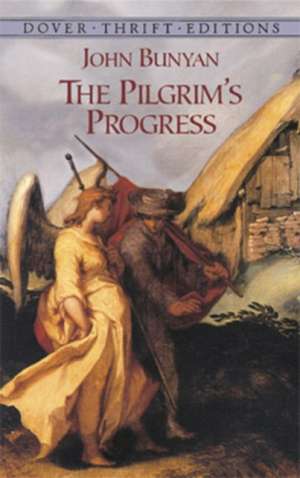
Bunyan, J: Pilgrim's Progress
en Limba Engleză Paperback – 10 feb 2003
Descoperim în The Pilgrim's Progress o lectură stratificată, a cărei cadență amintește de pasul hotărât, dar adesea îngreunat, al unui drumeț pe un teren necunoscut. Ritmul nu este unul al vitezei, ci al reflecției profunde; este o narațiune care se cere parcursă cu răbdare, lăsând fiecare simbol și fiecare întâlnire a protagonistului Christian să rezoneze cu propriile noastre căutări interioare. Scrisă parțial în izolarea unei celule de închisoare, opera lui John Bunyan transcende simpla literatură de secol XVII, devenind o hartă universală a spiritului uman. Apreciem modul în care Bunyan transformă concepte abstracte — disperarea, speranța, ignoranța — în personaje vii, cu care cititorul interacționează direct. Pe același raft cu Pilgrim's Progress in Today's English de James Thomas, această ediție de la Collins Classics se distinge prin păstrarea textului original, oferind acea patină de autenticitate și forță lingvistică pe care adaptările moderne o simplifică adesea. Considerăm că forța cărții rezidă tocmai în această asprime a limbajului arhaic, care conferă greutate fiecărei încercări prin care trece pelerinul. În contextul operei sale, The Pilgrim's Progress reprezintă vârful de lance al unei bibliografii vaste, fiind strâns legată de The Pilgrim's Progress and Grace Abounding to the Chief of Sinners. Dacă lucrarea autobiografică Grace Abounding to the Chief of Sinners ne oferă perspectiva intimă a luptei interioare a lui John Bunyan, pelerinajul lui Christian este transpunerea acestor trăiri într-o mitologie creștină universală. Este o operă fundamentală care a modelat imaginația literară occidentală, oferind nume și situații care au devenit puncte de referință în cultura universală.
Preț: 51.34 lei
Carte disponibilă
Livrare economică 13-27 noiembrie
Specificații
ISBN-10: 0486426750
Pagini: 336
Dimensiuni: 131 x 211 x 22 mm
Greutate: 0.25 kg
Editura: Dover Publications
Locul publicării:United States
V-ar putea interesa
-
 Robinson CrusoeDaniel DefoePreț: 28.01 lei
 -
 The Pilgrim's ProgressJohn BunyanPreț: 28.01 lei
 -
 The Pilgrim's RegressC. S. LewisPreț: 78.49 lei
 -
 The Oxford Handbook of John BunyanMichael Davies-29%Preț: 367.50 lei514.16 lei
 -
 Pilgrim's Progress (Hodder Classics)John BunyanPreț: 92.63 lei
 -
 Pilgrim's Progress in Today's EnglishJames ThomasPreț: 73.09 lei
 -
 Dangerous JourneyOliver HunkinPreț: 166.58 lei
 -
 Pilgrim's ProgressGary D. SchmidtPreț: 112.29 lei
 -
 The Pilgrim's Progress, Deluxe EditionJohn BunyanPreț: 224.79 lei
 -
 The Pilgrim's ProgressJohn BunyanPreț: 161.22 lei
 -
 Grace Abounding to the Chief of SinnersJohn BunyanPreț: 39.46 lei
 -
 Daily Readings - John BunyanJohn BunyanPreț: 135.74 lei
 -
 Preț: 67.12 lei
 -
 Preț: 105.42 lei
 -
 The Pilgrim's Progress (Illustrated Edition)John BunyanPreț: 100.42 lei
 -
 Dangerous JourneyJohn BunyanPreț: 108.76 lei
 -
 Pilgrim's Progress 2John BunyanPreț: 112.88 lei
 -
 BunyanJames Anthony FroudePreț: 86.55 lei
De ce să citești această carte
Recomandăm această carte celor care caută o lectură contemplativă, cu rădăcini istorice și spirituale adânci. Cititorul va câștiga nu doar acces la o piesă esențială a literaturii engleze, ci și o perspectivă fascinantă asupra rezilienței umane în fața adversității. Este un volum ideal pentru cei care apreciază alegoria clasică și doresc să exploreze textul original care a influențat generații de scriitori, de la C.S. Lewis la Nathaniel Hawthorne.
Despre autor
John Bunyan (1628–1688) a fost un scriitor și predicator puritan englez, a cărui viață a fost marcată de o profundă transformare spirituală și de o rezistență dârză în fața opresiunii religioase. De meserie cârpaci, Bunyan a servit în armata parlamentară în timpul Războiului Civil Englez înainte de a se dedica predicării nonconformiste. A petrecut doisprezece ani în închisoarea din Bedford pentru refuzul de a renunța la credința sa, perioadă în care a scris cele mai importante lucrări ale sale, inclusiv autobiografia spirituală Grace Abounding to the Chief of Sinners. Moștenirea sa literară este definită de un stil simplu, dar vizionar, care a făcut din scrierile sale un model de claritate și forță narativă.
Textul de pe ultima copertă
Along a road filled with monsters and spiritual terrors, Christian confronts such emblematic characters as Worldly Wiseman, Giant Despair, Talkative, Ignorance, and the demons of the Valley of the Shadow of Death. But he is also joined by Hopeful and Faithful.
An enormously influential 17th-century classic, universally known for its simplicity, vigor, and beauty of language, The Pilgrim's Progress remains one of the most widely read books in the English language.
Descriere scurtă
Notă biografică
John turned sixteen in 1644 at the height of the Civil War. He joined the army. Since Bedford was a Parliamentarian stronghold, it is probable he served Cromwell. While on duty he was "drawn out" to take part in a siege. Another soldier asked to take his place. "[A]s he stood sentinel he was shot in the head with a musket bullet and died." John came to see this as proof God had spared his life for a great work.
Returning home, John married. He was twenty. His wife was as poor as he; between them, they did not have a dish or spoon. Her godly father had furnished her with two Christian books--books which John read with an increasingly troubled conscience. One Sunday as he played, he heard a voice. "Will you leave your sins and go to Heaven, or have your sins and go to Hell?" His distress was acute. He felt that he had sinned so gravely he was beyond forgiveness. Nonetheless, he struggled to find peace with God by obeying scriptural commands. Outwardly, he reformed and put off swearing and improper sports. Inwardly, he still longed to participate. He read the Bible. Although without peace, he thought God must be pleased with him.
One day he overheard four women speaking of their inner religious experience, and he realized he lacked something. Leaving the Church of England, he joined their fellowship. Still, he lacked peace. Only after reading Luther's commentary on Galatians did he realize he could be justified by faith alone. His inner struggles were not over, but he found relief. Bunyan felt compelled to tell others of faith in Christ. He became a field preacher. So effective were his words, people would arrive at dawn to hear him preach at noon.