
Built to Fail: Structural Deficiencies and Student Failure
Autor Randy K. Trani, Robert K. Irvineen Limba Engleză Hardback – 9 apr 2014
Preț: 557.49 lei
Preț vechi: 792.40 lei
-30%
Puncte Express: 836
Carte disponibilă
Livrare economică 09-23 noiembrie
Livrare prin curier în România Termenul estimat este afișat lângă disponibilitate.
Transport gratuit pentru acest produs Plată online sau ramburs, în funcție de opțiunile comenzii.
Retur gratuit în 14 zile Comandă securizată și suport în română.
Specificații
ISBN-13: 9781475808636
ISBN-10: 1475808631
Pagini: 230
Ilustrații: 7 Tables, 11 Textboxes
Dimensiuni: 154 x 232 x 20 mm
Greutate: 0.48 kg
Editura: Bloomsbury Publishing
Colecția Rowman & Littlefield
Locul publicării:New York, United States
ISBN-10: 1475808631
Pagini: 230
Ilustrații: 7 Tables, 11 Textboxes
Dimensiuni: 154 x 232 x 20 mm
Greutate: 0.48 kg
Editura: Bloomsbury Publishing
Colecția Rowman & Littlefield
Locul publicării:New York, United States
V-ar putea interesa
-
 Preț: 263.76 lei
 -
 Preț: 391.11 lei
 -
 Preț: 472.64 lei
 -
 -15%Preț: 444.73 lei523.22 lei
 -
 Developing Equitable Education SystemsMel Ainscow-15%Preț: 451.35 lei531.00 lei
 -
 The Routledge International Handbook of the Sociology of EducationMichael W. Apple-15%Preț: 635.67 lei747.85 lei
 -
 Preț: 440.19 lei
 -
 -15%Preț: 456.05 lei536.54 lei
 -
 -15%Preț: 418.85 lei492.76 lei
 -
 Engaging StudentsSchlechtyPreț: 229.37 lei
 -
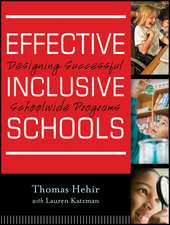 Effective Inclusive SchoolsThomas HehirPreț: 160.83 lei
 -
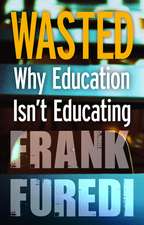 Wasted: Why Education Isn't EducatingProfessor Frank Furedi-40%Preț: 82.98 lei138.39 lei
 -
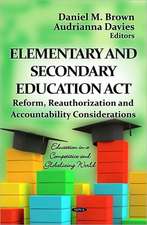 -27%Preț: 1218.59 lei1660.24 lei
 -
 Transforming Education Policy: Shaping a Democratic FuturePhilip A. WoodsPreț: 259.31 lei
 -
 -20%Preț: 109.63 lei137.35 lei
Cuprins
Acknowledgments
Epigraph
Preface
Introduction
The Modern State of Education in America A False Promise OR The Siren Song of Choice The US vs. the World The Educational Approaches of Other NationsGreat US Schools - Breaking From the Grade Level & ComprehensiveModelExamination of Minority AchievementToday's Paradigm Existing Sociological Theoretical Framework Empirical Data that Supports Structural Deficiency Theory Or: I wonder if anyone will ever read this dissertation stuff! Structural Efficiency Theory12, 14 and 15. A View to A Kill: How to Slay Your Cerberus
Appendix
Epigraph
Preface
Introduction
The Modern State of Education in America A False Promise OR The Siren Song of Choice The US vs. the World The Educational Approaches of Other NationsGreat US Schools - Breaking From the Grade Level & ComprehensiveModelExamination of Minority AchievementToday's Paradigm Existing Sociological Theoretical Framework Empirical Data that Supports Structural Deficiency Theory Or: I wonder if anyone will ever read this dissertation stuff! Structural Efficiency Theory12, 14 and 15. A View to A Kill: How to Slay Your Cerberus
Appendix
Recenzii
The authors take a critical look at the structure of the American schooling system and the negative impact the current structure is having on teaching and learning for all students - particularly students from culturally diverse and low income backgrounds. As a person who was educated in a private school of less than 1000 (K-12), I know firsthand the benefits of a smaller learning community, where everyone knew everyone, and while choices were limited, they were rich and meaningful. Much of the content makes perfect sense and is timely for the transformation needed in the K-12 education system.
In Structural Deficiencies in the School System, Trani and Irvine once again demonstrate how small, student-centered school systems can not only meet the learning needs of the students they serve, but provide fantastic opportunities for children to have long-term success by obtaining rigorous foundational skills.
Structural Deficiencies in the School System: How Grade Level, Comprehensive High Schools, and Big Districts Cause Student Failure is a compelling, sharp, and ringing indictment of the bloated and misguided state into which many of the schools in this nation have fallen. In this text, Randy Trani and Robert Irvine leverage their substantial experience and know-how in the educational space to provide an insightful look into where so many schools are going wrong, coming up short, or just missing the point altogether. Indeed, having served and worked as teachers, principals, and superintendents in schools across the country, the authors provide a crisp and unique insiders'perspective in a space that demands more insight and clarity. In so doing, Trani and Irvine illuminate certain facets of the modern American school system-both good and bad-that desperately need the type of attention and focus that they receive in Structural Deficiencies in the School System.
In Structural Deficiencies in the School System, Trani and Irvine once again demonstrate how small, student-centered school systems can not only meet the learning needs of the students they serve, but provide fantastic opportunities for children to have long-term success by obtaining rigorous foundational skills.
Structural Deficiencies in the School System: How Grade Level, Comprehensive High Schools, and Big Districts Cause Student Failure is a compelling, sharp, and ringing indictment of the bloated and misguided state into which many of the schools in this nation have fallen. In this text, Randy Trani and Robert Irvine leverage their substantial experience and know-how in the educational space to provide an insightful look into where so many schools are going wrong, coming up short, or just missing the point altogether. Indeed, having served and worked as teachers, principals, and superintendents in schools across the country, the authors provide a crisp and unique insiders'perspective in a space that demands more insight and clarity. In so doing, Trani and Irvine illuminate certain facets of the modern American school system-both good and bad-that desperately need the type of attention and focus that they receive in Structural Deficiencies in the School System.