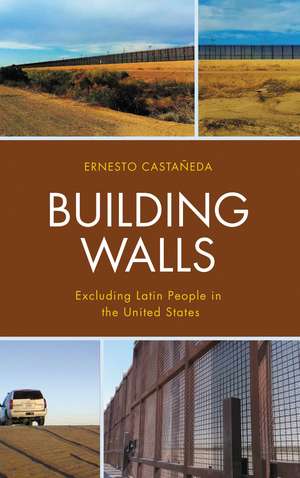
Building Walls: Excluding Latin People in the United States
Autor Ernesto Castañeda Contribuţii de Silvia Chávez-Baray, Eva Moya, Maura Fennelly, Dennis West, Catherine Harlos, Natali Collazosen Limba Engleză Hardback – 15 apr 2019
View a separate blog for the book here: https://dornsife.usc.edu/csii/blog-building-walls-excluding-people/
Preț: 582.53 lei
Preț vechi: 863.59 lei
-33%
Puncte Express: 874
Carte tipărită la comandă
Livrare economică 03-17 decembrie
Livrare prin curier în România Termenul estimat este afișat lângă disponibilitate.
Transport gratuit pentru acest produs Plată online sau ramburs, în funcție de opțiunile comenzii.
Retur gratuit în 14 zile Comandă securizată și suport în română.
Specificații
ISBN-13: 9781498585651
ISBN-10: 1498585655
Pagini: 240
Ilustrații: 11 b/w illustrations; 7 tables
Dimensiuni: 158 x 232 x 20 mm
Greutate: 0.49 kg
Editura: Bloomsbury Publishing
Colecția Lexington Books
Locul publicării:New York, United States
ISBN-10: 1498585655
Pagini: 240
Ilustrații: 11 b/w illustrations; 7 tables
Dimensiuni: 158 x 232 x 20 mm
Greutate: 0.49 kg
Editura: Bloomsbury Publishing
Colecția Lexington Books
Locul publicării:New York, United States
Cuprins
Part I Categorical Thinking
1 The Historical and Contemporary Exclusion of Latin People from the American Identity with Maura Fennelly
2 Migration and its Challenges to Political Theory and Nationalism
3 Boundary Formation: Nationalism, Immigration, and Categorical Inequality between Americans and Mexicans
Part II Anti-Immigrant Speech
4 Border Vigilantes at the University: Anti-immigrant Discourse and Ideological Campaigns
5 Fronting the White Storm with Dennis West
6 Anti-Immigrant Online Comment Sections in the Aftermath of Trump's Election with Catherine Harlos
Part III Immigration as an Experience
7 Different Understandings of the Border Wall: The Social Meanings of the Wall for Border Residents
8 Fear of Deportation among Mexicans fleeing Violence with Natali Collazos, Eva Moya, Silvia Chávez-Baray
9 Invisible New Yorkers: Boundaries, Interethnic Networks, Immigrant Integration, and Social Invisibility
10 Why Walls Won't Work: Interactions between Latin Immigrants and Americans with Maura Fennelly
References
1 The Historical and Contemporary Exclusion of Latin People from the American Identity with Maura Fennelly
2 Migration and its Challenges to Political Theory and Nationalism
3 Boundary Formation: Nationalism, Immigration, and Categorical Inequality between Americans and Mexicans
Part II Anti-Immigrant Speech
4 Border Vigilantes at the University: Anti-immigrant Discourse and Ideological Campaigns
5 Fronting the White Storm with Dennis West
6 Anti-Immigrant Online Comment Sections in the Aftermath of Trump's Election with Catherine Harlos
Part III Immigration as an Experience
7 Different Understandings of the Border Wall: The Social Meanings of the Wall for Border Residents
8 Fear of Deportation among Mexicans fleeing Violence with Natali Collazos, Eva Moya, Silvia Chávez-Baray
9 Invisible New Yorkers: Boundaries, Interethnic Networks, Immigrant Integration, and Social Invisibility
10 Why Walls Won't Work: Interactions between Latin Immigrants and Americans with Maura Fennelly
References
Recenzii
Castañeda presents a conceptually thorough and theoretically comprehensive account for understanding the structural, discursive, and experiential conditions that racialize and demean the life and presence of Latin people in the United States. We not only observe his contribution to the sociological subject matter but also witness an exemplar of where migration studies stands today. By introducing a framework on Latin racialization and Pan-American racial projects, Castañeda takes critical immigration studies in the direction that is most needed to assess the political, demographic, and racial future of the United States.
Buildings Walls is likely to appeal to a wide audience because of its strong theoretical underpinnings, applied work on boundary-formation processes, and focus on a unique aspect of the Mexican-origin experience in the United States. These intersecting foci make the book an appropriate choice for advanced undergraduate or graduate courses in political sociology or in the sociology of immigration or courses focused on race and ethnicity in the U.S. context. Overall, Building Walls is a thought-provoking book on an exigent topic, particularly given the rising anti-immigrant rhetoric and increasing hostility toward Mexican immigrants in the United States. While interaction and engagement may not be the ultimate solution, we have already witnessed the consequences of the status quo.
In their work Building Walls: Excluding Latin People in the United States, Ernesto Castañeda and his coauthors explore the building of boundaries, both symbolic and physical, and the exclusion that these boundaries entail for Latin American and Caribbean populations in the United States. This comprehensive book offers an analysis on three levels. . . Castañeda and his coauthors put forward a wide range of evidence obtained through several methods, above all qualitative and mixed, to show the causes and consequences of the exclusion of Latin people. Their book is highly recommendable for students and experts in several disciplines-including sociology, international relations, and political science-who take an interest in the migratory issue and in the everyday racism, nationalism, and discrimination suffered by the population of Latin American origin in United States.
Building Walls brings a much-needed critical race analysis to migration studies. Castañeda draws from a wide variety of sources and voices to paint a picture of the exclusion and racialization experienced by people with origins in Latin America who have made their homes in the United States. Expertly weaving in analyses of nationalism, border vigilantism, white supremacy, and immigration enforcement, Building Walls provides a clear and provocative analysis of our contemporary moment. This book would be an excellent addition to courses on race and migration across a wide variety of disciplines.
Despite facing a harsh context of reception, evidence shows that most immigrants today are successfully incorporating into the U.S. Nevertheless, anti-immigrant, and specially, anti-Latino sentiments have seemingly intensified and may have contributed to Trump's presidential victory. Why? This book explains it. Castañeda marshals compelling ethnographic, statistical, and historical evidence to show the roots and consequences of the exclusion of Latin people in the U.S. For those who care about the future of the country, Building Walls is a required text.
How perfectly fitting that Castañeda has masterfully mapped how detrimental it has been for Latinos when the US has and continues to build walls, as Trump built his campaign and presidency on the promise to build a wall between the US and Mexico. This book is truly timely and relevant because it is a testament of Latino racialization and exclusion, and it demonstrates why building walls does not work to keep immigrants out or to unite a country.
This comprehensive and thoughtful book offers an antidote to anti-migrant scapegoating and dehumanization. Meticulously researched and accessibly written, it shines a light on the long history and contributions of Latinos in the U.S., the cultural richness of the borderlands, and the cruelty of the current deportation regime. By placing claims about the 'border crisis' within a longer history of white supremacy, racial profiling, and discrimination, Castaneda offers an incisive counter-narrative to spectacularized media headlines and politicians' invectives.
Buildings Walls is likely to appeal to a wide audience because of its strong theoretical underpinnings, applied work on boundary-formation processes, and focus on a unique aspect of the Mexican-origin experience in the United States. These intersecting foci make the book an appropriate choice for advanced undergraduate or graduate courses in political sociology or in the sociology of immigration or courses focused on race and ethnicity in the U.S. context. Overall, Building Walls is a thought-provoking book on an exigent topic, particularly given the rising anti-immigrant rhetoric and increasing hostility toward Mexican immigrants in the United States. While interaction and engagement may not be the ultimate solution, we have already witnessed the consequences of the status quo.
In their work Building Walls: Excluding Latin People in the United States, Ernesto Castañeda and his coauthors explore the building of boundaries, both symbolic and physical, and the exclusion that these boundaries entail for Latin American and Caribbean populations in the United States. This comprehensive book offers an analysis on three levels. . . Castañeda and his coauthors put forward a wide range of evidence obtained through several methods, above all qualitative and mixed, to show the causes and consequences of the exclusion of Latin people. Their book is highly recommendable for students and experts in several disciplines-including sociology, international relations, and political science-who take an interest in the migratory issue and in the everyday racism, nationalism, and discrimination suffered by the population of Latin American origin in United States.
Building Walls brings a much-needed critical race analysis to migration studies. Castañeda draws from a wide variety of sources and voices to paint a picture of the exclusion and racialization experienced by people with origins in Latin America who have made their homes in the United States. Expertly weaving in analyses of nationalism, border vigilantism, white supremacy, and immigration enforcement, Building Walls provides a clear and provocative analysis of our contemporary moment. This book would be an excellent addition to courses on race and migration across a wide variety of disciplines.
Despite facing a harsh context of reception, evidence shows that most immigrants today are successfully incorporating into the U.S. Nevertheless, anti-immigrant, and specially, anti-Latino sentiments have seemingly intensified and may have contributed to Trump's presidential victory. Why? This book explains it. Castañeda marshals compelling ethnographic, statistical, and historical evidence to show the roots and consequences of the exclusion of Latin people in the U.S. For those who care about the future of the country, Building Walls is a required text.
How perfectly fitting that Castañeda has masterfully mapped how detrimental it has been for Latinos when the US has and continues to build walls, as Trump built his campaign and presidency on the promise to build a wall between the US and Mexico. This book is truly timely and relevant because it is a testament of Latino racialization and exclusion, and it demonstrates why building walls does not work to keep immigrants out or to unite a country.
This comprehensive and thoughtful book offers an antidote to anti-migrant scapegoating and dehumanization. Meticulously researched and accessibly written, it shines a light on the long history and contributions of Latinos in the U.S., the cultural richness of the borderlands, and the cruelty of the current deportation regime. By placing claims about the 'border crisis' within a longer history of white supremacy, racial profiling, and discrimination, Castaneda offers an incisive counter-narrative to spectacularized media headlines and politicians' invectives.