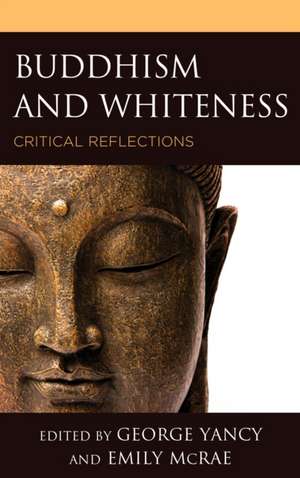
Buddhism and Whiteness: Critical Reflections: Philosophy of Race
Editat de George Yancy, Emily McRae Cuvânt înainte de Jan Willis Contribuţii de Sharon Suh, Ann Gleig Ann Gleig, associate professor of religion and cultural studies, University, Leah Kalmanson, Rima L. Vesely-Flad, Laurie Cassidy, Carolyn M. Jones Medine, Jasmine Syedullah, Dr Jessica Locke, Carol J. Moeller, Lama Justin von Bujdoss, Bryce Huebner, Rhonda V. Magee, Joy Brennan, Hsiao Lan Hu Cuvânt după de Charles Johnsonen Limba Engleză Paperback – 2 iul 2021
In their chapters, contributors draw on Buddhist philosophical and contemplative traditions to offer fresh, insightful, and powerful perspectives on issues regarding racial identity and whiteness, including such themes as cultural appropriation, mechanisms of racial injustice and racial justice, phenomenology of racial oppression, epistemologies of racial ignorance, liberatory practices with regard to racism, Womanism, and the intersections of gender-based, raced-based, and sexuality-based oppressions. Authors make use of both contemporary and ancient Buddhist philosophical and contemplative traditions. These include various Asian traditions, including Theravada, Mahayana, Tantra, and Zen, as well as comparatively new American Buddhist traditions.
Din seria Philosophy of Race
- 26%
 Preț: 161.19 lei
 - 27%
 Preț: 135.89 lei
 - 17%
 Preț: 198.91 lei
 - 17%
 Preț: 160.17 lei
 - 33%
 Preț: 527.65 lei
 - 17%
 Preț: 139.19 lei
 - 30%
 Preț: 208.39 lei
 - 28%
 Preț: 245.48 lei
 - 29%
 Preț: 209.55 lei
 - 30%
 Preț: 208.87 lei
 - 24%
 Preț: 269.95 lei
 - 27%
 Preț: 157.04 lei
 - 30%
 Preț: 208.58 lei
 - 34%
 Preț: 493.38 lei
 - 17%
 Preț: 212.21 lei
 - 29%
 Preț: 248.36 lei
 - 30%
 Preț: 207.71 lei
 - 30%
 Preț: 207.83 lei
 - 27%
 Preț: 345.12 lei
 - 29%
 Preț: 212.25 lei
 - 34%
 Preț: 499.39 lei
 - 30%
 Preț: 495.22 lei
 - 34%
 Preț: 523.37 lei
 - 28%
 Preț: 243.78 lei
 - 25%
 Preț: 620.58 lei
 - 12%
 Preț: 180.57 lei
 - 25%
 Preț: 208.29 lei
 - 34%
 Preț: 554.77 lei
 - 33%
 Preț: 468.42 lei
 - 34%
 Preț: 524.89 lei
 - 26%
 Preț: 329.57 lei
 - 30%
 Preț: 208.58 lei
 - 28%
 Preț: 255.33 lei
Preț: 269.16 lei
Preț vechi: 369.77 lei
-27%
Puncte Express: 404
Carte tipărită la comandă
Livrare economică 09-23 iunie
Specificații
ISBN-13: 9781498581042
ISBN-10: 1498581048
Pagini: 384
Dimensiuni: 146 x 224 x 22 mm
Greutate: 0.56 kg
Editura: Bloomsbury Publishing
Colecția Lexington Books
Seria Philosophy of Race
Locul publicării:New York, United States
ISBN-10: 1498581048
Pagini: 384
Dimensiuni: 146 x 224 x 22 mm
Greutate: 0.56 kg
Editura: Bloomsbury Publishing
Colecția Lexington Books
Seria Philosophy of Race
Locul publicării:New York, United States
Cuprins
Foreword
Jan Willis
Introduction
Emily McRae and George Yancy
1. "We Interrupt Your Regularly Scheduled Programming to Bring You This Very Important Public Service Announcement . . .": aka Buddhism as Usual in the Academy
Sharon Suh
2. Undoing Whiteness in American Buddhist Modernism: Critical, Collective, and Contextual Turns
Ann Gleig
3. White Delusion and Avidya: A Buddhist Approach to Understanding and Deconstructing White Ignorance
Emily McRae
4. Whiteness and the Construction of Buddhist Philosophy in Meiji Japan
Leah Kalmanson
5. Racism and Anatta: Black Buddhists, Embodiment, and Interpretations of Non-Self
Rima Vesely-Flad
6. "The Tranquil Meditator"
Laurie Cassidy
7. "Beyond Vietnam": Martin Luther King, Jr., Thích Nh?t H?nh, and the Confluence of Black and Engaged Buddhism in the Vietnam War
Carolyn M. Jones Medine
8. The Unbearable Will to Whiteness
Jasmine Syedullah
9. Making Consciousness an Ethical Project: Moral Phenomenology in Buddhist Ethics and White Anti-Racism
Jessica Locke
10. "bell hooks Made Me a Buddhist": Liberatory Cross-Cultural Learning-Or Is This Just Another Case of How White People Steal Everything?
Carol J. Moeller
11. Excoriating the Demon of Whiteness from Within: Disrupting Whiteness through the Tantric Buddhist Practice of Chöd and Exploring Whiteness from Within the Tradition
Lama Justin von Bujdoss
12. The Interdependence and Emptiness of Whiteness
Bryce Huebner
13. Taking and Making Refuge in Racial [Whiteness] Awareness and Racial Justice Work
Rhonda Magee
14. A Buddhist Phenomenology of the White Mind
Joy Brennan
15. The White Feminism in Rita Gross' Critique of Gender Identities and Reconstruction of Buddhism
Hsiao Lan Hu
Afterword
Charles Johnson
Jan Willis
Introduction
Emily McRae and George Yancy
1. "We Interrupt Your Regularly Scheduled Programming to Bring You This Very Important Public Service Announcement . . .": aka Buddhism as Usual in the Academy
Sharon Suh
2. Undoing Whiteness in American Buddhist Modernism: Critical, Collective, and Contextual Turns
Ann Gleig
3. White Delusion and Avidya: A Buddhist Approach to Understanding and Deconstructing White Ignorance
Emily McRae
4. Whiteness and the Construction of Buddhist Philosophy in Meiji Japan
Leah Kalmanson
5. Racism and Anatta: Black Buddhists, Embodiment, and Interpretations of Non-Self
Rima Vesely-Flad
6. "The Tranquil Meditator"
Laurie Cassidy
7. "Beyond Vietnam": Martin Luther King, Jr., Thích Nh?t H?nh, and the Confluence of Black and Engaged Buddhism in the Vietnam War
Carolyn M. Jones Medine
8. The Unbearable Will to Whiteness
Jasmine Syedullah
9. Making Consciousness an Ethical Project: Moral Phenomenology in Buddhist Ethics and White Anti-Racism
Jessica Locke
10. "bell hooks Made Me a Buddhist": Liberatory Cross-Cultural Learning-Or Is This Just Another Case of How White People Steal Everything?
Carol J. Moeller
11. Excoriating the Demon of Whiteness from Within: Disrupting Whiteness through the Tantric Buddhist Practice of Chöd and Exploring Whiteness from Within the Tradition
Lama Justin von Bujdoss
12. The Interdependence and Emptiness of Whiteness
Bryce Huebner
13. Taking and Making Refuge in Racial [Whiteness] Awareness and Racial Justice Work
Rhonda Magee
14. A Buddhist Phenomenology of the White Mind
Joy Brennan
15. The White Feminism in Rita Gross' Critique of Gender Identities and Reconstruction of Buddhism
Hsiao Lan Hu
Afterword
Charles Johnson
Recenzii
This volume opens with a foreword by noted scholar of religion Jan Willis in which she observes that although there is only one race, Homo sapiens, racism still thrives. The collection documents views from the peripheries that reveal that LGBTQ people and people of color are challenged in white US Buddhist communities as if they have no place. Often they are not seen at all. The way forward, Laurie Cassidy writes, is to listen deeply and take responsibility for the shared reality of all people. In his essay Bryce Huebner argues that "races are not biologically real" and "race is a conceptual fiction." This book is about modifying practices as well as changing minds. This reviewer was impressed by the program-recommended by Jessica Locke (following Patricia Devine)-of implicit bias intervention. Metta ("lovingkindness") meditation to develop a competing and positive narrative to the racist one about blackness is also effective. This important book offers ideas and values that could change how meditation works. In an afterword Charles Johnson writes that what is new here "is the effort to find common ground between ancient Buddhist ideas and principles with feminist theory, existential phenomenology, and Critical Race Theory, and Critical Whiteness Studies."
Summing Up: Highly recommended. Upper-division undergraduates through faculty and professionals; general readers.
With essays from more than 15 thinkers, including Tricycle contributing editor Charles Johnson, this book offers new scholarly ideas on Buddhism's equal access to liberation in the context of the persistent racism experienced in America and beyond. The editors write in the introduction that "racism or white supremacy is like the water in which we all swim"-though only some of us notice that we're submerged. Contributors from across traditions, who also draw on feminist and cultural studies in addition to race theory, ask whether we can use Buddhist philosophy to put an end to racism and white supremacy just as we apply teachings to cut through our sense of "self."
Buddhism and Whiteness is highly recommended to anyone interested in modern Buddhism, as well as an interesting alternative lens for those studying the development of racism in North America and Europe.
Part of the importance of this collection of essays lies in its multipronged approach to both naming the white supremacist bedrock of whiteness and describing Buddhist models for understanding how it arises. . . Authors in this volume bring to light a number of attitudes that help the reader "see" white ignorance in action. . . . Relinquishing the privilege of being the authority on what constitutes "real" Buddhism, who is a "real" American, and what counts as "real" practice involves giving something up. That act, and all the myriad ways whites can practice giving away unearned privilege, can itself become a powerful method of merit-making, of dana as a form of moral development in the pursuit of benefiting others. In this respect and others, Buddhism and Whiteness offers gifts of insight that constitute a wise and compassionate act of merit.
It is high time for a book like this. For too long the story of the transmission of Buddhism to the West has been told without attention to the ways that transmission is inflected by race and racism. This carefully curated collection of essays opens that question, and offers a rich set of perspectives on the complex interaction of Buddhist transmission, ideology, and practice with race and racism in the West. A must read for anyone interested in contemporary global Buddhism.
It is impossible to read Buddhism and Whiteness and not experience an itch for action. This timely-and indeed, "futurely"- volume challenges all of us to reflect creatively and imaginatively about how we can best make a politics of the possible a constitutive contour of our religious lives, our efforts to learn about and from Buddhism, and especially our everyday lives, even as all of these are deeply conditioned and distorted by structural racism together with other oppressive and exclusionary structures.
Buddhism and Whiteness instructs with the spirit of Thich Naht Hanh- "Freedom is not given to us by anyone, we have to cultivate it." Composting ignorance and violence, this volume seeds peace for local and global care from US to Rohingya and Yemen communities.
Summing Up: Highly recommended. Upper-division undergraduates through faculty and professionals; general readers.
With essays from more than 15 thinkers, including Tricycle contributing editor Charles Johnson, this book offers new scholarly ideas on Buddhism's equal access to liberation in the context of the persistent racism experienced in America and beyond. The editors write in the introduction that "racism or white supremacy is like the water in which we all swim"-though only some of us notice that we're submerged. Contributors from across traditions, who also draw on feminist and cultural studies in addition to race theory, ask whether we can use Buddhist philosophy to put an end to racism and white supremacy just as we apply teachings to cut through our sense of "self."
Buddhism and Whiteness is highly recommended to anyone interested in modern Buddhism, as well as an interesting alternative lens for those studying the development of racism in North America and Europe.
Part of the importance of this collection of essays lies in its multipronged approach to both naming the white supremacist bedrock of whiteness and describing Buddhist models for understanding how it arises. . . Authors in this volume bring to light a number of attitudes that help the reader "see" white ignorance in action. . . . Relinquishing the privilege of being the authority on what constitutes "real" Buddhism, who is a "real" American, and what counts as "real" practice involves giving something up. That act, and all the myriad ways whites can practice giving away unearned privilege, can itself become a powerful method of merit-making, of dana as a form of moral development in the pursuit of benefiting others. In this respect and others, Buddhism and Whiteness offers gifts of insight that constitute a wise and compassionate act of merit.
It is high time for a book like this. For too long the story of the transmission of Buddhism to the West has been told without attention to the ways that transmission is inflected by race and racism. This carefully curated collection of essays opens that question, and offers a rich set of perspectives on the complex interaction of Buddhist transmission, ideology, and practice with race and racism in the West. A must read for anyone interested in contemporary global Buddhism.
It is impossible to read Buddhism and Whiteness and not experience an itch for action. This timely-and indeed, "futurely"- volume challenges all of us to reflect creatively and imaginatively about how we can best make a politics of the possible a constitutive contour of our religious lives, our efforts to learn about and from Buddhism, and especially our everyday lives, even as all of these are deeply conditioned and distorted by structural racism together with other oppressive and exclusionary structures.
Buddhism and Whiteness instructs with the spirit of Thich Naht Hanh- "Freedom is not given to us by anyone, we have to cultivate it." Composting ignorance and violence, this volume seeds peace for local and global care from US to Rohingya and Yemen communities.