Cantitate/Preț
Produs

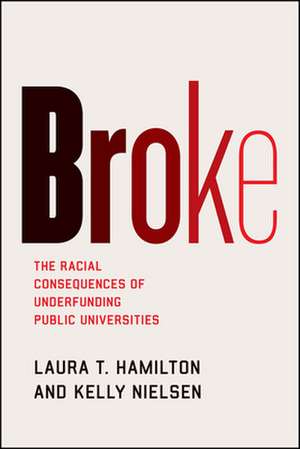
Broke: The Racial Consequences of Underfunding Public Universities

Autor Laura T. Hamilton, Kelly Nielsen
en Limba Engleză Hardback – 5 feb 2021

Descoperim în Broke o analiză sociologică percutantă care aduce în prim-plan o realitate inconfortabilă: declinul finanțării publice pentru învățământul superior american a coincis istoric cu momentul în care acesta a devenit mai accesibil studenților din medii marginalizate. Laura T. Hamilton și Kelly Nielsen investighează cum universitățile publice de cercetare, în special cele din cadrul sistemului University of California, s-au transformat din instituții susținute de stat în entități forțate să adopte strategii de austeritate. Cartea acoperă aceeași arie tematică precum Who Killed Higher Education? de Edna Chun, însă se diferențiază printr-o abordare mai focalizată pe viața de campus și pe mecanismele interne de adaptare instituțională, cum ar fi utilizarea marketingului diversității pentru a compensa lipsa resurselor materiale. Structura lucrării este organizată riguros, pornind de la presiunea clasamentelor universitare și ajungând la concepte precum „suboptimizarea tolerabilă” — o stare de degradare acceptată a infrastructurii și serviciilor. Notăm cu interes capitolul dedicat parteneriatelor public-privat (P3), pe care autorii le descriu ca pe o soluție de compromis cu efecte pe termen lung asupra calității educației. Spre deosebire de Public No More, care oferă un cadru strategic pentru administratori, Broke menține o perspectivă critică asupra modului în care studenții sunt cei care plătesc, în final, prețul acestor transformări economice.

Citește tot Restrânge

Preț: 64827 lei

Preț vechi: 84191 lei
-23%

Puncte Express: 972

Carte tipărită la comandă

Livrare economică 04-18 iulie


Specificații

ISBN-13: 9780226605401
ISBN-10: 022660540X
Pagini: 288
Ilustrații: 7 halftones, 3 line drawings, 1 table
Dimensiuni: 152 x 229 x 23 mm
Greutate: 0.57 kg
Ediția:First Edition
Editura: University of Chicago Press
Colecția University of Chicago Press

De ce să citești această carte

Această lucrare este esențială pentru profesioniștii din mediul academic și studenții la sociologie care doresc să înțeleagă legătura dintre politicile de austeritate și inechitatea rasială. Cititorul câștigă o perspectivă clară asupra modului în care structurile de finanțare modelează experiența educațională, primind în același timp un cadru teoretic solid pentru a analiza viitorul universităților publice.


Despre autor

Laura T. Hamilton este profesor asociat de sociologie la University of California, Merced. Activitatea sa academică se concentrează pe inegalitatea socială, gen și educație, fiind recunoscută pentru modul în care analizează intersecția dintre politicile instituționale și traiectoriile individuale ale studenților. În volumul Broke, ea colaborează cu Kelly Nielsen pentru a aduce o expertiză profundă asupra sistemului UC, îmbinând cercetarea de teren cu analiza structurală a finanțelor universitare.


Descriere scurtă

Public research universities were previously able to provide excellent education to white families thanks to healthy government funding. However, that funding has all but dried up in recent decades as historically underrepresented students have gained greater access, and now less prestigious public universities face major economic challenges.

In Broke, Laura T. Hamilton and Kelly Nielsen examine virtually all aspects of campus life to show how the new economic order in public universities, particularly at two campuses in the renowned University of California system, affects students. For most of the twentieth century, they show, less affluent families of color paid with their taxes for wealthy white students to attend universities where their own offspring were not welcome. That changed as a subset of public research universities, some quite old, opted for a “new” approach, making racially and economically marginalized youth the lifeblood of the university. These new universities, however, have been particularly hard hit by austerity. To survive, they’ve had to adapt, finding new ways to secure funding and trim costs—but ultimately it’s their students who pay the price, in decreased services and inadequate infrastructure.

The rise of new universities is a reminder that a world-class education for all is possible. Broke shows us how far we are from that ideal and sets out a path for how we could get there.

Notă biografică

Laura T. Hamilton is professor of sociology at the University of California, Merced. She is coauthor of Paying for the Party: How College Maintains Inequality and author of Parenting to a Degree: How Family Matters for College and Beyond. Kelly Nielsen is a postdoctoral scholar at the University of California, Merced.
 

Cuprins

Introduction

The Changing Face of the UC

1. Battle with the Rankings
2. P3 Paradise
3. Running Political Cover

Responses to Underfunding

4. Austerity Administration
5. Tolerable Suboptimization

Dealing in Diversity

6. Student Labor and Centers of Support 
with Veronica Lerma

7. Marketing Diversity

Breaking the Cycle
 
Acknowledgments
Methodological Appendix: On Being White and Studying Race
Notes
References
Index

Recenzii

"Sobering... Broke enables readers to understand how public institutions contribute to hardening the striations of the national class structure."

“In a crowded field of studies on higher education, Broke distinguishes itself by presenting a truly unique, multifaceted, and critical portrait of the 'new university' as a racial project. Hamilton and Nielsen convincingly demonstrate how processes of 'postsecondary racial neoliberalism' concentrate underrepresented students of color in the least resourced public universities. In these institutional settings, diversity policies and practices are shaped not by only colorblind ideology, but austerity as well."

Broke has the makings of a classic for the sociology of higher education, race, and class stratification. Hamilton and Nielsen document the evolution of the 'new university' in race- and class-stratified society during what they coin as the 'postsecondary racial neoliberal' era.  Bolstered by strong empirical analyses and captivating, incisive writing, this book draws the reader in and beckons us to shatter both the realities and ironies of segregated university education as conduits of economic mobility in a wealthy society."
 

"While their better-off peers enjoy the fruits of massive endowments and high tuitions, the striving students of 'new universities'—less-prestigious research universities serving disproportionately Black and Brown students—get the short end of the stick. A must-read analysis of the self-reinforcing effects of racist austerity logics and their painful human consequences, Broke pulls no punches."
 

Broke is theoretically rich, empirically sound, and radically clear-eyed about race and racism. It is high time that sociology and higher education research reckon with the inherent racialization of the institutions upon which we have pinned so many of our hopes for social change.”

"In Broke: The Racial Consequences of Underfunding Public Universities, authors Laura T. Hamilton and Kelly Nielsen argue that 'postsecondary radical neoliberalism' is at the root of the decades-long dismantling of public funding for higher education in the United States . . . The nuanced discussion of how neoliberalism yields austerity logics, which yield disinvestment in public universities, which yields creative solutions to funding problems, which yield exploitation of students’ career futures, all wrapped up in tensions and conflicts over campus diversity, makes Broke a compelling read."

"Broke presents a compelling portrait of the steps public campuses take to 'survive, and even thrive', and of the implications for the students, along with other members of new university campuses, who are stuck managing the fallout."

"This cleverly structured book compares two campuses serving the largest proportion of underrepresented racial and ethnic minority students within the University of California (UC) system. While low levels of state funding levels affect all 10 institutions within that system, these two campuses, according to the authors, have access to fewer additional resources and lower rankings on most best colleges lists because of the characteristics of the students they serve. . . . The authors draw effectively on race theory to explain their findings. . . thought-provoking. . ."

"[Hamilton and Nielsen] suggest a parallel structural trend between antiracist transformation and inequality: Rather than being engines of inequality eradication, new university forms emerge or adapt to survive the structural conditions of inequality. . . . Broke offers insights regarding intra-system inequalities based on the institutional status in the University of California (UC)."