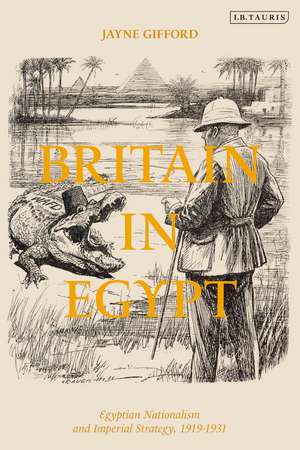
Britain in Egypt: Egyptian Nationalism and Imperial Strategy, 1919-1931
Autor Jayne Gifforden Limba Engleză Paperback – 17 iun 2021
Preț: 236.74 lei
Preț vechi: 322.95 lei
-27%
Puncte Express: 355
Carte tipărită la comandă
Livrare economică 30 noiembrie-14 decembrie
Livrare prin curier în România Termenul estimat este afișat lângă disponibilitate.
Transport gratuit de la 400.00 lei Plată online sau ramburs, în funcție de opțiunile comenzii.
Retur gratuit în 14 zile Comandă securizată și suport în română.
Specificații
ISBN-13: 9780755636686
ISBN-10: 0755636686
Pagini: 272
Dimensiuni: 154 x 232 x 18 mm
Greutate: 0.42 kg
Editura: Bloomsbury Publishing
Colecția I.B.Tauris
Locul publicării:London, United Kingdom
ISBN-10: 0755636686
Pagini: 272
Dimensiuni: 154 x 232 x 18 mm
Greutate: 0.42 kg
Editura: Bloomsbury Publishing
Colecția I.B.Tauris
Locul publicării:London, United Kingdom
Cuprins
Introduction
Chapter 1: Between Two Worlds: Britain and Egypt in Africa and the Middle East
Chapter 2: Riots and Resistance: Britain and Egypt, 1918 - 1922
Chapter 3: Negotiating at home and abroad: the CID, Labour and the Egyptian Nationalists, 1924
Chapter 4: The "colonised coloniser": the Anglo-Egyptian Sudan
Chapter 5: The Assassination of Sir Lee Stack: The British Lion's Final Roar?
Chapter 6: "I wish Austen were less of an old woman and less occupied with his tea parties in Geneva": The Conservative Government and the Anglo-Egyptian Treaty Negotiations
Chapter 7: "The Two ends just didn't meet": The Labour Government and Anglo-Egyptian Treaty Negotiations
Conclusion
Bibliography
Chapter 1: Between Two Worlds: Britain and Egypt in Africa and the Middle East
Chapter 2: Riots and Resistance: Britain and Egypt, 1918 - 1922
Chapter 3: Negotiating at home and abroad: the CID, Labour and the Egyptian Nationalists, 1924
Chapter 4: The "colonised coloniser": the Anglo-Egyptian Sudan
Chapter 5: The Assassination of Sir Lee Stack: The British Lion's Final Roar?
Chapter 6: "I wish Austen were less of an old woman and less occupied with his tea parties in Geneva": The Conservative Government and the Anglo-Egyptian Treaty Negotiations
Chapter 7: "The Two ends just didn't meet": The Labour Government and Anglo-Egyptian Treaty Negotiations
Conclusion
Bibliography
Recenzii
Painstakingly researched from the viewpoint of the colonizer, the study explores imperial relations between Britain and Egypt. The author's major argument is that the nationalist Wafd Party posed a greater threat to Britain's dominance in the Nile Valley than communism, Pan-Arabism, or Pan-Islamism ... [T]he text successfully sorts through key decision-makers' personalities, affiliations, and inclinations. Summing Up: Recommended.
[T]his study is substantial, being of chief interest to specialist imperial historians, albeit with references, signposts, and dialectical stimulation also useful for general and postcolonial scholars.
Jayne Gifford has produced an important and timely work. Meticulously researched, well-written and deeply insightful, her book is an important contribution to our understanding of British imperialism overall and in the Middle East in particular: what it was and what it was supposed to achieve. Scholars of Britain's interwar foreign and imperial policy will benefit enormously from this detailed analysis of the place of Egypt in those areas of British strategic thinking and planning, as will contemporary policy makers who wish to learn from the past with regard to dealing with changing social and political dynamics in the region.
An excellent history of Britain's strategic focus of Egypt in the interwar years, and an important contribution to understanding the complex background of the regional situation today. Britain was a major force is shaping the modern Middle East, and Gifford provides a clear, deeply researched, and highly accessible account of this critical phase in its relationship with Egypt.
Jayne Gifford's ground breaking new study of Anglo-Egyptian relations between 1919 and 1931 based on multiple archives fills an important gap. At a time of rising nationalism, decision-makers wanted to maintain a foothold in a strategically vital country linking the empire via Suez. Debates between Whitehall and the men on the spot on the best way forward are carefully sifted. The result is an absorbing and illuminating portrayal of a neglected dimension of British imperial history, including colourful portraits of the British High Commissioners in Cairo during this turbulent period.
Jayne Gifford presents an important analysis of how personalities and institutional rivalries shaped the development of both imperialist policies and nationalism in the first half of the twentieth century. Her in-depth study of British imperial policy and Egyptian nationalism is a valuable contribution to understanding modern Egyptian political history and also provides very useful insights into the operational realities of imperialist-nationalist diplomacy in general.
[T]his study is substantial, being of chief interest to specialist imperial historians, albeit with references, signposts, and dialectical stimulation also useful for general and postcolonial scholars.
Jayne Gifford has produced an important and timely work. Meticulously researched, well-written and deeply insightful, her book is an important contribution to our understanding of British imperialism overall and in the Middle East in particular: what it was and what it was supposed to achieve. Scholars of Britain's interwar foreign and imperial policy will benefit enormously from this detailed analysis of the place of Egypt in those areas of British strategic thinking and planning, as will contemporary policy makers who wish to learn from the past with regard to dealing with changing social and political dynamics in the region.
An excellent history of Britain's strategic focus of Egypt in the interwar years, and an important contribution to understanding the complex background of the regional situation today. Britain was a major force is shaping the modern Middle East, and Gifford provides a clear, deeply researched, and highly accessible account of this critical phase in its relationship with Egypt.
Jayne Gifford's ground breaking new study of Anglo-Egyptian relations between 1919 and 1931 based on multiple archives fills an important gap. At a time of rising nationalism, decision-makers wanted to maintain a foothold in a strategically vital country linking the empire via Suez. Debates between Whitehall and the men on the spot on the best way forward are carefully sifted. The result is an absorbing and illuminating portrayal of a neglected dimension of British imperial history, including colourful portraits of the British High Commissioners in Cairo during this turbulent period.
Jayne Gifford presents an important analysis of how personalities and institutional rivalries shaped the development of both imperialist policies and nationalism in the first half of the twentieth century. Her in-depth study of British imperial policy and Egyptian nationalism is a valuable contribution to understanding modern Egyptian political history and also provides very useful insights into the operational realities of imperialist-nationalist diplomacy in general.