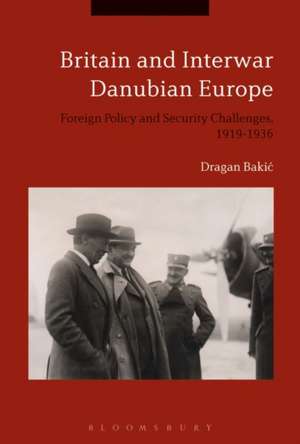
Britain and Interwar Danubian Europe: Foreign Policy and Security Challenges, 1919-1936
Autor Dr Dragan Bakicen Limba Engleză Hardback – 4 mai 2017
With Hitler's accession to power, Danubian Europe was viewed in Whitehall in relation to its place in the prospective policy for preserving Austrian independence and containing German aggression. Dragan Bakic argues that the British approach to security problems in Danubian Europe had certain permanent features which stemmed from the general British outlook on the new successor states -the members of the Little Entente- founded on the ruins of the Habsburg monarchy. This book shows that it was the lack of confidence in their stability and permanence, as well as the misperceptions about the motives and intentions of the policies pursued by other Powers towards Central/South-Eastern Europe, which accounted for the apparent sluggishness and ineffectiveness of the Foreign Office's dealings with security challenges.
Based on extensive, original archival research, this is a fascinating volume for any historian keen to know more about the 20th-century history of East-Central Europe or British foreign policy in the interwar years.
Preț: 797.26 lei
Preț vechi: 1204.98 lei
-34%
Puncte Express: 1196
Carte tipărită la comandă
Livrare economică 05-19 iunie
Specificații
ISBN-13: 9781474250085
ISBN-10: 1474250084
Pagini: 288
Ilustrații: 24 bw illus
Dimensiuni: 156 x 234 x 23 mm
Greutate: 0.57 kg
Editura: Bloomsbury Publishing
Colecția Bloomsbury Academic
Locul publicării:London, United Kingdom
ISBN-10: 1474250084
Pagini: 288
Ilustrații: 24 bw illus
Dimensiuni: 156 x 234 x 23 mm
Greutate: 0.57 kg
Editura: Bloomsbury Publishing
Colecția Bloomsbury Academic
Locul publicării:London, United Kingdom
V-ar putea interesa
-
 -26%Preț: 540.95 lei726.17 lei
 -
 The Iron IndustryRichard Hayman-33%Preț: 44.27 lei65.85 lei
 -
 A Companion to the Norman ConquestPeter BramleyPreț: 145.61 lei
 -
 -28%Preț: 73.55 lei102.25 lei
 -
 Beloved Emma: The Life of Emma, Lady HamiltonFlora Fraser-27%Preț: 95.42 lei131.11 lei
 -
 The Life of R. H. Tawney: Socialism and HistoryLawrence Goldman-41%Preț: 140.24 lei235.79 lei
 -
 -29%Preț: 47.85 lei67.44 lei
 -
 Royal London: Colouful Tales of Pomp and Pageantry From London's Past and PresentKaren Pierce GouldingPreț: 43.46 lei
Cuprins
Acknowledgements
Abbreviations
Introduction
1. A New Europe or a "Balkanised Europe"? The British Dilemma, 1919-1921
2. The Attitudes and Calculations Determining British Policy towards Danubian Europe, 1921-1925
3. Managing Perpetual Crisis, 1925-1927
4. The Transitional Years, 1928-1932
5. The Quest for an Elusive Danubian Security, 1933-1936
Conclusion
Notes
Bibliography
Abbreviations
Introduction
1. A New Europe or a "Balkanised Europe"? The British Dilemma, 1919-1921
2. The Attitudes and Calculations Determining British Policy towards Danubian Europe, 1921-1925
3. Managing Perpetual Crisis, 1925-1927
4. The Transitional Years, 1928-1932
5. The Quest for an Elusive Danubian Security, 1933-1936
Conclusion
Notes
Bibliography
Recenzii
In all, this is an extraordinary work that makes a welcome contribution to the growing literature on interwar Danubian Europe. It will be of considerable interest to scholars of European studies, international relations, and diplomacy.
This is a well-researched, insightful and challenging critique of British inter-war foreign policy as diplomats and politicians struggled to find solutions to problems posed by the post-First World War settlement in Central Europe and the Balkans. Voices insisting that European peace was indivisible and that the affairs of Central Europe could not be dismissed as faraway and insignificant were ignored with tragic consequences, offering lessons that remain relevant today.
The British knew little about Eastern Central Europe between the two world wars, for only in Shakespeare does Bohemia have a coastline. Yet, as Dragan Bakic shows in this lucid and timely exposition, the region occupied by the successor states of the Hapsburg Empire played an important role in British foreign policy, which intersected with Britain's relations with the Great Powers at crucial moments.
In considering the diplomacy of interwar Europe from an unexpected angle Dragan Bakic helps to illuminate its complexities. Combining thorough research in British sources with previously unavailable or unused Yugoslav archives, this work is a valuable resource for those interested in both the period and in the wider workings of British diplomacy.
A welcome addition to an otherwise scant bibliography on British foreign policy in this part of Europe in the period before the Munich Conference ... An important book, grounded in excellent archival research, which opens many interesting questions ... As such, it should stimulate further research of the topic.
This is a well-researched, insightful and challenging critique of British inter-war foreign policy as diplomats and politicians struggled to find solutions to problems posed by the post-First World War settlement in Central Europe and the Balkans. Voices insisting that European peace was indivisible and that the affairs of Central Europe could not be dismissed as faraway and insignificant were ignored with tragic consequences, offering lessons that remain relevant today.
The British knew little about Eastern Central Europe between the two world wars, for only in Shakespeare does Bohemia have a coastline. Yet, as Dragan Bakic shows in this lucid and timely exposition, the region occupied by the successor states of the Hapsburg Empire played an important role in British foreign policy, which intersected with Britain's relations with the Great Powers at crucial moments.
In considering the diplomacy of interwar Europe from an unexpected angle Dragan Bakic helps to illuminate its complexities. Combining thorough research in British sources with previously unavailable or unused Yugoslav archives, this work is a valuable resource for those interested in both the period and in the wider workings of British diplomacy.
A welcome addition to an otherwise scant bibliography on British foreign policy in this part of Europe in the period before the Munich Conference ... An important book, grounded in excellent archival research, which opens many interesting questions ... As such, it should stimulate further research of the topic.