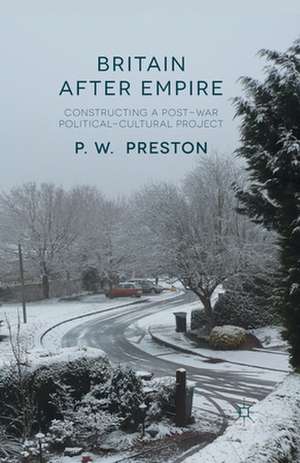
Britain After Empire
Autor P. Prestonen Limba Engleză Paperback – 2014
Preț: 372.75 lei
Puncte Express: 559
Carte tipărită la comandă
Livrare economică 18 noiembrie-02 decembrie
Livrare prin curier în România Termenul estimat este afișat lângă disponibilitate.
Transport gratuit de la 400.00 lei Plată online sau ramburs, în funcție de opțiunile comenzii.
Retur gratuit în 14 zile Comandă securizată și suport în română.
Specificații
ISBN-13: 9781349438341
ISBN-10: 1349438340
Pagini: 288
Ilustrații: VIII, 278 p.
Dimensiuni: 140 x 216 x 16 mm
Greutate: 0.37 kg
Ediția:1st edition 2014
Editura: Palgrave MacMillan
Locul publicării:London, United Kingdom
ISBN-10: 1349438340
Pagini: 288
Ilustrații: VIII, 278 p.
Dimensiuni: 140 x 216 x 16 mm
Greutate: 0.37 kg
Ediția:1st edition 2014
Editura: Palgrave MacMillan
Locul publicării:London, United Kingdom
V-ar putea interesa
-
 Gladstone and IrelandD G Boyce-15%Preț: 645.03 lei758.86 lei
 -
 Migration in Irish History 1607-2007Patrick Fitzgerald-18%Preț: 812.43 lei990.77 lei
 -
 Protestant Dublin, 1660-1760R. Usher-15%Preț: 701.95 lei825.83 lei
 -
 Governing Post-War BritainGlen O'HaraPreț: 407.78 lei
 -
 Preț: 400.22 lei
 -
 Bohemia in LondonP. BrookerPreț: 383.15 lei
 -
 Ireland, Slavery and Anti-Slavery: 1612-1865N. Rodgers-18%Preț: 1005.62 lei1226.36 lei
 -
 The Palgrave Dictionary of Anglo-Jewish HistoryW. Rubinstein-18%Preț: 1744.79 lei2127.79 lei
 -
 The Darkest DaysDouglas NewtonPreț: 78.92 lei
 -
 Richard III and the Princes in the TowerAlison Weir-20%Preț: 74.14 lei92.11 lei
 -
 Hidden Treasures of LondonMichael Mcnay-15%Preț: 203.73 lei239.59 lei
Cuprins
Preface Acknowledgement 1. After the Empire 2. Foundation Myths 3. Grand Designs 4. Making Enemies 5. Voices of Complaint 6. Patrician Retreat 7. Affluence Attained 8. Corporate World 9. Bullshit Industries 10. Familiar Utopias 11. Continuing Britain Bibliography Index
Recenzii
'This is a book that should be read by anyone interested in contemporary Britain. It traces developments in post-war Britain in the context of the end of Empire, but does so in a different way which focuses upon the role of ideas/narratives reflected in government designs, high arts and popular culture. It is challenging, but always interesting; even where the reader might disagree.'
- David Marsh, Director of Research, ANZSOG Institute for Governance, University of Canberra, Australia
- David Marsh, Director of Research, ANZSOG Institute for Governance, University of Canberra, Australia
Notă biografică
P. W. Preston has taught comparative politics in a number of universities in Europe and East Asia and has published widely on topics related to these two regions. His most recent concerns have been with the ways in which collective memories of violence find expression in contemporary politics both in Europe and East Asia.