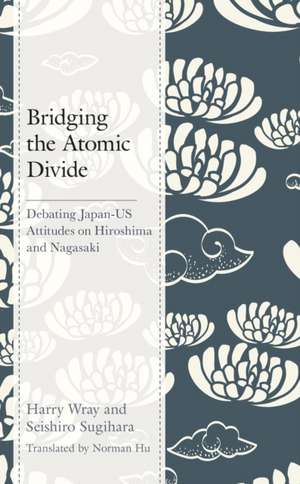
Bridging the Atomic Divide: Debating Japan-US Attitudes on Hiroshima and Nagasaki
Autor Harry J. Wray, Seishiro Sugihara Traducere de Norman Huen Limba Engleză Paperback – 7 oct 2020
Preț: 310.54 lei
Preț vechi: 409.10 lei
-24%
Puncte Express: 466
Carte tipărită la comandă
Livrare economică 30 noiembrie-14 decembrie
Livrare prin curier în România Termenul estimat este afișat lângă disponibilitate.
Transport gratuit de la 400.00 lei Plată online sau ramburs, în funcție de opțiunile comenzii.
Retur gratuit în 14 zile Comandă securizată și suport în română.
Specificații
ISBN-13: 9781498593236
ISBN-10: 1498593232
Pagini: 340
Dimensiuni: 154 x 218 x 25 mm
Greutate: 0.5 kg
Editura: Bloomsbury Publishing
Colecția Lexington Books
Locul publicării:New York, United States
ISBN-10: 1498593232
Pagini: 340
Dimensiuni: 154 x 218 x 25 mm
Greutate: 0.5 kg
Editura: Bloomsbury Publishing
Colecția Lexington Books
Locul publicării:New York, United States
Cuprins
Foreword, Miyuki Wray
Preface to the Japanese Edition
Translator's Note
Chapter 1: Descent into Inhumanity
Chapter 2: The Unconditional Surrender Formula and Limited Alternatives to Atomic Bombs: Pros and Cons
Chapter 3: The Potsdam Declaration: A Missed Opportunity By Japan To Avoid Atomic Bombings and a Soviet Entry
Chapter 4: That "Final Decisive Battle"
Chapter 5: The Role of Decrypted Messages
Chapter 6: Japan's Decision to Wage a Final Decisive Battle Produced the Atomic Bombing of Hiroshima, the first of the "Triple Shocks"
Chapter 7: Two Shocks in One Day
Chapter 8: Militants' Intransigent Response: Extinction before Surrender
Chapter 9: Contentious Issues Surrounding the Atomic Bombings, the Mistaken "Atomic Diplomacy" Thesis, and its Impact on Japanese Textbooks
Conclusion
Appendix A: Supplemental Commentary-Diplomacy at Start and End of Japan-US War, and Subsequent Problems
Appendix B: Regarding Wray's Examination of the Pearl Harbor Issue
Appendix C: The Historical Significance of President Obama's Visit to Hiroshima
Afterword
Preface to the Japanese Edition
Translator's Note
Chapter 1: Descent into Inhumanity
Chapter 2: The Unconditional Surrender Formula and Limited Alternatives to Atomic Bombs: Pros and Cons
Chapter 3: The Potsdam Declaration: A Missed Opportunity By Japan To Avoid Atomic Bombings and a Soviet Entry
Chapter 4: That "Final Decisive Battle"
Chapter 5: The Role of Decrypted Messages
Chapter 6: Japan's Decision to Wage a Final Decisive Battle Produced the Atomic Bombing of Hiroshima, the first of the "Triple Shocks"
Chapter 7: Two Shocks in One Day
Chapter 8: Militants' Intransigent Response: Extinction before Surrender
Chapter 9: Contentious Issues Surrounding the Atomic Bombings, the Mistaken "Atomic Diplomacy" Thesis, and its Impact on Japanese Textbooks
Conclusion
Appendix A: Supplemental Commentary-Diplomacy at Start and End of Japan-US War, and Subsequent Problems
Appendix B: Regarding Wray's Examination of the Pearl Harbor Issue
Appendix C: The Historical Significance of President Obama's Visit to Hiroshima
Afterword
Recenzii
In Bridging the Atomic Divide: Debating Japan-U.S. Attitudes on Hiroshima and Nagasaki, veteran Japan scholars Harry Wray (now deceased) and Seishiro Sugihara consider, in remarkably fine-grained, blow-by-blow detail, the events of July and August of that fateful year. . . . remarkably, the first time that an American and a Japanese have gathered in a scholarly setting to hash out the myriad of views on the atomic bombings. . . . Anyone interested in history, or in History, will want to buy and read [this] powerful new [book].
The act of interpretation is an integral part of human life, and therefore varies depending on an individual's perspective. Although there can be only one set of historical facts, the interpretation of those facts may differ according to point of view. It is only natural then that the understanding of the dropping of the atomic bombs will also vary between the side which used them and the side on which they were used. Even so, a flawed understanding of historical fact will result in faulty interpretations, and a stubborn insistence on those unsound interpretations can lead to the corruption of the national moral code. This book presents the first dialogue between two scholars, one Japanese and one American, which tries to put an end to these flawed interpretations while acknowledging real differences in position. It represents a genuine reconciliation between Japan and the US over the atomic bombings of Hiroshima and Nagasaki.
The act of interpretation is an integral part of human life, and therefore varies depending on an individual's perspective. Although there can be only one set of historical facts, the interpretation of those facts may differ according to point of view. It is only natural then that the understanding of the dropping of the atomic bombs will also vary between the side which used them and the side on which they were used. Even so, a flawed understanding of historical fact will result in faulty interpretations, and a stubborn insistence on those unsound interpretations can lead to the corruption of the national moral code. This book presents the first dialogue between two scholars, one Japanese and one American, which tries to put an end to these flawed interpretations while acknowledging real differences in position. It represents a genuine reconciliation between Japan and the US over the atomic bombings of Hiroshima and Nagasaki.