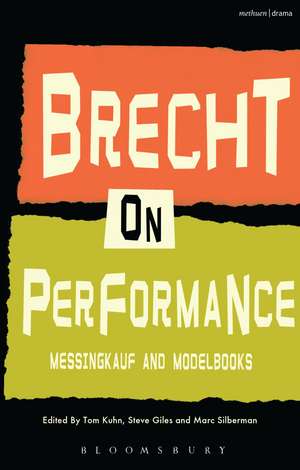
Brecht on Performance: Messingkauf and Modelbooks
Autor Bertolt Brecht Editat de Tom Kuhn, Marc Silberman, Prof. Steve Giles Traducere de Charlotte Ryland, John Willett, Romy Furslanden Limba Engleză Hardback – 20 noi 2014
Experiența vizuală propusă de Brecht on Performance este una a imersiunii directe în laboratorul de creație al unuia dintre cei mai influenți oameni de teatru ai secolului XX. Remarcăm imediat calitatea documentară a celor peste 30 de fotografii extrase din faimoasele „Modelbooks”, care transformă acest volum dintr-un simplu tratat teoretic într-o arhivă vie a gestului scenic. Privitorul este invitat să observe nu doar rezultatul final, ci procesul organic de construcție a spectacolului, de la poziționarea actorilor la detalii de scenografie care definesc estetica brechtiană.
Subliniem structura riguroasă a cărții, organizată în două părți fundamentale: prima oferă dialogurile teoretice din „Messingkauf” (Cumpărarea alamei), unde conceptele complexe precum Verfremdungseffekt (efectul de distanțare) sunt dezbătute sub formă de dialog, iar a doua parte prezintă înregistrări concrete de la repetițiile unor piese monumentale. Complementar lui Brecht in Practice de David Barnett, care oferă un studiu accesibil asupra aplicabilității teoriilor, volumul de față este mai degrabă un instrument primar de lucru, oferind acces la textele sursă și la exercițiile practice pe care Bertolt Brecht le folosea pentru a deconstrui clasicii precum Shakespeare sau Schiller.
În contextul operei sale, dacă The Life of Galileo sau Mother Courage reprezintă materializarea viziunii sale politice, Brecht on Performance funcționează ca un manual de instrucțiuni esențial. Această lucrare cristalizează tranziția de la teoria pură, întâlnită în Aesthetics and Politics, către o metodologie aplicată, oferind regizorilor și actorilor contemporani un fundament solid pentru realizarea textelor pe scenă. Tonul este unul analitic, dar profund ancorat în realitatea fizică a scenei, invitând la o lectură activă și participativă.
Preț: 772.69 lei
Preț vechi: 1021.87 lei
-24%
Carte tipărită la comandă
Livrare economică 07-21 decembrie
Specificații
ISBN-10: 147255860X
Pagini: 312
Ilustrații: 50 bw illus
Dimensiuni: 138 x 216 x 23 mm
Greutate: 0.52 kg
Editura: Bloomsbury Publishing
Colecția Methuen Drama
Locul publicării:London, United Kingdom
V-ar putea interesa
-
 The Empty SpacePeter Brook-27%Preț: 56.93 lei77.92 lei
 -
 Brecht and the Art of SpectatorshipLaura Bradley-32%Preț: 587.25 lei861.64 lei
 -
 A Practical Handbook for the ActorLee Michael CohnPreț: 88.97 lei
 -
 Nagler, A: Source Book in Theatrical HistoryAlois Maria NaglerPreț: 199.22 lei
 -
 True and FalseDavid MametPreț: 92.31 lei
 -
 Marat/SadePeter WeissPreț: 76.52 lei
 -
 -15%Preț: 66.26 lei77.91 lei
 -
 Brecht on TheatreBertolt BrechtPreț: 143.63 lei
 -
 -31%Preț: 448.80 lei652.46 lei
 -
 -16%Preț: 79.68 lei94.66 lei
 -
 A Beginner’s Guide to Directing TheatreRobert Marsden-10%Preț: 170.01 lei189.22 lei
 -
 Acting: A Backstage GuideLucian Msamati-10%Preț: 73.17 lei81.42 lei
 -
 -11%Preț: 125.03 lei139.95 lei
 -
 -8%Preț: 170.64 lei185.61 lei
 -
 Understanding BrechtWalter BenjaminPreț: 105.32 lei
 -
 Getting DirectionsRuss HopePreț: 96.63 lei
 -
 Brecht: A Practical HandbookDavid ZoobPreț: 94.34 lei
 -
 The Drama School HandbookJohn AbbottPreț: 214.01 lei
 -
 The Complete Brecht ToolkitStephen UnwinPreț: 93.99 lei
 -
 Different Every NightMike AlfredsPreț: 125.82 lei
De ce să citești această carte
Recomandăm acest volum oricărui student la actorie sau regie care dorește să înțeleagă teatrul dialectic dincolo de definițiile din dicționar. Cititorul câștigă acces la exerciții practice de repetiție și la documentația vizuală rară a ansamblului Berliner Ensemble. Este o resursă indispensabilă pentru a învăța cum să transformi o idee politică într-o prezență scenică vibrantă și critică, beneficiind de expertiza unor editori de renume mondial.
Despre autor
Bertolt Brecht (1898–1956) a fost un dramaturg, poet și regizor german, a cărui influență asupra teatrului modern rămâne inegalabilă. Creator al „teatrului epic”, Brecht a revoluționat arta dramatică prin introducerea efectului de distanțare, menit să încurajeze spectatorul să gândească critic, nu doar să empatizeze emoțional. După exilul în Scandinavia și SUA în timpul regimului nazist, s-a întors în Berlinul de Est, unde a fondat legendara companie Berliner Ensemble împreună cu Helene Weigel. Opera sa, marcată de gândirea marxistă, explorează constant tensiunea dintre individ, știință și structurile de putere socială.
Descriere
The volume is in two parts. The first features an entirely new commentated edition of Brecht's dialogues and essays about the practice of theatre, known as the Messingkauf, or Buying Brass, including the 'Practice Pieces' for actors (rehearsal scenes for classics by Shakespeare and Schiller). The second contains rehearsal and production records from Brecht's work on productions of Life of Galileo, Antigone, Mother Courage and others.
Edited by an international team of Brecht scholars and including an essay by director and teacher Di Trevis examining the practical application of these texts for theatres and actors today, Brecht on Performance is a wonderfully rich resource. The text is illustrated with over 30 photographs from the Modelbooks.
Recenzii
An excellent complement to Brecht in Practice. . These theoretical essays concern the practice of theatre (known as Messingkauf, or "buying brass") and explore the way actors should interpret and perform a text.
Combined with Brecht in Practice, [Brecht on Performance] makes a compelling contribution to the anglophone understanding of Brecht and may indeed breathe new life into how we do theatre in the twenty-first century.
Brecht in Performance is the ideal and long-awaited companion to the much loved, but now greatly improved Brecht on Theatre. Essential reading for students, theatre practitioners and anyone interested in this hugely important figure.
This is a book at least as essential as Brecht on Theatre, not least because it restores to print a carefully reconstructed version of Brecht's major theoretical work The Messingkauf Dialogues (first released in English by Willett in 1965), with many variant texts absent from the first publication of that treatise. . It is unnecessary to qualify my praise for the other major element of Brecht on Performance, and that is a fresh, lushly illustrated translation of three of Brecht's modelbooks, created for the Berliner Ensemble during the brief period that Brecht was at its helm.
Brecht on Performance is a vital aid to English speakers in understanding Brecht as a theatre practitioner as well as what constitutes Brechtian performance. For the first time, a full edition of the unfinished Messingkauf - translated as Buying Brass - is available in English. [This book] will allow Anglophone scholars and performance practitioners to revisit Brecht's influence as a writer, theoretician, and theatre maker specifically, but also - more generally - the relationship between political thought and aesthetics, and between the theory and the practice of making art.
Cuprins
Part One - The Messingkauf, or Buying Brass
Introduction to Buying Brass
Preamble
First Night
(i) Setting the Scene
(ii) Naturalism, Realism, Empathy
(iii) Tragedy; Learning, Science, Marxism
Second Night
(i) Intoxication, Empathy, V-effect
(ii) Acting, Performance
(iii) Science, Social Class, Learning
(iv) Elizabethan Theatre, Shakespeare
(v) The Augsburger, Piscator
Third Night
(i) The Fourth Wall, Emotion; V-effect, Acting
(ii) The Augsburger, Piscator, Weigel
(iii) Social Science and Art
(iv) 'Extreme Situations'
Fourth Night
(i) The Nature of Art
(ii) Emotion, Critique, Representation
(iii) The Augsburger
(iv) Shakespeare
(v) Finale
Miscellaneous Texts
(i) Illusionism, Realism, Naturalism; Social Function of Theatre; Empathy
(ii) Acting
(iii) Thaëter, Piscator, Neher
Plans and Appendices
(i) Plans
(ii) Appendices
Practice Pieces for Actors
(i) Parallel Scenes
The Murder in the Porter's Lodge
(Parallel Scene to Shakespeare's Macbeth, Act 2, Scene 2)
The Battle of the Fishwives
(Parallel to Schiller's Maria Stuart, Act 3)
(ii) Intercalary Scenes
Ferry Scene
(To be played between Scenes 3 and 4, Act 4 of Shakespeare's Hamlet)
The Servants
(To be played between Scenes 1 and 2, Act 2 of Shakespeare's Romeo and Juliet)
(iii) Circular Poems
Part Two - Modelbooks
Introduction to the Modelbooks
On Life of Galileo (1947/48) from Constructing a Role: Laughton's Galileo
Foreword
A Sequence from Scene One: Rotation of the Earth and Rotation of the Brain
Background to the Performance
On The Antigone of Sophocles (1947/48) from Antigone Model 1948
Foreword
Ruth Berlau's Prefatory Note
Prelude and Bridge to Scene One
Neher's Second Design for the Antigone Stage
On Mother Courage and Her Children (1949/50/51) from Courage Model 1949
Opening Remarks
Notes and Scene-Photos for the Prologue, Scenes One and Two
Details from Scene Three
Variations in Berlin and Munich
Concluding Texts from the Model: Scene Twelve
From Theatre Work (1952)
Some Remarks on My Discipline
Bertolt Brecht's Stage Direction
Phases of a Stage Direction
Five Notes on Acting
The Berliner Ensemble Models
Theatre Photography
Does Use of the Model Restrict Artistic Freedom
How Erich Engel Uses the Model
How the Director Brecht Uses His Own Model
From the Correspondence of the Berliner Ensemble about the Model
Creative Evaluation of Models
From Katzgraben Notes 1953
Epic Theatre
Rehearsal Methods
Scenery
Crises and Conflicts
Politics in the Theatre
III,2 Constructing a Hero
Is Katzgraben a Proselytizing Play?
The Verse Form
Verfremdung
II, 3 [Revelation and Justification]
Empathy
The New Farmer, the Medium Farmer, the Big Farmer
What Are Our Actors Actually Doing?
The Positive Hero
Second Dress Rehearsal
Criticism of Elli and Criticism of Elli 2
New Content - New Form
Di Trevis: "Acting is Not Theoretical"
Select Bibliography
Index of Names and Key Terms