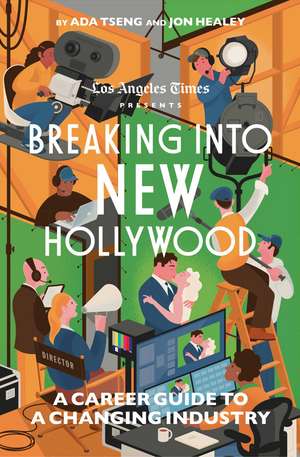
Breaking Into New Hollywood: A Career Guide to a Changing Industry
Autor The Los Angeles Timesen Limba Engleză Paperback – 24 sep 2026
Everyone loves a captivating Hollywood rags-to-riches story. Take Charlize Theron, who was on her last paycheck and in a heated discussion with a bank teller when a kind stranger—who happened to be a talent agent—stepped in to help her cash an out-of-town check. Or consider Rosario Dawson, discovered right on her front porch by filmmakers looking for fresh talent for Kids. And then there’s Leonardo DiCaprio, the son of a secretary and a writer and distributor of underground comics, who saw acting as a way out of poverty.
But that’s not how it usually happens for the tens of thousands of people who work in the entertainment industry. For many just starting out, and even those already in the business, the road can feel mysterious and overwhelming. From actors and directors to behind-the-scenes heroes like managers, grips, and sound designers, Breaking into the New Hollywood is here to uncover the many opportunities for newcomers hustling in what the Los Angeles Times calls the “company town”—and beyond.
This practical guide offers invaluable insights on navigating the industry today. How has working in film changed in the age of streaming? What does CGI mean for special effects? Even with the rapid rise of YouTubers and social media stars raking in millions of views and competing for traditional movie theater audiences, there are still more job opportunities than ever for those eager to start a career in film and TV. Breaking into the New Hollywood is an up-to-date roadmap for aspiring stars wanting to make a living in front of the camera, but it’s also for those passionate about being part of the collaborative, creative community like no other.
Preț: 67.29 lei
Preț vechi: 80.62 lei
-17% Nou
Puncte Express: 101
Carte disponibilă
Livrare economică 13-25 noiembrie
Livrare express 29 octombrie-04 noiembrie pentru 39.05 lei
Livrare prin curier în România Termenul estimat este afișat lângă disponibilitate.
Transport gratuit de la 400.00 lei Plată online sau ramburs, în funcție de opțiunile comenzii.
Retur gratuit în 14 zile Comandă securizată și suport în română.
Specificații
ISBN-13: 9781668049983
ISBN-10: 1668049988
Pagini: 368
Dimensiuni: 140 x 213 x 25 mm
Greutate: 0.34 kg
Editura: Simon&Schuster
Colecția Simon & Schuster
ISBN-10: 1668049988
Pagini: 368
Dimensiuni: 140 x 213 x 25 mm
Greutate: 0.34 kg
Editura: Simon&Schuster
Colecția Simon & Schuster
V-ar putea interesa
-
 Hollywood VampiresKelly LoudenbergPreț: 119.52 lei
 -
 Pandora's BoxPeter BiskindPreț: 93.99 lei
 -
 Preț: 115.57 lei
 -
 -25%Preț: 143.91 lei190.79 lei
 -
 -26%Preț: 53.31 lei71.56 lei
 -
 The Big PictureBen FritzPreț: 99.98 lei
 -
 Acting ProfessionallyJames Calleri-33%Preț: 374.66 lei555.65 lei
 -
 Acting Professionally: An Essential Career Guide for the ActorProfessor Robert Cohen-14%Preț: 133.04 lei155.37 lei
 -
 -15%Preț: 143.97 lei169.83 lei
 -
 Actors’ and Performers’ Yearbook 2026Aileen Gonsalves-10%Preț: 148.56 lei164.91 lei
 -
 Preț: 146.42 lei
 -
 -31%Preț: 79.11 lei115.32 lei
 -
 -19%Preț: 183.69 lei228.18 lei
 -
 -19%Preț: 64.05 lei78.92 leiRecomandat
 -
 Charity Trickett Is Not So GlamorousChristine Stringer-18%Preț: 100.28 lei122.79 lei
 -
 Take Me to the RiverJackie KempPreț: 144.22 lei
 -
 Preț: 57.19 lei
 -
 Hollywood in the New MillenniumTino Balio-30%Preț: 187.29 lei267.49 lei
 -
 -18%Preț: 116.93 lei143.43 leiRecomandat
 -
 Catching the LightHarold Becker-23%Preț: 133.33 lei172.09 lei
Notă biografică
Published since 1881, the Los Angeles Times is the sixth-largest newspaper by circulation in the United States, as well as the largest newspaper in the western United States.
Ada Tseng is a writer and editor who led the Hollywood careers series at the Los Angeles Times. She cohosts the Asian American pop culture history podcast Saturday School with Brian Hu.
Jon Healey is a former reporter and editor for the Los Angeles Times, where he spent more than two decades doing explanatory journalism, tech reporting, opinion pieces, and breaking news.
Ada Tseng is a writer and editor who led the Hollywood careers series at the Los Angeles Times. She cohosts the Asian American pop culture history podcast Saturday School with Brian Hu.
Jon Healey is a former reporter and editor for the Los Angeles Times, where he spent more than two decades doing explanatory journalism, tech reporting, opinion pieces, and breaking news.
Extras
Chapter 1: How to Become an Actor in Film or Television
We see actors everywhere. We see them in our favorite films and TV shows. We see them on talk shows and posters. We see them on red carpets and on their Instagram posts (showing us how they glammed up for the red carpets). We see them win awards. We read their memoirs.
Unlike the hundreds of other jobs in Hollywood that are often so seamlessly tucked behind the scenes that they’re invisible, the job of an actor is hyper-visible. It’s the job—professionals say—that everyone thinks they understand.
But the public often only sees the most glamorous parts of being a celebrity, not the daily grind of a typical Hollywood actor.
When you book an acting role, you get to do all the work that made you want to be an actor in the first place. You break down a script. You learn your lines. You create your character with the help of hair, makeup, and costume people. You discuss your role with the director. You rehearse with your fellow cast members. You deliver the best performance you can muster with the time you were given to prepare and the number of takes you were able to do. Then you hope it’s shot and edited in a way that showcases your brilliance, so you can have an easier time booking your next big role.
But it’s imperative for aspiring film and TV actors to understand that for most professional actors in Hollywood, the time on a set is very limited.
“People come out of high school and college, they’ve been acting in theater their whole lives, they’ve been cast in every single school play, and that’s just a very different lifestyle than a working actor,” said Ben Whitehair, an actor, active Screen Actors Guild member, and cofounder of Working. Actor, an extensive resource for aspiring actors.
The main part of the job is auditioning. It’s the hustle. Many working actors liken the lifestyle to owning a small business. While you’re starting out, you have to be your own talent, marketing, customer service, and community outreach departments. Like with any small business, it takes time, energy, and money to get an acting career off the ground.
There is a tremendous amount of luck involved. Get comfortable with rejection that you cannot control—rejection that often has more to do with the superficial parts of you (how you look, your chemistry with another actor, how much you match with someone’s idea of a script’s character) and less to do with your talent and skills.
In the beginning, you won’t book many gigs. You’ll need another way to pay your bills that allows you to easily take time off to do auditions or take on small roles. Even when you start landing gigs regularly—a combination of student films, indie films, voice-over gigs, workshops, table reads, commercials and other one-day appearances—none of them, by themselves, will provide a livable wage. But it all adds up, and the reward is that you get to do what you love for work.
Outsiders can easily point out an actor’s most high-profile credits on IMDb. For Behzad Dabu, that would be his role as Simon Drake on How to Get Away with Murder. But when he made enough money that he was able to quit his safety job as a college admissions administrator, that was a huge win for him.
Many professionals would love for people to stop romanticizing the role of a working actor. What does a typical Hollywood actor really look like? “They can go to the park and grocery store without getting stopped or mobbed,” Dabu said. “They bought a house. They raised children. They have a car. And they can afford all of that by being an actor.”
It might sound obvious, but actors need to love performing. You have to love it so much that you’re willing to do things that you don’t always want to do to get paid to act. That could include juggling multiple side jobs to support yourself, taking any role that comes your way, or making self-taped auditions not knowing if someone is going to watch them all the way through.
Actors are storytellers. They tend to be good listeners who are highly attuned to all the different ways people communicate and show their emotions. They also tend to be curious about human behavior and psychology, because part of the job is being empathetic and understanding why people do the dramatic things they do.
Actors usually love doing research about different cultures and time periods. They do a lot of that to embody their characters.
And lastly, actors must have really thick skin. Actors who survive in Hollywood have to be very good at managing their emotions. They have to be the type of people who can be extremely vulnerable on camera; give their entire heart, mind, and body to a project; won’t get fazed by comments from anonymous strangers who pick apart their looks and performances; and afterward decide that they want to do it again.
Training—and continuing to train even when you start getting work—is essential. There are many ways to get training. You could get a theater degree at a college or university. (Look up the annual lists of best acting colleges compiled by Backstage or the Hollywood Reporter. Juilliard, Yale, the University of North Carolina, and Carnegie Mellon are often listed among the top-tier schools.) You could enroll in more intensive acting conservatory programs, like Los Angeles Performing Arts Conservatory, T. Schreiber, Atlantic Acting School, William Esper Studio, the Lee Strasberg Theatre & Film Institute, or Stella Adler Studio of Acting. You could take classes focused on acting techniques, like Stanislavski’s Method or the Meisner technique.
There are also classes that teach specific skills, including scene study, character study, auditioning, and improv. There are classes that focus on acting for commercials. There are coaches—including DaJuan Johnson (Bosch), founder of Think Bigger Coaching, and Anna LaMadrid (This Fool), owner of Put Me On Self-Tape—who specialize in helping actors film self-taped auditions. Modeling classes can help you get comfortable in front of the camera. Learning stand-up comedy can help you nail your comedic timing and find your unique voice.
The goal is to eventually get good enough at your craft that you get booked for roles that will give you on-the-job training. To book these roles, you often need representation—an agent who submits you for jobs and negotiates contracts, and a manager who guides your career.
But first, you need headshots, a résumé, and a reel. So how do you create a reel of work before you’ve booked anything?
There are national casting networks and websites—including Actors Access and Backstage.com—that list auditions, also known as breakdowns, that you can apply for on your own if you don’t yet have an agent. These are typically for smaller projects: short films, commercials, web series, and social media sketches. There are many local networks and Facebook groups that are free. Most opportunities will be found in Los Angeles and New York, but there are growing hubs in cities including Las Vegas, Atlanta, San Francisco, Austin, and Chicago.
The process can be a grind. “Let’s say you submit yourself to thirty projects, two get back to you, you do those two auditions, and you don’t hear anything. Tomorrow, submit yourself to thirty more projects,” Dabu said.
While you’re getting used to rejection, make your own content. Actor Randall Park (WandaVision, Fresh Off the Boat) regularly directed and starred in his own comedic short films—often featuring alumni from the LCC Theatre Company, the Asian American company he cofounded at UCLA as a student—decades before he got his first professional directing opportunity. Even if you just get your friends together and piece some clips over a few months, you can create a reel to show agents and managers who focus on discovering new actors.
Look for representation that’s right for you. A manager oversees the day-to-day operations of your career, while agents help find and secure opportunities, bookings, and auditions. Once you start booking more gigs, you might consider hiring a publicist and an attorney for dealing with contracts.
And lastly, anytime you get the chance to work on set, think about everything you can do in the moment to help yourself get your next role. That means showing up on time, being respectful, and making everyone else’s job easier. It means learning how different departments work and connecting with like-minded people you might want to collaborate with in the future.
Don’t define yourself (or be defeated) by any individual project. Treat all your experiences—big and small, good and bad—as steps to develop yourself as an artist and build toward your eventual goal. That goal often evolves as you learn more about the industry and yourself.
There is no one path and no set timeline for the career of an actor. But there is a general hierarchy. Most working actors start with agents and managers who specialize in getting actors with less experience auditions for smaller jobs, and then eventually work up to the higher-profile agents and managers, who can get auditions for major networks and streaming services.
The only way to fast-track to the top is if a casting director or filmmaker chooses you for a role that’s much bigger than the one you did before. But that’s out of your control.
Here is a breakdown of the typical acting roles in television:
There are similar levels for acting in film: extras, featured extras, supporting roles, supporting leads, and leads.
Getting into the union—SAG-AFTRA—is imperative. Once you get into the union, you agree to stop taking nonunion jobs for any work covered by the SAG-AFTRA contract. Statistically, that limits your options, but union work will offer protections, including health insurance, and set you up for the higher pay you need to have a sustainable acting career.
For most actors, though, it takes at least a couple of years to book jobs that will qualify them for membership. There are two primary routes to get into SAG-AFTRA: You get a job on a union project, or you do work as a member of an affiliated performers’ union, such as the American Guild of Musical Artists or the American Guild of Variety Artists.
How do you get a job on a union project if you’re nonunion? A producer files a Taft-Hartley form to hire a nonunion actor if they can’t find a union one to fill the role. “A common example would be if they need a person who has a particular skill,” said Whitehair. “For example, if the character speaks Farsi, they might petition to hire a nonunion actor, and then [the actor] becomes eligible for the union.”
SAG-AFTRA has a number of rate sheets that dictate the minimum pay that its members make for a given production. As of 2025, the amount for an episode—a day’s work for a performer is worth a minimum of $1,246 and a performer who is hired longer term has to be paid $4,326 a week—might seem high at first glance, but keep in mind that most actors are not booking gigs throughout the year. And it takes a while to book these more well-paid roles, because it takes time to get the type of representation you need to get those types of auditions.
Even established actors might book only two $14,000-an-episode guest star roles a year. Also, most working actors take home only about 40 percent of their check. The rest goes to their agent, manager, and lawyer, as well as the union and taxes.
The reality is that most actors, even if they appear established, have another job that makes them money. They might produce projects, invest in restaurants, dabble in real estate, or start small businesses. Having another source of income isn’t a temporary phase or a sign of failure, professionals say. It’s a strategy that helps actors sustain their creative career.
Commercials can provide income for actors in between jobs. Actor Brent Bailey (The Idea of You, The Holiday Dating Guide), who has shot over one hundred commercials, said he’s rarely had to turn down a TV or film role because of a commercial, because the turnaround time is so fast. “If I get offered a really big TV or film role, obviously I’d take that role, but commercials pay so well that it’s hard to say no,” he said. “You can audition for a commercial this week that shoots next week, and it only shoots for one day.”
How much you’ll get paid for working in a commercial depends on such factors as whether you’re the principal or a background actor, whether it runs on cable or broadcast television, how long it runs, how large its reach is, and, most important, whether it’s shot under a union contract. A principal actor could earn up to $20,000 for a national broadcast TV commercial, but only about $1,000 for an ad shot for YouTube.
With the advent of streaming and the decline of traditional advertising, commercial acting is not as lucrative as it once was. But acting in commercials can also be a good opportunity to work with big directors and cinematographers in the business. Bailey shot commercials with both Doug Liman (The Recruit, The Bourne Identity) and Antoine Fuqua (Michael, Training Day).
One of the main changes is the transition from in-person auditions to self-tapes. Self-taped auditions were becoming more popular before the COVID-19 pandemic. But when the shutdowns proved how safe and effective those prerecorded versions can be—allowing casting directors to see far more actors, including ones out of town—they’ve become an industry standard.
Actors suddenly needed to learn the basics of filmmaking, lighting, and sound so that their tapes would be competitive. SAG-AFTRA also put in protections for their members for how many pages actors could be asked to film for first-round self-tape auditions and interviews. It felt like an extra responsibility placed upon actors, who just wanted to act. But some professionals encourage actors to think of it as a new opportunity—a way to take control of the audition and submit their best take.
The marketplace for actors has also changed dramatically. In previous generations, actors put most of their emphasis on training. And while mastering the craft is still important, actors are more focused now on expanding beyond the traditional confines of an actor—and they have more opportunity to do so.
Carolyn Michelle Smith (The Chi, Familiar Touch) coaches and mentors young actors, and she said their references for success are actors who also write and produce, like Michaela Coel, creator and star of Chewing Gum and I May Destroy You, and Quinta Brunson, creator and star of Abbott Elementary. Or Tabitha Brown, an actor, author, and media personality who’s gained a massive online following with comedic videos about veganism.
Professionals say there are more opportunities to craft your own life and career as an actor than ever before. That said, the abrupt production shutdowns caused by the 2023 actors’ and writers’ strike was a reminder that it’s always important to be prepared for disruptions as a working actor by saving money and having multiple income streams.
Be (extremely) patient. Whitehair tells aspiring actors to go on IMDb, the Internet Movie Database, and look up their favorite actor’s very first credits—knowing that this credit probably took a while for them to get. Then look at how long it took them to get from their first job to their first recognizable job, and you’ll see how acting careers almost always take a long time to build and grow.
Don’t attach yourself to any one part—or one vision of what your acting career should look like. “It may take longer than you thought it would,” Whitehair said. “Daily life might look different than you thought it would. But you can always be an actor. You can always tell stories.”
Audition for the casting directors, not for the specific role. Instead of trying to guess what casting directors want, it’s better to showcase your personal strengths. Keep in mind that casting directors are not only trying to cast their current project; they’re always on the lookout for talent for future projects.
Don’t compare yourself to anyone. Actors can feel like they’re being pitted against one another, and it’s easy to become jealous, especially when people feel like there are limited opportunities. “But for me, I’ve been in L.A. fourteen years now, and to see people I knew in college or an acting class now be on a show—it’s so exciting to me,” Whitehair said. “And it proves to me that it’s possible. This isn’t a ‘celebrity.’ This is my buddy, my friend.”
Don’t let anyone tell you that you’re too old to start acting. There are roles for all ages. People start their acting careers later in life for all sorts of reasons. They may get distracted by life challenges. They may be afraid of putting themselves out there. They may have been dissuaded from pursuing acting by loved ones.
As in any industry, it’s easier to have an earlier start. But having other life experiences can also work in your favor, and one of the benefits of starting to act later in life may be that you have achieved financial stability.
Have a wellness plan. Professionals say that the actor’s life is made of extreme highs—when you’re on set, living the dream—which can also come with big crashes when the job is over, you’re alone in your apartment, and you don’t have anything lined up.
Many actors recommend therapy. “We’re constantly going through the process of healing and breaking down, and sometimes your body doesn’t understand that it’s imagination, and it feels real,” said actor Annie Gonzalez, best known for Flamin’ Hot and Gentefied.
Have a plan for how to make use of your downtime so you don’t spiral, Smith recommended. That’s when you should update your social media and all your materials. Make lists of people you’ve worked with and whom you’d like to work with. See what connections you have. Start thinking about passion projects. Soak up culture. And rest. “Now you see it as a gift of time, not a curse,” she said. “The reason it’s a gift is because you could be creating your next project.”
Find a solid community. Actors Nik Dodani (The Parenting, Atypical) and Vinny Chhibber (Big Sky, For All Mankind) are cofounders of The Salon, a forum for South Asians in entertainment with a mentorship program for mid-career talent. It started as a social gathering, but they soon realized how crucial it was for actors and creatives—especially in marginalized communities—to have spaces that allow them to have honest conversations about their struggles.
They try to be transparent with their mentees when they first meet. They’ll tell them it’s a very tough, competitive industry. You need to find people who will validate you when you are being mistreated and help you figure out how to navigate the systems.
Social media and word of mouth are simple ways to find communities that share your culture or goals. Those support systems help you feel confident and safe as you’re exploring your own path.
“At the end of the day, you have to be in the driver’s seat,” Dodani said. “The only person who is going to be thinking about your career twenty-four-seven is you. But it’s a lot easier when you don’t feel like you’re dealing with these struggles by yourself.”
Don’t let Hollywood be the center of your entire life. Acting is “the type of career where a lot of people fool themselves into putting everything into it,” Park said. “They believe that everything has to be sacrificed to be successful in this.”
You don’t want your relationship with the industry to be an abusive, unbalanced one. Therapist Brian Torres, who works regularly with Hollywood clients, tries to get artists to pinpoint what drives them to act. Is it about telling stories or expressing yourself? Is it about the adrenaline of the stage or the power to change minds? He encourages actors to find other ways to feel fulfilled outside of the often brutal acting grind.
Expect some heartbreak. Park said the reality of pursuing a career in the entertainment industry is that you won’t come out unscathed. “I think just by doing it, you get destroyed a little bit,” he said. “In life too, right?”
He added, “It makes sense that the funnest job in the world is really hard to get…. If you want to experience that much fun for a living, you gotta go through some hoops.”
CHAPTER 1 How to Become an Actor in Film or Television
We see actors everywhere. We see them in our favorite films and TV shows. We see them on talk shows and posters. We see them on red carpets and on their Instagram posts (showing us how they glammed up for the red carpets). We see them win awards. We read their memoirs.
Unlike the hundreds of other jobs in Hollywood that are often so seamlessly tucked behind the scenes that they’re invisible, the job of an actor is hyper-visible. It’s the job—professionals say—that everyone thinks they understand.
But the public often only sees the most glamorous parts of being a celebrity, not the daily grind of a typical Hollywood actor.
When you book an acting role, you get to do all the work that made you want to be an actor in the first place. You break down a script. You learn your lines. You create your character with the help of hair, makeup, and costume people. You discuss your role with the director. You rehearse with your fellow cast members. You deliver the best performance you can muster with the time you were given to prepare and the number of takes you were able to do. Then you hope it’s shot and edited in a way that showcases your brilliance, so you can have an easier time booking your next big role.
But it’s imperative for aspiring film and TV actors to understand that for most professional actors in Hollywood, the time on a set is very limited.
“People come out of high school and college, they’ve been acting in theater their whole lives, they’ve been cast in every single school play, and that’s just a very different lifestyle than a working actor,” said Ben Whitehair, an actor, active Screen Actors Guild member, and cofounder of Working. Actor, an extensive resource for aspiring actors.
The main part of the job is auditioning. It’s the hustle. Many working actors liken the lifestyle to owning a small business. While you’re starting out, you have to be your own talent, marketing, customer service, and community outreach departments. Like with any small business, it takes time, energy, and money to get an acting career off the ground.
There is a tremendous amount of luck involved. Get comfortable with rejection that you cannot control—rejection that often has more to do with the superficial parts of you (how you look, your chemistry with another actor, how much you match with someone’s idea of a script’s character) and less to do with your talent and skills.
In the beginning, you won’t book many gigs. You’ll need another way to pay your bills that allows you to easily take time off to do auditions or take on small roles. Even when you start landing gigs regularly—a combination of student films, indie films, voice-over gigs, workshops, table reads, commercials and other one-day appearances—none of them, by themselves, will provide a livable wage. But it all adds up, and the reward is that you get to do what you love for work.
Outsiders can easily point out an actor’s most high-profile credits on IMDb. For Behzad Dabu, that would be his role as Simon Drake on How to Get Away with Murder. But when he made enough money that he was able to quit his safety job as a college admissions administrator, that was a huge win for him.
Many professionals would love for people to stop romanticizing the role of a working actor. What does a typical Hollywood actor really look like? “They can go to the park and grocery store without getting stopped or mobbed,” Dabu said. “They bought a house. They raised children. They have a car. And they can afford all of that by being an actor.”
What Qualities Do You Find in a Successful Actor?
It might sound obvious, but actors need to love performing. You have to love it so much that you’re willing to do things that you don’t always want to do to get paid to act. That could include juggling multiple side jobs to support yourself, taking any role that comes your way, or making self-taped auditions not knowing if someone is going to watch them all the way through.
Actors are storytellers. They tend to be good listeners who are highly attuned to all the different ways people communicate and show their emotions. They also tend to be curious about human behavior and psychology, because part of the job is being empathetic and understanding why people do the dramatic things they do.
Actors usually love doing research about different cultures and time periods. They do a lot of that to embody their characters.
And lastly, actors must have really thick skin. Actors who survive in Hollywood have to be very good at managing their emotions. They have to be the type of people who can be extremely vulnerable on camera; give their entire heart, mind, and body to a project; won’t get fazed by comments from anonymous strangers who pick apart their looks and performances; and afterward decide that they want to do it again.
How Do You Get Started?
Training—and continuing to train even when you start getting work—is essential. There are many ways to get training. You could get a theater degree at a college or university. (Look up the annual lists of best acting colleges compiled by Backstage or the Hollywood Reporter. Juilliard, Yale, the University of North Carolina, and Carnegie Mellon are often listed among the top-tier schools.) You could enroll in more intensive acting conservatory programs, like Los Angeles Performing Arts Conservatory, T. Schreiber, Atlantic Acting School, William Esper Studio, the Lee Strasberg Theatre & Film Institute, or Stella Adler Studio of Acting. You could take classes focused on acting techniques, like Stanislavski’s Method or the Meisner technique.
There are also classes that teach specific skills, including scene study, character study, auditioning, and improv. There are classes that focus on acting for commercials. There are coaches—including DaJuan Johnson (Bosch), founder of Think Bigger Coaching, and Anna LaMadrid (This Fool), owner of Put Me On Self-Tape—who specialize in helping actors film self-taped auditions. Modeling classes can help you get comfortable in front of the camera. Learning stand-up comedy can help you nail your comedic timing and find your unique voice.
The goal is to eventually get good enough at your craft that you get booked for roles that will give you on-the-job training. To book these roles, you often need representation—an agent who submits you for jobs and negotiates contracts, and a manager who guides your career.
But first, you need headshots, a résumé, and a reel. So how do you create a reel of work before you’ve booked anything?
There are national casting networks and websites—including Actors Access and Backstage.com—that list auditions, also known as breakdowns, that you can apply for on your own if you don’t yet have an agent. These are typically for smaller projects: short films, commercials, web series, and social media sketches. There are many local networks and Facebook groups that are free. Most opportunities will be found in Los Angeles and New York, but there are growing hubs in cities including Las Vegas, Atlanta, San Francisco, Austin, and Chicago.
The process can be a grind. “Let’s say you submit yourself to thirty projects, two get back to you, you do those two auditions, and you don’t hear anything. Tomorrow, submit yourself to thirty more projects,” Dabu said.
While you’re getting used to rejection, make your own content. Actor Randall Park (WandaVision, Fresh Off the Boat) regularly directed and starred in his own comedic short films—often featuring alumni from the LCC Theatre Company, the Asian American company he cofounded at UCLA as a student—decades before he got his first professional directing opportunity. Even if you just get your friends together and piece some clips over a few months, you can create a reel to show agents and managers who focus on discovering new actors.
Look for representation that’s right for you. A manager oversees the day-to-day operations of your career, while agents help find and secure opportunities, bookings, and auditions. Once you start booking more gigs, you might consider hiring a publicist and an attorney for dealing with contracts.
And lastly, anytime you get the chance to work on set, think about everything you can do in the moment to help yourself get your next role. That means showing up on time, being respectful, and making everyone else’s job easier. It means learning how different departments work and connecting with like-minded people you might want to collaborate with in the future.
Don’t define yourself (or be defeated) by any individual project. Treat all your experiences—big and small, good and bad—as steps to develop yourself as an artist and build toward your eventual goal. That goal often evolves as you learn more about the industry and yourself.
What Are the Career Paths?
There is no one path and no set timeline for the career of an actor. But there is a general hierarchy. Most working actors start with agents and managers who specialize in getting actors with less experience auditions for smaller jobs, and then eventually work up to the higher-profile agents and managers, who can get auditions for major networks and streaming services.
The only way to fast-track to the top is if a casting director or filmmaker chooses you for a role that’s much bigger than the one you did before. But that’s out of your control.
Here is a breakdown of the typical acting roles in television:
- Background actor: These actors used to be called extras. They don’t have any lines, but they help create the atmosphere of the scene.
- Bit role, costar, or “under-5”: This refers to an actor who has fewer than five lines of dialogue.
- Guest star: This is a role that affects plot.
- Recurring guest star: This is a character that affects plot for multiple episodes.
- Top of show guest star: This is when you’ve become a recognizable actor and your name comes up in the credits at the beginning of the show.
- Series regulars: These are the characters you see in every episode of the show.
There are similar levels for acting in film: extras, featured extras, supporting roles, supporting leads, and leads.
How Do You Make Money? And What Kind of Money?
Getting into the union—SAG-AFTRA—is imperative. Once you get into the union, you agree to stop taking nonunion jobs for any work covered by the SAG-AFTRA contract. Statistically, that limits your options, but union work will offer protections, including health insurance, and set you up for the higher pay you need to have a sustainable acting career.
For most actors, though, it takes at least a couple of years to book jobs that will qualify them for membership. There are two primary routes to get into SAG-AFTRA: You get a job on a union project, or you do work as a member of an affiliated performers’ union, such as the American Guild of Musical Artists or the American Guild of Variety Artists.
How do you get a job on a union project if you’re nonunion? A producer files a Taft-Hartley form to hire a nonunion actor if they can’t find a union one to fill the role. “A common example would be if they need a person who has a particular skill,” said Whitehair. “For example, if the character speaks Farsi, they might petition to hire a nonunion actor, and then [the actor] becomes eligible for the union.”
SAG-AFTRA has a number of rate sheets that dictate the minimum pay that its members make for a given production. As of 2025, the amount for an episode—a day’s work for a performer is worth a minimum of $1,246 and a performer who is hired longer term has to be paid $4,326 a week—might seem high at first glance, but keep in mind that most actors are not booking gigs throughout the year. And it takes a while to book these more well-paid roles, because it takes time to get the type of representation you need to get those types of auditions.
Even established actors might book only two $14,000-an-episode guest star roles a year. Also, most working actors take home only about 40 percent of their check. The rest goes to their agent, manager, and lawyer, as well as the union and taxes.
The reality is that most actors, even if they appear established, have another job that makes them money. They might produce projects, invest in restaurants, dabble in real estate, or start small businesses. Having another source of income isn’t a temporary phase or a sign of failure, professionals say. It’s a strategy that helps actors sustain their creative career.
Commercials can provide income for actors in between jobs. Actor Brent Bailey (The Idea of You, The Holiday Dating Guide), who has shot over one hundred commercials, said he’s rarely had to turn down a TV or film role because of a commercial, because the turnaround time is so fast. “If I get offered a really big TV or film role, obviously I’d take that role, but commercials pay so well that it’s hard to say no,” he said. “You can audition for a commercial this week that shoots next week, and it only shoots for one day.”
How much you’ll get paid for working in a commercial depends on such factors as whether you’re the principal or a background actor, whether it runs on cable or broadcast television, how long it runs, how large its reach is, and, most important, whether it’s shot under a union contract. A principal actor could earn up to $20,000 for a national broadcast TV commercial, but only about $1,000 for an ad shot for YouTube.
With the advent of streaming and the decline of traditional advertising, commercial acting is not as lucrative as it once was. But acting in commercials can also be a good opportunity to work with big directors and cinematographers in the business. Bailey shot commercials with both Doug Liman (The Recruit, The Bourne Identity) and Antoine Fuqua (Michael, Training Day).
How Is This Career Different from Ten or Twenty-Five Years Ago?
One of the main changes is the transition from in-person auditions to self-tapes. Self-taped auditions were becoming more popular before the COVID-19 pandemic. But when the shutdowns proved how safe and effective those prerecorded versions can be—allowing casting directors to see far more actors, including ones out of town—they’ve become an industry standard.
Actors suddenly needed to learn the basics of filmmaking, lighting, and sound so that their tapes would be competitive. SAG-AFTRA also put in protections for their members for how many pages actors could be asked to film for first-round self-tape auditions and interviews. It felt like an extra responsibility placed upon actors, who just wanted to act. But some professionals encourage actors to think of it as a new opportunity—a way to take control of the audition and submit their best take.
The marketplace for actors has also changed dramatically. In previous generations, actors put most of their emphasis on training. And while mastering the craft is still important, actors are more focused now on expanding beyond the traditional confines of an actor—and they have more opportunity to do so.
Carolyn Michelle Smith (The Chi, Familiar Touch) coaches and mentors young actors, and she said their references for success are actors who also write and produce, like Michaela Coel, creator and star of Chewing Gum and I May Destroy You, and Quinta Brunson, creator and star of Abbott Elementary. Or Tabitha Brown, an actor, author, and media personality who’s gained a massive online following with comedic videos about veganism.
Professionals say there are more opportunities to craft your own life and career as an actor than ever before. That said, the abrupt production shutdowns caused by the 2023 actors’ and writers’ strike was a reminder that it’s always important to be prepared for disruptions as a working actor by saving money and having multiple income streams.
What’s Some Good Advice?
Be (extremely) patient. Whitehair tells aspiring actors to go on IMDb, the Internet Movie Database, and look up their favorite actor’s very first credits—knowing that this credit probably took a while for them to get. Then look at how long it took them to get from their first job to their first recognizable job, and you’ll see how acting careers almost always take a long time to build and grow.
Don’t attach yourself to any one part—or one vision of what your acting career should look like. “It may take longer than you thought it would,” Whitehair said. “Daily life might look different than you thought it would. But you can always be an actor. You can always tell stories.”
Audition for the casting directors, not for the specific role. Instead of trying to guess what casting directors want, it’s better to showcase your personal strengths. Keep in mind that casting directors are not only trying to cast their current project; they’re always on the lookout for talent for future projects.
Don’t compare yourself to anyone. Actors can feel like they’re being pitted against one another, and it’s easy to become jealous, especially when people feel like there are limited opportunities. “But for me, I’ve been in L.A. fourteen years now, and to see people I knew in college or an acting class now be on a show—it’s so exciting to me,” Whitehair said. “And it proves to me that it’s possible. This isn’t a ‘celebrity.’ This is my buddy, my friend.”
Don’t let anyone tell you that you’re too old to start acting. There are roles for all ages. People start their acting careers later in life for all sorts of reasons. They may get distracted by life challenges. They may be afraid of putting themselves out there. They may have been dissuaded from pursuing acting by loved ones.
As in any industry, it’s easier to have an earlier start. But having other life experiences can also work in your favor, and one of the benefits of starting to act later in life may be that you have achieved financial stability.
Have a wellness plan. Professionals say that the actor’s life is made of extreme highs—when you’re on set, living the dream—which can also come with big crashes when the job is over, you’re alone in your apartment, and you don’t have anything lined up.
Many actors recommend therapy. “We’re constantly going through the process of healing and breaking down, and sometimes your body doesn’t understand that it’s imagination, and it feels real,” said actor Annie Gonzalez, best known for Flamin’ Hot and Gentefied.
Have a plan for how to make use of your downtime so you don’t spiral, Smith recommended. That’s when you should update your social media and all your materials. Make lists of people you’ve worked with and whom you’d like to work with. See what connections you have. Start thinking about passion projects. Soak up culture. And rest. “Now you see it as a gift of time, not a curse,” she said. “The reason it’s a gift is because you could be creating your next project.”
Find a solid community. Actors Nik Dodani (The Parenting, Atypical) and Vinny Chhibber (Big Sky, For All Mankind) are cofounders of The Salon, a forum for South Asians in entertainment with a mentorship program for mid-career talent. It started as a social gathering, but they soon realized how crucial it was for actors and creatives—especially in marginalized communities—to have spaces that allow them to have honest conversations about their struggles.
They try to be transparent with their mentees when they first meet. They’ll tell them it’s a very tough, competitive industry. You need to find people who will validate you when you are being mistreated and help you figure out how to navigate the systems.
Social media and word of mouth are simple ways to find communities that share your culture or goals. Those support systems help you feel confident and safe as you’re exploring your own path.
“At the end of the day, you have to be in the driver’s seat,” Dodani said. “The only person who is going to be thinking about your career twenty-four-seven is you. But it’s a lot easier when you don’t feel like you’re dealing with these struggles by yourself.”
Don’t let Hollywood be the center of your entire life. Acting is “the type of career where a lot of people fool themselves into putting everything into it,” Park said. “They believe that everything has to be sacrificed to be successful in this.”
You don’t want your relationship with the industry to be an abusive, unbalanced one. Therapist Brian Torres, who works regularly with Hollywood clients, tries to get artists to pinpoint what drives them to act. Is it about telling stories or expressing yourself? Is it about the adrenaline of the stage or the power to change minds? He encourages actors to find other ways to feel fulfilled outside of the often brutal acting grind.
Expect some heartbreak. Park said the reality of pursuing a career in the entertainment industry is that you won’t come out unscathed. “I think just by doing it, you get destroyed a little bit,” he said. “In life too, right?”
He added, “It makes sense that the funnest job in the world is really hard to get…. If you want to experience that much fun for a living, you gotta go through some hoops.”
Descriere
For the millions seeking to pursue their Hollywood dreams, this is the definitive guide to breaking into the entertainment industry that explores and demystifies dozens of careers from acting to post-production, and also takes into account changes brought by the rise of streaming and AI.