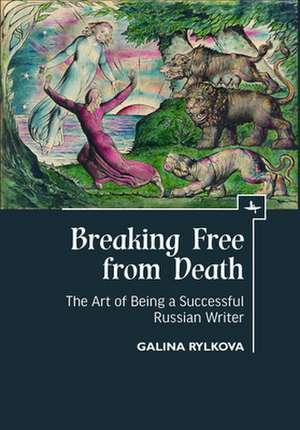
Breaking Free from Death: The Art of Being a Successful Russian Writer
Autor Galina Rylkovaen Limba Engleză Hardback – 10 mar 2020
Breaking Free from Death examines how Russian writers respond to the burden of living with anxieties about their creative outputs, and, ultimately, about their own inevitable finitude. What contributes to creative death are not just crippling diseases that make man defenseless in the face of death, and not just the arguably universal fear of death but, equally important, the innumerable impositions on the part of various outsiders. Many conflicts in the lives of Rylkova’s subjects arose not from their opposition to the existing political regimes but from their interactions with like-minded and supporting intellectuals, friends, and relatives. The book describes the lives and choices that concrete individuals and—by extrapolation—their literary characters must face in order to preserve their singularity and integrity while attempting to achieve fame, greatness, and success.
Preț: 591.43 lei
Preț vechi: 798.88 lei
-26%
Puncte Express: 887
Carte disponibilă
Livrare economică 07-21 noiembrie
Livrare express 27-31 octombrie pentru 97.21 lei
Livrare prin curier în România Termenul estimat este afișat lângă disponibilitate.
Transport gratuit pentru acest produs Plată online sau ramburs, în funcție de opțiunile comenzii.
Retur gratuit în 14 zile Comandă securizată și suport în română.
Specificații
ISBN-13: 9781644692646
ISBN-10: 1644692643
Pagini: 206
Dimensiuni: 156 x 234 x 18 mm
Greutate: 0.47 kg
Editura: Academic Studies Press
Colecția Academic Studies Press
Locul publicării:Boston, MA, United States
ISBN-10: 1644692643
Pagini: 206
Dimensiuni: 156 x 234 x 18 mm
Greutate: 0.47 kg
Editura: Academic Studies Press
Colecția Academic Studies Press
Locul publicării:Boston, MA, United States
Cuprins
Table of Contents
AcknowledgementsPrologue: Breaking Free from Death
Part One: Beginnings and Endings
1. Leo Tolstoy and the Privilege of Formidable Hypochondria
2. In Chertkov’s Grip
3. Uncle Vanya: The Drama of Sustainability
4. “Homo Sachaliensis”: Chekhov’s “Character” as a Strategy
5. The Steppe as a Story of Humble and Spectacular Beginnings
Part Two: Transcending Death
6. Reading Chekhov through Meyerhold’s Eyes
7. Living with Tolstoy and Dying with Chekhov: Ivan Bunin’s Liberation of Tolstoy (1937) and About Chekhov (1953) as Two Modes of Auto/Biographical Writing
8. “There is a way out”: The Cherry Orchard in the Twenty-First Century
9. A Boring Story: Chekhov’s Trip to Germany in 1904
Epilogue: Oyster Fever: Chekhov and Turgenev
Index
Recenzii
"Galina Rylkova’s Breaking Free from Death is a deeply personal study of Chekhov and Tolstoi and their respective legacies. The book is steeped in the author’s intimate knowledge not only of the writers’ fictional writings but also their epistolary heritage. While the book is aimed at a broad audience, specialists in the field will discover many new and intellectually provocative ways to think about these famous Russian writers."
—Denis A. Zhernokleyev, Vanderbilt University, Slavonic and East European Review
“Rylkova’s meticulous study is full of original insights and new interpretations of famous literary works, delivered in a lucid and accessible writing style, with numerous references to primary sources; it is a joy to read. Furthermore, she supplies her readers with a clear road map throughout the book, explaining her next steps and intentions at every turn. Her narrative is thought-provoking even when one disagrees with her. … In general, it is perhaps an ungrateful task to try to disentangle the inner workings of a personality, especially that of genius. However, one can hope to add yet another facet to complement the existing picture. Rylkova’s book, in my view, does just that—and does so with elegance—supplying another jigsaw piece to our understanding of Russian literary giants and their legacy. Only through the resulting multifaceted perspective can we hope for a holistic grasp of the subject, and of human condition in general.”
—Olga Tabachnikova, University of Central Lancashire, Russian Review
“Rylkova provides a great deal of excerpts from letters, diaries, primary texts, and critical and philosophical sources, almost too many, as they sometimes drown out the scholar’s voice. Each chapter in the book might be read independently; they seem to be the products of years of careful reading (and teaching) the beloved texts that the author now assembled and brought under a theoretical umbrella. The theoretical apparatus is eclectic in a good way: from Edward Becker’s Denial of Death to Arthur Schopenhauer, to Edward Said, to the Chinese Book of Changes, to Virginia Wolf’s Art of Biography. All this makes for a satisfying reading, an invitation to reconsider writers’ relationship with mortality and our continuing relationship with them.”
— Lyudmila Parts, Slavic Review
—Denis A. Zhernokleyev, Vanderbilt University, Slavonic and East European Review
“Rylkova’s meticulous study is full of original insights and new interpretations of famous literary works, delivered in a lucid and accessible writing style, with numerous references to primary sources; it is a joy to read. Furthermore, she supplies her readers with a clear road map throughout the book, explaining her next steps and intentions at every turn. Her narrative is thought-provoking even when one disagrees with her. … In general, it is perhaps an ungrateful task to try to disentangle the inner workings of a personality, especially that of genius. However, one can hope to add yet another facet to complement the existing picture. Rylkova’s book, in my view, does just that—and does so with elegance—supplying another jigsaw piece to our understanding of Russian literary giants and their legacy. Only through the resulting multifaceted perspective can we hope for a holistic grasp of the subject, and of human condition in general.”
—Olga Tabachnikova, University of Central Lancashire, Russian Review
“Rylkova provides a great deal of excerpts from letters, diaries, primary texts, and critical and philosophical sources, almost too many, as they sometimes drown out the scholar’s voice. Each chapter in the book might be read independently; they seem to be the products of years of careful reading (and teaching) the beloved texts that the author now assembled and brought under a theoretical umbrella. The theoretical apparatus is eclectic in a good way: from Edward Becker’s Denial of Death to Arthur Schopenhauer, to Edward Said, to the Chinese Book of Changes, to Virginia Wolf’s Art of Biography. All this makes for a satisfying reading, an invitation to reconsider writers’ relationship with mortality and our continuing relationship with them.”
— Lyudmila Parts, Slavic Review