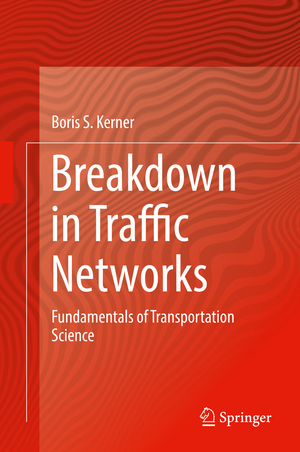
Breakdown in Traffic Networks
Autor Boris S. Kerneren Limba Engleză Hardback – 7 iun 2017
Starting from a large volume of field traffic data collected from various sources obtained solely through measurements in real world traffic, the author develops his insights, with an emphasis less on reviewing existing methodologies, models and theories, and more on providing a detailed analysis of empirical traffic data anddrawing consequences regarding the minimum requirements for any traffic and transportation theories to be valid. The book
- proves the empirical nucleation nature of traffic breakdown in networks
- discusses the origin of the failure of classical traffic and transportation theories
- shows that the three-phase theory is incommensurable with the classical traffic theories, and
- explains why current state-of-the art dynamic traffic assignments tend to provoke heavy traffic congestion,
making it a valuable reference resource for a wide audience of scientists and postgraduate students interested in the fundamental understanding of empirical traffic phenomena and related data-driven phenomenology, as well as for practitioners working in the fields of traffic and transportation engineering.
Preț: 1174.81 lei
Preț vechi: 1432.70 lei
-18%
Puncte Express: 1762
Carte tipărită la comandă
Livrare economică 24 noiembrie-08 decembrie
Livrare prin curier în România Termenul estimat este afișat lângă disponibilitate.
Transport gratuit pentru acest produs Plată online sau ramburs, în funcție de opțiunile comenzii.
Retur gratuit în 14 zile Comandă securizată și suport în română.
Specificații
ISBN-13: 9783662544716
ISBN-10: 3662544717
Pagini: 684
Ilustrații: XXIX, 652 p. 214 illus., 102 illus. in color.
Dimensiuni: 160 x 241 x 42 mm
Greutate: 1.13 kg
Ediția:1st edition 2017
Editura: Springer Berlin, Heidelberg
Locul publicării:Berlin, Heidelberg, Germany
ISBN-10: 3662544717
Pagini: 684
Ilustrații: XXIX, 652 p. 214 illus., 102 illus. in color.
Dimensiuni: 160 x 241 x 42 mm
Greutate: 1.13 kg
Ediția:1st edition 2017
Editura: Springer Berlin, Heidelberg
Locul publicării:Berlin, Heidelberg, Germany
V-ar putea interesa
-
 Behavioural Adaptation and Road Safety: Theory, Evidence and ActionChristina Rudin-Brown-18%Preț: 1261.66 lei1538.60 lei
 -
 High Speed Rail Planning, Policy, and Engineering, Volume ITerry L. Koglin-8%Preț: 394.89 lei429.24 lei
 -
 -8%Preț: 377.06 lei409.85 lei
 -
 Handbook of Railway Engineering and SecurityMarshall Roy-15%Preț: 501.10 lei589.52 lei
 -
 Railway Engineering and SecurityMarshall Roy-18%Preț: 702.71 lei856.96 lei
 -
 Internet of Vehicles - Safe and Intelligent MobilityChing-Hsien Hsu-20%Preț: 345.45 lei431.82 lei
 -
 The Aerodynamics of a Container Freight TrainDavid Soper-18%Preț: 986.75 lei1203.35 lei
 -
 Simulating Urban Traffic ScenariosMichael Behrisch-15%Preț: 663.68 lei780.80 lei
 -
 Rail Transport-Systems ApproachAleksander S¿adkowski-18%Preț: 1163.19 lei1418.52 lei
 -
 The Physics of TrafficBoris S. Kerner-18%Preț: 1170.06 lei1426.91 lei
 -
 -15%Preț: 620.86 lei730.42 lei
 -
 Preț: 121.79 lei
 -
 Train Operation in EmergenciesLimin Jia-15%Preț: 661.73 lei778.50 lei
Cuprins
Introduction. The Reason for Paradigm Shift in Transportation Science.- Achievements of Empirical Studies of Traffic Breakdown at Highway Bottlenecks.- Nucleation Nature of Traffic Breakdown – Empirical Fundamentalof Transportation Science.- Failure of Generally Accepted Classical Traffic Flow Theories.- Theoretical Fundamental of Transportation Science – The Three-Phase Theory.- Effect of Automatic Driving on Probability of Breakdown in Traffic Networks.- Future Automatic Driving based on Three-Phase Theory.- The Reason for Incommensurability of Three-Phase Theory with Classical Traffic Flow Theories.- Time-Delayed Breakdown at Traffic Signal in City Traffic.- Theoretical Fundamental of Transportation Science – Breakdown Minimization (BM) Principle.- Maximization of Network Throughput Ensuring Free Flow Conditions in Network.- Minimization of Traffic Congestion in Networks.- Deterioration of Traffic System through Standard Dynamic Traffic Assignment in Networks.- Discussion of Future Dynamic Traffic Assignment and Control in Networks.- Conclusions and Outlook.- Kerner-Klenov Stochastic Microscopic Model in Framework of Three-Phase Theory.- Kerner-Klenov-Schreckenberg-Wolf (KKSW) Cellular Automaton (CA) Three-Phase Model.- Dynamic Traffic Assignment based on Wardrop’s UE with Step-by-Step Method.- Glossary.- Index.
Textul de pe ultima copertă
This book offers a detailed investigation of breakdowns in traffic and transportation networks. It shows empirically that transitions from free flow to so-called synchronized flow, initiated by local disturbances at network bottlenecks, display a nucleation-type behavior: while small disturbances in free flow decay, larger ones grow further and lead to breakdowns at the bottlenecks. Further, it discusses in detail the significance of this nucleation effect for traffic and transportation theories, and the consequences this has for future automatic driving, traffic control, dynamic traffic assignment, and optimization in traffic and transportation networks.
Starting from a large volume of field traffic data collected from various sources obtained solely through measurements in real world traffic, the author develops his insights, with an emphasis less on reviewing existing methodologies, models and theories, and more on providing a detailed analysis of empirical traffic data and drawing consequences regarding the minimum requirements for any traffic and transportation theories to be valid. The book
- proves the empirical nucleation nature of traffic breakdown in networks
- discusses the origin of the failure of classical traffic and transportation theories
- shows that the three-phase theory is incommensurable with the classical traffic theories, and
- explains why current state-of-the art dynamic traffic assignments tend to provoke heavy traffic congestion,
making it a valuable reference resource for a wide audience of scientists and postgraduate students interested in the fundamental understanding of empirical traffic phenomena and related data-driven phenomenology, as well as for practitioners working in the fields of traffic and transportation engineering.
Starting from a large volume of field traffic data collected from various sources obtained solely through measurements in real world traffic, the author develops his insights, with an emphasis less on reviewing existing methodologies, models and theories, and more on providing a detailed analysis of empirical traffic data and drawing consequences regarding the minimum requirements for any traffic and transportation theories to be valid. The book
- proves the empirical nucleation nature of traffic breakdown in networks
- discusses the origin of the failure of classical traffic and transportation theories
- shows that the three-phase theory is incommensurable with the classical traffic theories, and
- explains why current state-of-the art dynamic traffic assignments tend to provoke heavy traffic congestion,
making it a valuable reference resource for a wide audience of scientists and postgraduate students interested in the fundamental understanding of empirical traffic phenomena and related data-driven phenomenology, as well as for practitioners working in the fields of traffic and transportation engineering.
Notă biografică
Boris S. Kerner was born in Moscow in 1947 and graduated from Moscow Technical University MIREA in 1972. He received the Ph.D. and Sc.D. (Doctor of Sciences) degrees from the Academy of Sciences of the Soviet Union in 1979 and 1986, respectively. Between 1972 and 1992, his major research interests included the physics of semiconductors, plasma and solid-state physics as well as the development of a theory of autosolitons - solitary intrinsic states, which form in a broad class of physical, chemical and biological dissipative systems.
Since 1992, he worked on understanding vehicular traffic at Daimler Company in Stuttgart, Germany. He is the pioneer of the three-phase traffic theory, which he introduced and developed in 1996-2002. Between 2000 and 2013, he was Head of Traffic, a field of research at Daimler. In 2011, he was appointed Professor at the University of Duisburg-Essen in Germany. Since his retirement from Daimler in 2013, Prof. Kernerhas been working at the University of Duisburg-Essen.
He authored more than 260 scientific works and patents as well as five books that are devoted to a variety of physical systems, complex dynamics of traffic flow in traffic and transportation networks, applications of diverse intelligent transportation systems for traffic prognosis, traffic control, dynamic traffic assignment as well as to the study of autonomous and connected vehicles in mixed traffic flow.