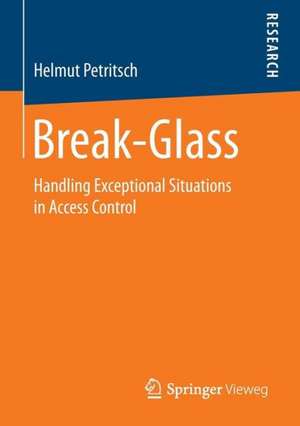
Break-Glass
Autor Helmut Petritschen Limba Engleză Paperback – oct 2014
Preț: 329.66 lei
Preț vechi: 412.08 lei
-20%
Puncte Express: 494
Carte tipărită la comandă
Livrare economică 30 noiembrie-14 decembrie
Livrare prin curier în România Termenul estimat este afișat lângă disponibilitate.
Transport gratuit de la 400.00 lei Plată online sau ramburs, în funcție de opțiunile comenzii.
Retur gratuit în 14 zile Comandă securizată și suport în română.
Specificații
ISBN-13: 9783658073640
ISBN-10: 3658073640
Pagini: 236
Ilustrații: XIII, 220 p. 15 illus.
Dimensiuni: 148 x 210 x 13 mm
Greutate: 0.31 kg
Ediția:2014
Editura: SPRINGER VIEWEG
Locul publicării:Wiesbaden, Germany
ISBN-10: 3658073640
Pagini: 236
Ilustrații: XIII, 220 p. 15 illus.
Dimensiuni: 148 x 210 x 13 mm
Greutate: 0.31 kg
Ediția:2014
Editura: SPRINGER VIEWEG
Locul publicării:Wiesbaden, Germany
V-ar putea interesa
-
 Lean DevopsRobert BenefieldPreț: 314.62 lei
 -
 -20%Preț: 317.35 lei396.68 lei
 -
 Software TestingAli Mili-20%Preț: 879.19 lei1098.99 lei
 -
 Software Project EstimationAlain Abran-20%Preț: 540.39 lei675.49 lei
 -
 Thinking with DataMax Shron-20%Preț: 177.88 lei222.34 lei
 -
 The Art of Application Performance Testing 2eIan Molyneaux-20%Preț: 217.63 lei272.04 lei
 -
 User Story MappingJeff Patton-20%Preț: 207.03 lei258.79 lei
 -
 Ada for Software EngineersMordechai Ben-Ari-20%Preț: 557.53 lei696.91 lei
 -
 Java Methods for Financial EngineeringPhilip Barker-20%Preț: 603.86 lei754.82 lei
 -
 -20%Preț: 315.66 lei394.58 lei
 -
 The Cucumber for Java BookSeb Rose-20%Preț: 219.29 lei274.11 lei
 -
 Successful Test ManagementIris Pinkster-20%Preț: 355.40 lei444.26 lei
 -
 Algorithms and Architectures for Parallel ProcessingAnu G. Bourgeois-20%Preț: 324.22 lei405.27 lei
 -
 Model Driven Engineering and Ontology DevelopmentDragan Ga¿evic-20%Preț: 677.21 lei846.51 lei
 -
 Assurances for Self-Adaptive SystemsJavier Cámara-20%Preț: 337.80 lei422.24 lei
 -
 -20%Preț: 410.80 lei513.50 lei
Public țintă
ResearchCuprins
Introduction.- Background.- A Generic Break-Glass Model.- Policy Definition: Pre-Access.- User Information: At-Access.- Analysis: Post-Access.- Implementation.- Related Work.- Evaluation.- Discussion and Conclusion.
Textul de pe ultima copertă
Helmut Petritsch describes the first holistic approach to Break-Glass which covers the whole life-cycle: from access control modeling (pre-access), to logging the security-relevant system state during Break-Glass accesses (at-access), and the automated analysis of Break-Glass accesses (post-access).
Break-Glass allows users to override security restrictions in exceptional situations. While several Break-Glass models specific to given access control models have already been discussed in research (e.g., extending RBAC with Break-Glass), the author introduces a generic Break-Glass model. The presented model is generic both in the sense that it allows to model existing Break-Glass approaches and that it is independent of the underlying access control model.
Contents
Helmut Petritsch is currently working as developer of enterprise software at a German multinational company.
Break-Glass allows users to override security restrictions in exceptional situations. While several Break-Glass models specific to given access control models have already been discussed in research (e.g., extending RBAC with Break-Glass), the author introduces a generic Break-Glass model. The presented model is generic both in the sense that it allows to model existing Break-Glass approaches and that it is independent of the underlying access control model.
Contents
- Generic Break-Glass model and Break-Glass lifecycle
- Policy definition: pre-access
- User information, recording the system state: at-access
- Analysis: post-access
- Researchers and students in the field of computer science and access control, as well as scholars applying the concept of emergency access, e.g., inmedical care
- Application developers with demanding requirements regarding the access control system, e.g., using XACML; application architects for systems implementing emergency access
Helmut Petritsch is currently working as developer of enterprise software at a German multinational company.
Caracteristici
Publication in the field of technical science Includes supplementary material: sn.pub/extras