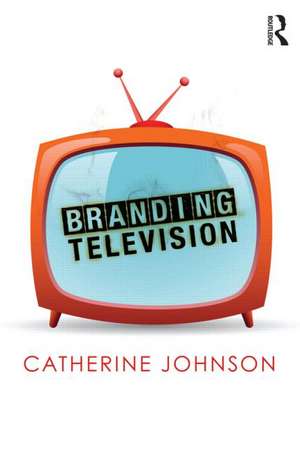
Branding Television: Comedia
Autor Catherine Johnsonen Limba Engleză Paperback – 20 oct 2011
This is the first book to offer a sustained critical analysis of this new cultural development. Branding Television examines the industrial, regulatory and technological changes since the 1980s in the UK and the USA that have led to the adoption of branding as broadcasters have attempted to manage the behaviour of viewers and the values associated with their channels, services and programmes in a world of increased choice and interactivity. Wide-ranging case studies drawn from commercial, public service, network and cable/satellite television (from NBC and HBO to MTV, and from BBC and Channel 4 to UKTV and Sky) analyse the role of marketing and design in branding channels and corporations, and the development of programmes as brands.
Exploring both successful and controversial uses of branding, this book asks what problems there are in creating television brands and whether branding supports or undermines commercial and public service broadcasting.
Branding Television extends and complicates our understanding of the changes to television over the past 30 years and of the role of branding in contemporary Western culture. It will be of particular interest to students and researchers in television studies, but also in creative industries and media and cultural studies more generally.
Din seria Comedia
-
 Preț: 342.47 lei
 -
 Preț: 410.31 lei
 -
 Preț: 398.58 lei
 -
 Preț: 437.63 lei
 -
 Preț: 382.61 lei
 -
 Preț: 396.27 lei
 -
 Preț: 404.77 lei
 -
 Preț: 404.35 lei
 -
 Preț: 418.54 lei
 -
 Preț: 386.46 lei
 -
 Preț: 492.64 lei
 -
 Preț: 390.91 lei
 -
 Preț: 400.95 lei
 -
 Preț: 401.80 lei
 - 18%
 Preț: 1131.79 lei
 -
 Preț: 415.00 lei
 - 18%
 Preț: 1256.55 lei
 -
 Preț: 380.39 lei
 -
 Preț: 395.84 lei
 -
 Preț: 400.95 lei
 -
 Preț: 432.41 lei
 - 18%
 Preț: 1118.66 lei
 -
 Preț: 400.95 lei
 -
 Preț: 264.61 lei
 -
 Preț: 394.27 lei
 -
 Preț: 368.05 lei
 -
 Preț: 423.78 lei
 -
 Preț: 498.66 lei
 -
 Preț: 398.40 lei
Preț: 419.10 lei
Puncte Express: 629
Carte tipărită la comandă
Livrare economică 26 noiembrie-10 decembrie
Livrare prin curier în România Termenul estimat este afișat lângă disponibilitate.
Transport gratuit pentru acest produs Plată online sau ramburs, în funcție de opțiunile comenzii.
Retur gratuit în 14 zile Comandă securizată și suport în română.
Specificații
ISBN-13: 9780415548434
ISBN-10: 0415548438
Pagini: 224
Ilustrații: 3 tables
Dimensiuni: 156 x 234 x 18 mm
Greutate: 0.36 kg
Ediția:1
Editura: Taylor & Francis
Colecția Routledge
Seria Comedia
Locul publicării:Oxford, United Kingdom
ISBN-10: 0415548438
Pagini: 224
Ilustrații: 3 tables
Dimensiuni: 156 x 234 x 18 mm
Greutate: 0.36 kg
Ediția:1
Editura: Taylor & Francis
Colecția Routledge
Seria Comedia
Locul publicării:Oxford, United Kingdom
V-ar putea interesa
-
 -25%Preț: 208.80 lei280.21 lei
 -
 The Oxford Handbook of Dance and the Popular ScreenMelissa Blanco Borelli-14%Preț: 1049.52 lei1220.37 lei
 -
 Lady in the Dark – Iris Barry and the Art of FilmRobert SittonPreț: 374.20 lei
 -
 Cinema and NationMette HjortPreț: 427.25 lei
 -
 British Cinema, Past and PresentJustine AshbyPreț: 389.82 lei
 -
 The Matter of Images: Essays on RepresentationsRichard DyerPreț: 392.02 lei
 -
 Preț: 392.02 lei
 -
 Signatures of the VisibleFredric JamesonPreț: 191.35 lei
 -
 Philosophy and FilmCynthia A. FreelandPreț: 486.25 lei
 -
 The Curious Tale of the Lady CarabooCatherine Johnson-18%Preț: 46.66 lei57.11 lei
 -
 Shadow SyndromesJohn J. RateyPreț: 119.18 lei
 -
 Blade and BoneCatherine JohnsonPreț: 64.66 lei
 -
 Picture ThisMolly Bang-14%Preț: 120.66 lei139.76 lei
Public țintă
UndergraduateCuprins
Introduction: ‘But Television’s Not Soap!’: Theories and histories of branding and television Part I: Branding and the US Television Industry Chapter 1. The Age of Brand Marketing: US network television enters the digital era Chapter 2. It’s Not TV, It’s HBO!’: Branding US pay-TV Chapter 3. The End of Public Service Broadcasting?: Branding and UK television in the digital era Part II: Branding and the UK Television Industry Chapter 4. All the 4s: Branding Commercial UK Public Service Broadcasting Chapter 5. Of Logos and Idents: Branding interstitial space Part III: The Texts and Intertexts of Branding Chapter 6. Programme Brands Chapter 7. Negotiating, Contesting and Managing the Brand
Recenzii
'Much more than joining a conversation, Johnson's (2001) research is starting it, making a case for a field of scholarly inquiry largely ignored thus far by television studies. Branding Television provides a solid theoretical foundation for further research, and one that fills in a gap within the breadth of work on television's industrial and economic development over the past several decades.' Darcey West Morris, Critical Studies in Television
'Catherine Johnson's book Branding Television contributes to television studies by describing, explaining, and illustrating why and how television industries have turned to branding as a response to changes in technology....The book draws on a rich and detailed knowledge of both British and American television industries during this period.....' Alison Payne, NECSUS: European Journal of Media Studies
'Branding Television analyzes different strategies from channel branding to quality schedule branding, from relationship branding to service branding and to programme branding in the UK and US landscape...a value of this present book is the plenitude of case studies: from different broadcasts of two different nations and addressing both commercial and public services...to compare corporate, channel/service and a program's brand as interrelated elements allows [us] to consider television as a cultural form and to understand its evolution from a different perspective.' Deborah Toschi, Cinema&Cie
'Catherine Johnson's book Branding Television contributes to television studies by describing, explaining, and illustrating why and how television industries have turned to branding as a response to changes in technology....The book draws on a rich and detailed knowledge of both British and American television industries during this period.....' Alison Payne, NECSUS: European Journal of Media Studies
'Branding Television analyzes different strategies from channel branding to quality schedule branding, from relationship branding to service branding and to programme branding in the UK and US landscape...a value of this present book is the plenitude of case studies: from different broadcasts of two different nations and addressing both commercial and public services...to compare corporate, channel/service and a program's brand as interrelated elements allows [us] to consider television as a cultural form and to understand its evolution from a different perspective.' Deborah Toschi, Cinema&Cie
Descriere
Branding Television considers the broader context of new digital media, including an examination of the extension of television on to new media such as the internet and mobile phones.