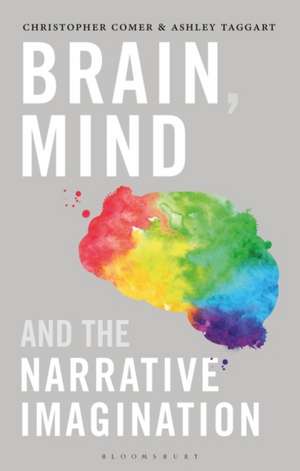
Brain, Mind, and the Narrative Imagination
Autor Professor Christopher Comer, Dr Ashley Taggarten Limba Engleză Paperback – 25 feb 2021
Rapid advances in the scientific understanding of the brain have cast new light on how we engage with literature. This book - collaboratively written by an experienced neuroscientist and literary critic and writer - explores these new insights. Key concepts in neuroscience are first introduced for non-specialists and a range of literary texts by writers such as Ian McEwan, Jim Crace and E.L. Doctorow are read in light of the latest scientific thought on the workings of the mind and brain. Brain, Mind, and the Narrative Imagination demonstrates how literature taps into deep structures of memory and emotion that lie at the heart of our humanity. It will be of interest to readers of all sorts and students from both the humanities and the sciences.
Preț: 147.79 lei
Preț vechi: 188.29 lei
-22%
Puncte Express: 222
Carte tipărită la comandă
Livrare economică 28 noiembrie-12 decembrie
Livrare express 27-31 octombrie pentru 72.57 lei
Livrare prin curier în România Termenul estimat este afișat lângă disponibilitate.
Transport gratuit de la 400.00 lei Plată online sau ramburs, în funcție de opțiunile comenzii.
Retur gratuit în 14 zile Comandă securizată și suport în română.
Specificații
ISBN-13: 9781350127791
ISBN-10: 1350127795
Pagini: 304
Ilustrații: 28 bw illus
Dimensiuni: 156 x 234 x 18 mm
Greutate: 0.48 kg
Editura: Bloomsbury Publishing
Colecția Bloomsbury Academic
Locul publicării:London, United Kingdom
ISBN-10: 1350127795
Pagini: 304
Ilustrații: 28 bw illus
Dimensiuni: 156 x 234 x 18 mm
Greutate: 0.48 kg
Editura: Bloomsbury Publishing
Colecția Bloomsbury Academic
Locul publicării:London, United Kingdom
Cuprins
List of Figures
Preface
Acknowledgments
Introduction Back to the Future
PART I: Motivations to Explore Our Storied Mind
Chapter 1 The Scheherazade Syndrome
Chapter 2 Orchestrating the Imagination
PART II: Into the Neural Terrain
Chapter 3 Brain and Behavior
Chapter 4 Deep Substrates of Narrative Imagination
PART III: The Journey from Words to Narratives
Chapter 5 Compelled by Words
Chapter 6 The Cognitive Habitat of Narratives
PART IV: Converging Paths?
Chapter 7 Affective Cognition and Sociality
Chapter 8 The Feeling of What Happened
Chapter 9 Memory, Imagination, Self
Chapter 10 The via dolorosa of the Self
Afterword
References Cited
Index
Preface
Acknowledgments
Introduction Back to the Future
PART I: Motivations to Explore Our Storied Mind
Chapter 1 The Scheherazade Syndrome
Chapter 2 Orchestrating the Imagination
PART II: Into the Neural Terrain
Chapter 3 Brain and Behavior
Chapter 4 Deep Substrates of Narrative Imagination
PART III: The Journey from Words to Narratives
Chapter 5 Compelled by Words
Chapter 6 The Cognitive Habitat of Narratives
PART IV: Converging Paths?
Chapter 7 Affective Cognition and Sociality
Chapter 8 The Feeling of What Happened
Chapter 9 Memory, Imagination, Self
Chapter 10 The via dolorosa of the Self
Afterword
References Cited
Index
Recenzii
It is easy to get lost in the narrative of this book, only to remember how meta the experience is. This accessible book will interest readers in the sciences as well as the humanities.
I have always thought that studies of the brain conducted by neuroscientists had nothing to tell us about the literary imagination and the process of interpretation. After reading Christopher Comer and Ashley Taggart's new book, I find my mind completely changed. Drawing on multiple disciplines on both sides of the aisle, the authors amply demonstrate that by exploring the master category of narrative our understanding of both the brain as a physical mechanism and of literature as a resource for living can be greatly enhanced. A notable achievement!
This book is an essential read, since it offers eloquent debate around story-telling, what it has to tell us about the brain, and thence about ourselves.
Of the works I am aware of, [Brain, Mind and the Narrative Imagination] provides the clearest, most thorough, and fairest treatment of neurocognitive literary study today.
I have always thought that studies of the brain conducted by neuroscientists had nothing to tell us about the literary imagination and the process of interpretation. After reading Christopher Comer and Ashley Taggart's new book, I find my mind completely changed. Drawing on multiple disciplines on both sides of the aisle, the authors amply demonstrate that by exploring the master category of narrative our understanding of both the brain as a physical mechanism and of literature as a resource for living can be greatly enhanced. A notable achievement!
This book is an essential read, since it offers eloquent debate around story-telling, what it has to tell us about the brain, and thence about ourselves.
Of the works I am aware of, [Brain, Mind and the Narrative Imagination] provides the clearest, most thorough, and fairest treatment of neurocognitive literary study today.
Notă biografică
Christopher Comer is Professor of Neuroscience at the University of Montana, USA.