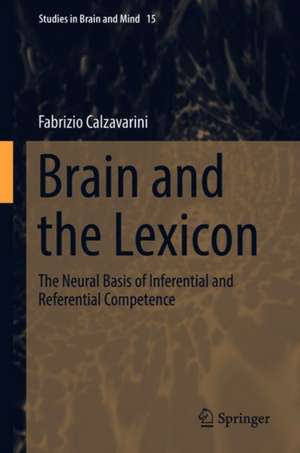
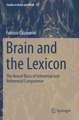
Brain and the Lexicon: Studies in Brain and Mind, cartea 15
Autor Fabrizio Calzavarinien Limba Engleză Hardback – 9 ian 2020
Din seria Studies in Brain and Mind
-
 Preț: 402.89 lei
 - 15%
 Preț: 669.66 lei
 - 15%
 Preț: 605.68 lei
 - 24%
 Preț: 750.65 lei
 - 15%
 Preț: 724.99 lei
 - 18%
 Preț: 762.05 lei
 - 15%
 Preț: 642.59 lei
 - 15%
 Preț: 666.74 lei
 -
 Preț: 402.76 lei
 - 20%
 Preț: 605.88 lei
 - 15%
 Preț: 558.73 lei
 - 18%
 Preț: 826.84 lei
 - 18%
 Preț: 750.68 lei
 - 15%
 Preț: 664.01 lei
 - 15%
 Preț: 694.98 lei
 - 24%
 Preț: 625.29 lei
 - 18%
 Preț: 754.69 lei
 - 15%
 Preț: 629.50 lei
 - 18%
 Preț: 1153.45 lei
 - 15%
 Preț: 664.14 lei
 - 15%
 Preț: 679.04 lei
 -
 Preț: 405.36 lei
 -
 Preț: 407.91 lei
 -
 Preț: 407.91 lei
Preț: 642.86 lei
Preț vechi: 803.57 lei
-20%
Puncte Express: 964
Carte tipărită la comandă
Livrare economică 02-08 decembrie
Livrare prin curier în România Termenul estimat este afișat lângă disponibilitate.
Transport gratuit pentru acest produs Plată online sau ramburs, în funcție de opțiunile comenzii.
Retur gratuit în 14 zile Comandă securizată și suport în română.
Specificații
ISBN-13: 9783030275877
ISBN-10: 3030275876
Pagini: 228
Ilustrații: IX, 215 p. 32 illus., 20 illus. in color.
Dimensiuni: 160 x 241 x 18 mm
Greutate: 0.5 kg
Ediția:1st ed. 2019
Editura: Springer
Colecția Studies in Brain and Mind
Seria Studies in Brain and Mind
Locul publicării:Cham, Switzerland
ISBN-10: 3030275876
Pagini: 228
Ilustrații: IX, 215 p. 32 illus., 20 illus. in color.
Dimensiuni: 160 x 241 x 18 mm
Greutate: 0.5 kg
Ediția:1st ed. 2019
Editura: Springer
Colecția Studies in Brain and Mind
Seria Studies in Brain and Mind
Locul publicării:Cham, Switzerland
Cuprins
Chapter 1. Formal semantics and the problem of word meaning.- Chapter 2. The structure of inferential competence.- Chapter 3. The structure of referential competence.- Chapter 4. Functional dissociation.- Chapter 5. Anatomical dissociation.- Chapter 6. The neural substrates of inferential and referential competence.- Chapter 7. Inferential and referential competence and the Embodied Framework.- Chapter 8. Dual pictures of semantic cognition?.- Chapter 9 Conclusions.
Notă biografică
Fabrizio Calzavarini is a Post doc Researcher at University of Bergamo, Italy, and is affiliated at with the Center for Logic, Language, and Cognition, Turin, Italy. His research is organized into two interrelated streams. One stream falls at the intersection between the philosophy and neuroscience of semantics, focusing on the neural substrates of lexical competence. The other stream addresses philosophical issues in neuroscience more generally. He is the co-organizer of Neural Mechanisms Online, a series of webinars and web-conferences in the philosophy of neuroscience.
Textul de pe ultima copertă
This monograph offers a novel, neurocognitive theory concerning words and language. It explores the distinction between inferential and referential semantic competence. The former accounts for the relationship of words among themselves, the latter for the relationship of words to the world. The author discusses this distinction at the level of the human brain on both theoretical and neuroscientific grounds. In addition, this investigation considers the relation between the inf/ref neurocognitive theory and other accounts of semantic cognition proposed in the field of neurosemantics, as well as some potential implications of the theory for clinical neuroscience and the philosophy of semantics. Overall, the book offers an important contribution to the debate about lexical semantic competence. It combines a strong philosophical and linguistic background with a comprehensive and critical analysis of neurosemantic literature. Topics discussed lie at the intersection of philosophical semantics, linguistics, neurolinguistics, cognitive science, artificial intelligence, cognitive neuroscience, and clinical psychology. Due to its interdisciplinary orientation, coverage is rich in introductory remarks and not overly technical, therefore it is accessible to non-experts as well.