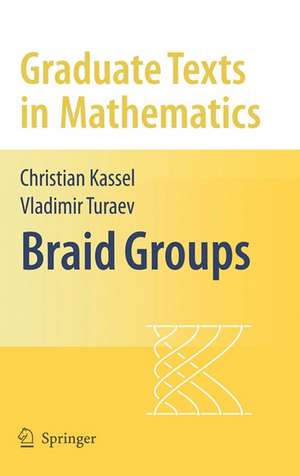
Braid Groups
Autor Christian Kassel, Vladimir Turaeven Limba Engleză Hardback – 5 aug 2008
Găsim în Braid Groups o abordare riguroasă și extrem de bine structurată a unui subiect care a revoluționat topologia în ultimele două decenii. Notăm cu interes faptul că autorii încep expunerea prin numeroase exemple și probleme, facilitând tranziția de la intuiția geometrică la formalismul algebric. Această componentă practică transformă volumul într-un instrument de lucru activ pentru studenții de la nivel masteral sau doctoral, oferind o bază solidă înainte de a trece la concepte avansate. Reținem organizarea progresivă a materialului: primele capitole stabilesc echivalența definițiilor de bază și relația fundamentală dintre funii, noduri și legături. Ulterior, Christian Kassel și Vladimir Turaev ghidează cititorul spre subiecte de o complexitate sporită, precum reprezentările omologice, algebrele Iwahori-Hecke și monoidul Garside. Un punct forte al acestei ediții îl reprezintă cele cinci apendice generoase, care completează textul principal cu detalii tehnice despre seturile de auto-distributivitate la stânga și algebrele Birman-Murakami-Wenzl. Alternativă la A Study of Braids de Kunio Murasugi pentru cursurile de algebră și topologie, această lucrare are avantajul de a integra progresele recente care au dus la nașterea topologiei cuantice. În timp ce volumul lui Murasugi se concentrează pe omotopie și invarianți Milnor, textul de față oferă o perspectivă mai largă asupra liniarității și ordonabilității grupurilor de funii, fiind esențial pentru înțelegerea conexiunilor cu fizica matematică. Stilul este precis, cu demonstrații detaliate și clare, confirmând reputația editurii Springer în literatura matematică academică.
Preț: 613.54 lei
Preț vechi: 721.81 lei
-15%
Carte tipărită la comandă
Livrare economică 30 noiembrie-14 decembrie
Livrare express 24-30 octombrie pentru 57.59 lei
Specificații
ISBN-10: 0387338411
Pagini: 338
Ilustrații: X, 338 p. 60 illus.
Dimensiuni: 164 x 245 x 23 mm
Greutate: 0.63 kg
Ediția:2008 edition
Editura: Springer
Locul publicării:New York, NY, United States
V-ar putea interesa
-
 Linear Algebraic GroupsJames E. Humphreys-15%Preț: 551.21 lei648.48 lei
 -
 Introduction to Affine Group SchemesW. C. Waterhouse-15%Preț: 601.64 lei707.81 lei
 -
 Cohomology of GroupsKenneth S. Brown-15%Preț: 554.07 lei651.85 lei
 -
 Quantum GroupsChristian Kassel-15%Preț: 680.17 lei800.20 lei
 -
 The Maple® O.D.E. Lab BookDarren Redfern-15%Preț: 554.19 lei651.99 lei
 -
 Finite Reflection GroupsL. C. Grove-15%Preț: 487.45 lei573.47 lei
 -
 Algebraic Groups and Class FieldsJean Pierre Serre-15%Preț: 656.51 lei772.36 lei
 -
 Gröbner BasesThomas Becker-15%Preț: 683.01 lei803.53 lei
 -
 Galois TheoryJoseph RotmanPreț: 482.65 lei
 -
 BuildingsKenneth S. Brown-15%Preț: 665.89 lei783.39 lei
 -
 Semigroups: An Introduction to the Structure TheoryPierre A. Grillet-18%Preț: 2262.74 lei2759.44 lei
 -
 Word Processing in GroupsDavid B.A. Epstein-18%Preț: 1467.72 lei1789.90 lei
 -
 Collected PapersWilhelm Magnus-15%Preț: 497.52 lei585.33 lei
 -
 -26%Preț: 622.19 lei841.90 lei
 -
 Monoidal Categories and Topological Field TheoryVladimir Turaev-18%Preț: 1166.99 lei1423.15 lei
 -
 -15%Preț: 617.72 lei726.72 lei
 -
 Algebra IV: Infinite Groups. Linear GroupsA.I. Kostrikin-15%Preț: 618.03 lei727.08 lei
 -
 Introduction to Combinatorial TorsionsVladimir TuraevPreț: 415.35 lei
 -
 Torsions of 3-dimensional ManifoldsVladimir TuraevPreț: 403.54 lei
Public țintă
GraduateDe ce să citești această carte
Recomandăm această carte oricărui matematician care dorește să stăpânească teoria grupurilor de funii. Cititorul câștigă o înțelegere profundă a echivalențelor structurale și a aplicațiilor în topologia 3D. Este o resursă esențială pentru cercetarea în topologie cuantică, oferind un echilibru rar între rigoarea teoretică și exercițiile aplicate, totul într-un format accesibil nivelului academic de master.
Despre autor
Christian Kassel este un matematician francez de renume, director de cercetare la CNRS, cunoscut pentru contribuțiile sale în algebra cuantică și teoria grupurilor. Vladimir Turaev este un specialist de talie mondială în topologie, profesor la Indiana University, fiind cel care a introdus concepte fundamentale precum invarianții Turaev-Viro în topologia 3D. Împreună, cei doi autori îmbină expertiza în algebră și topologie pentru a oferi o viziune unitară asupra grupurilor de funii, transformând acest volum într-o referință standard pentru comunitatea matematică internațională.
Descriere scurtă
In this well-written presentation, motivated by numerous examples and problems, the authors introduce the basic theory of braid groups, highlighting several definitions that show their equivalence; this is followed by a treatment of the relationship between braids, knots and links. Important results then treat the linearity and orderability of the subject. Relevant additional material is included in five large appendices.
Braid Groups will serve graduate students and a number of mathematicians coming from diverse disciplines.
Cuprins
Recenzii
"Details on … braid groups are carefully provided by Kassel and Turaev’s text Braid Groups. … Braid Groups is very well written. The proofs are detailed, clear, and complete. ... The text is to be praised for its level of detail. … For people … who want to understand current research in braid group related areas, Braid Groups is an excellent, in fact indispensable, text." (Scott Taylor, The Mathematical Association of America, October, 2008)
"This is a very useful, carefully written book that will bring the reader up to date with some of the recent important advances in the study of the braid groups and their generalizations. It continues the tradition of these high quality graduate texts in mathematics. The book could easily be used as a text for a year course on braid groups for graduate students, one advantage being that the chapters are largely independent of each other." (Stephen P. Humphries, Mathematical Reviews, Issue 2009 e)
“This book is a comprehensive introduction to the theory of braid groups. Assuming only a basic knowledge of topology and algebra, it is intended mainly for graduate and postdoctoral students.” (Hirokazu Nishimura, Zentralblatt MATH, Vol. 1208, 2011)
“The book of Kassel and Turaev is a textbook … for graduate students and researchers. As such, it covers the basic material on braids, knots, and links … at a level which requires minimal background, yet moves rapidly to non-trivial topics. … It is a carefully planned and well-written book; the authors are true experts, and it fills a gap. … it will have many readers.” (Joan S. Birman, Bulletin of the American Mathematical Society, Vol. 48 (1), January, 2011)
Notă biografică
Dr. Vladimir Turaev was also a professor at the CNRS and is currently at Indiana University in the Department of Mathematics.
Textul de pe ultima copertă
In this presentation the authors thoroughly examine various aspects of the theory of braids, starting from basic definitions and then moving to more recent results. The advanced topics cover the Burau and the Lawrence--Krammer--Bigelow representations of the braid groups, the Alexander--Conway and Jones link polynomials, connections with the representation theory of the Iwahori--Hecke algebras, and the Garside structure and orderability of the braid groups.
This book will serve graduate students, mathematicians, and theoretical physicists interested in low-dimensional topology and its connections with representation theory.