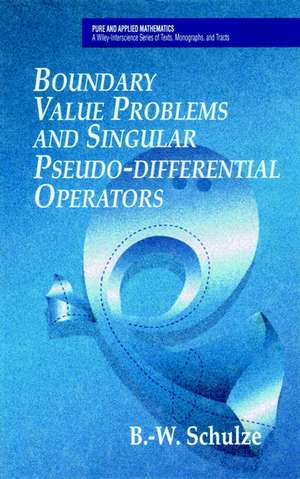
Boundary Value Problems and Singular Pseudo-Differential Operators
Autor Bert-Wolfgang Schulzeen Limba Engleză Hardback – 11 feb 1998
Preț: 1989.36 lei
Preț vechi: 2186.11 lei
-9%
Puncte Express: 2984
Carte tipărită la comandă
Livrare economică 03-17 decembrie
Livrare prin curier în România Termenul estimat este afișat lângă disponibilitate.
Transport gratuit pentru acest produs Plată online sau ramburs, în funcție de opțiunile comenzii.
Retur gratuit în 14 zile Comandă securizată și suport în română.
Specificații
ISBN-13: 9780471975571
ISBN-10: 0471975575
Pagini: 656
Dimensiuni: 161 x 240 x 39 mm
Greutate: 1.14 kg
Editura: Wiley
Locul publicării:Chichester, United Kingdom
ISBN-10: 0471975575
Pagini: 656
Dimensiuni: 161 x 240 x 39 mm
Greutate: 1.14 kg
Editura: Wiley
Locul publicării:Chichester, United Kingdom
V-ar putea interesa
-
 The Factorization Method for Inverse ProblemsAndreas Kirsch-31%Preț: 741.52 lei1071.43 lei
 -
 Theory and Practice of Finite ElementsAlexandre Ern-18%Preț: 768.11 lei936.72 lei
 -
 An Introduction to Ordinary Differential EquationsRavi P. Agarwal-15%Preț: 531.96 lei625.83 lei
 -
 -15%Preț: 532.08 lei625.97 lei
 -
 -11%Preț: 446.62 lei501.82 lei
 -
 Introduction to Partial Differential Equations with MATLABJeffery M. Cooper-17%Preț: 490.75 lei591.27 lei
 -
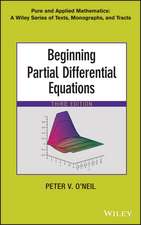 -27%Preț: 703.98 lei964.37 lei
 -
 Preț: 262.24 lei
 -
 Extremes and Recurrence in Dynamical SystemsValerio Lucarini-9%Preț: 721.06 lei792.37 lei
 -
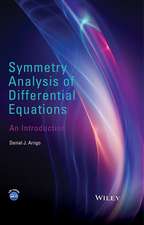 -23%Preț: 613.10 lei796.23 lei
 -
 Differential Equations and Mathematical BiologyD. S. Jones-18%Preț: 733.23 lei894.18 lei
 -
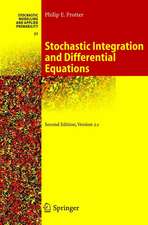 Stochastic Integration and Differential EquationsPhilip Protter-18%Preț: 766.34 lei934.56 lei
 -
 Stochastic Differential EquationsBernt Øksendal-17%Preț: 399.28 lei481.06 lei
 -
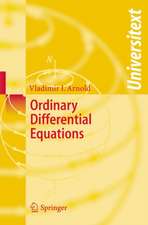 Ordinary Differential EquationsVladimir I. Arnold-17%Preț: 525.45 lei633.08 lei
Public țintă
Researchers in Mathematics, Physics, and Engineering.Notă biografică
Bert-Wolfgang Schulze is the author of Boundary Value Problems and Singular Pseudo-Differential Operators, published by Wiley.
Descriere
This book covers the analysis of pseudo-differential operators on manifolds with conical points and edges. The standard singular integral operators on the half-axis as well as boundary value problems on smooth manifolds are treated as particular cone and wedge theories.