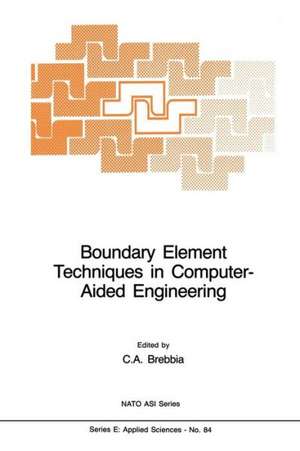
Boundary Element Techniques in Computer-Aided Engineering: NATO Science Series E:, cartea 84
Editat de C. A. Brebbiaen Limba Engleză Paperback – 12 oct 2011
Din seria NATO Science Series E:
- 18%
 Preț: 983.83 lei
 - 18%
 Preț: 1905.37 lei
 -
 Preț: 374.84 lei
 -
 Preț: 386.34 lei
 - 20%
 Preț: 349.72 lei
 -
 Preț: 408.17 lei
 - 18%
 Preț: 1262.17 lei
 - 18%
 Preț: 1895.10 lei
 - 18%
 Preț: 1758.89 lei
 - 18%
 Preț: 1267.94 lei
 -
 Preț: 368.86 lei
 -
 Preț: 393.75 lei
 - 18%
 Preț: 1898.69 lei
 - 18%
 Preț: 1761.90 lei
 - 5%
 Preț: 355.87 lei
 -
 Preț: 391.71 lei
 -
 Preț: 412.56 lei
 -
 Preț: 388.01 lei
 -
 Preț: 387.28 lei
 - 18%
 Preț: 3138.09 lei
 -
 Preț: 377.01 lei
 - 5%
 Preț: 376.18 lei
 - 18%
 Preț: 1267.94 lei
 - 18%
 Preț: 1268.37 lei
 - 18%
 Preț: 1273.50 lei
 - 5%
 Preț: 3393.87 lei
 - 18%
 Preț: 1898.48 lei
 - 5%
 Preț: 367.92 lei
 - 18%
 Preț: 1266.27 lei
 -
 Preț: 382.33 lei
 -
 Preț: 384.16 lei
 - 18%
 Preț: 2569.38 lei
 - 5%
 Preț: 1474.32 lei
 -
 Preț: 384.40 lei
 - 5%
 Preț: 2211.40 lei
 - 18%
 Preț: 1903.71 lei
 -
 Preț: 388.20 lei
 -
 Preț: 398.39 lei
 -
 Preț: 402.06 lei
 - 20%
 Preț: 331.65 lei
 - 18%
 Preț: 979.10 lei
 - 18%
 Preț: 1268.99 lei
 - 20%
 Preț: 1974.01 lei
 - 20%
 Preț: 2105.96 lei
Preț: 1229.76 lei
Preț vechi: 1499.71 lei
-18%
Puncte Express: 1845
Carte tipărită la comandă
Livrare economică 27 noiembrie-11 decembrie
Livrare prin curier în România Termenul estimat este afișat lângă disponibilitate.
Transport gratuit pentru acest produs Plată online sau ramburs, în funcție de opțiunile comenzii.
Retur gratuit în 14 zile Comandă securizată și suport în română.
Specificații
ISBN-13: 9789400961944
ISBN-10: 9400961944
Pagini: 456
Ilustrații: XII, 440 p.
Dimensiuni: 155 x 235 x 25 mm
Greutate: 0.69 kg
Ediția:Softcover reprint of the original 1st ed. 1984
Editura: Springer
Colecția NATO Science Series E:
Seria NATO Science Series E:
Locul publicării:Dordrecht, Netherlands
ISBN-10: 9400961944
Pagini: 456
Ilustrații: XII, 440 p.
Dimensiuni: 155 x 235 x 25 mm
Greutate: 0.69 kg
Ediția:Softcover reprint of the original 1st ed. 1984
Editura: Springer
Colecția NATO Science Series E:
Seria NATO Science Series E:
Locul publicării:Dordrecht, Netherlands
V-ar putea interesa
-
 Collins Easy Learning Age 7-11 -- Multiplication and Division Ages 7-9: New EditionCollins Easy LearningPreț: 31.04 lei
 -
 Collins Easy Learning Age 5-7 -- Multiplication and Division Ages 5-7: New EditionCollins Easy LearningPreț: 31.20 lei
 -
 Fractions Ages 5-7Collins Easy LearningPreț: 30.88 lei
 -
 Fractions and Decimals Ages 7-9Collins Easy LearningPreț: 30.86 lei
 -
 Problems in Algebraic Number TheoryM. Ram Murty-15%Preț: 606.77 lei713.85 lei
 -
 Introduction to Analytic Number TheoryTom M. ApostolPreț: 417.04 lei
 -
 Additive Number Theory The Classical BasesMelvyn B. Nathanson-18%Preț: 921.66 lei1123.97 lei
 -
 Elementary Number Theory with ProgrammingMarty Lewinter-23%Preț: 584.94 lei759.66 lei
 -
 Transcendental NumbersM. Ram Murty-15%Preț: 470.47 lei553.50 lei
 -
 Right-Brained Addition & SubtractionSarah MajorPreț: 291.00 lei
 -
 The Problem of CatalanYuri F. BiluPreț: 406.64 lei
 -
 Probabilistic Diophantine ApproximationJózsef Beck-15%Preț: 680.99 lei801.16 lei
 -
 Topics in Algebra and AnalysisRadmila Bulajich ManfrinoPreț: 461.56 lei
 -
 Preț: 299.82 lei
Public țintă
ResearchCuprins
1. Weighted Residual Formulation of Approximate Methods.- 1.1. Introduction.- 1.2. Basic Definition.- 1.3. Approximate Solutions.- 1.4. Method of Weighted Residuals.- 1.5. Weak Formulations.- 1.6. The Inverse Problem.- 1.7. Conclusions.- References.- 2. Boundary Element Methods.- 2.1. Fundamentals of Functional Analysis.- 2.2. Generalized Green’s Formula.- 2.3. Variational Formulation.- 2.4. Weighted Residual Scheme.- 2.5. Boundary Element Formulation of Poisson’s Equation.- 2.6. Fundamental Solutions.- 2.7. Boundary Discretisation and Systems Equations.- 2.8. Computation of Integrals — 2D case.- 3. Boundary Integral Equations.- 3.1. Simple-layer Formulations.- 3.2. Double-layer Formulations.- 3.3. Direct Formulations.- 3.4. Indirect Vector Formulations.- 3.5. Direct Formulations.- References.- 4. Scalar and Vector Potential Theory.- 4.1. The Simple-layer Potential.- 4.2. The Double-layer Potential.- 4.3. Green’s Formula.- 4.4. Identification of Scalar and Vector Symbolism.- 4.5. Somigliana’s Identity.- 4.6. Rigid-body Displacement Field.- References.- 5. Potential Problems in Two Dimensions.- 5.1. Introduction.- 5.2. Flow past an Obstacle.- 5.3. Discretisation.- 5.4. Green’s Boundary Formula.- 5.5. Applications.- 5.6. Boundary Singularities.- 5.7. Composite Domains.- 5.8. Conclusion.- References.- 6. Three-dimensional Axisymmetrical Potential Problems.- 6.1. Introduction.- 6.2. The Newtonian Potential.- 6.3. Discretisation.- 6.4. General Domain.- 6.5. Axisymmetric Problems.- 6.6. Conclusion.- References.- 7. Heat Transfer Applications.- 7.1. Introduction.- 7.2. Integral Equations associated with Steady Heat Conduction Problems.- 7.3. Numerical Solution of the Integral Equations.- 7.4. Poisson’s Equation.- 7.5. Non-homogeneous Bodies; Method ofSubregions.- 7.6. Anisotropic Bodies.- References.- 8. Numerical Integration and other Computational Techniques.- 8.1. Introduction.- 8.2. Isoparametric Elements.- 8.3. Numerical Integration.- References.- 9. Starting to work with Boundary Elements.- 9.1. Introduction.- 9.2. The Boundary Element Method.- 9.3. Advantages and Disadvantages of the BEM compared to FEM.- 9.4. Introduction to BEASY.- 9.5. Examples.- 9.6. Conclusions.- References.- 10. Experiences in Boundary Element Applications.- 10.1. Introduction.- 10.2. Pre- and Post Processing.- 10.3. C.A.D. Coupling.- 10.4. Installation on Different Computers.- 10.5. Recommendations for BEM use.- 11. Electrostatics Problems.- 11.1. Introduction.- 11.2. Theoretical Basis.- 11.3. Boundary Elements.- 11.4. Applications.- 11.5. Conclusions.- References.- 12. A Boundary Element Solution of the Wave Equation.- 12.1. Introduction.- 12.2. Theoretical Development.- 12.3. Boundary Conditions.- 12.4. Numerical Implementation.- 12.5. Velocities and Pressures.- 12.6. Identification of Areas in Shadow.- 12.7. Test Example.- 12.8. Conclusions.- References.- 13. Elasticity Problems.- 13.1. Introduction.- 13.2. Governing Equations.- 13.3. Boundary Integral Formulation.- 13.4. Two Dimensional Elasticity Problems.- 13.5. Three Dimensional Elasticity Problems.- 13.6. Axisymmetric Elasticity Problems.- References.- 14. Elasticity Problems with Body Forces.- 14.1. Introduction.- 14.2. Transformation to Boundary Integrals.- 14.3. 2D Body Forces.- 14.4. 3D Body Forces.- 14.5. Axisymmetric Body Forces.- References.- 15. Time Dependent Problems.- 15.1. Introduction.- 15.2. Time Dependent Diffusion.- 15.3. The Scalar Wave Equation.- 15.4. Transient Elastodynamics.- 15.5. Mass Matrix Representation.- 15.6. Conclusions.- References.- 16. Time Dependent Potential Problems.- 16.1. Introduction.- 16.2. Integral Formulation of Heat Conduction Problems.- 16.3. Numerical Solution of the Integral Equations.- 16.4. Conclusions.- References.- 17. Plate Bending Problems.- 17.1. Preliminaries.- 17.2. Reciprocal Work Relation.- 17.3. Boundary Integral Representations.- 17.4. Concluding Remarks.- References.- 18. A Choice of Fundamental Solutions.- 18.1. Introductory Remarks.- 18.2. A simple example: 2D Heat Conduction.- 18.3. A more significant example: Plane Elastostatics.- 18.4. Concluding Remarks.- References.- 19. Formulation for Cracks in Plate Bending.- 19.1. Fundamental Solutions for Cracks.- 19.2. Augmented Boundary Integral Equations.- 19.3. Concluding Remarks.- References.- 20. Fracture Mechanics Stress Analysis, I..- 20.1. Introduction.- 20.2. Stress Intensity Factors.- 20.3. Integral Equation Methods for Crack Tip Stress Analysis.- References.- 21. Fracture Mechanics Stress Analysis, II.- 21.1. Introduction.- 21.2. Invariant Integral based on the Energy Momentum Tensor.- 21.3 Invariant Integrals deduced from Betti’s Reciprocal Theorem.- 21.4. Some Numerical Results for a Nocht Problem.- 21.5. A Problem of Debond Stress Analysis.- References.- 22. BEM in Geomechanics.- 22.1. Introduction.- 22.2. Notation and some Basic Ideas.- 22.3. BEM applied to the Interaction between Structures and the Supporting Ground.- 22.4. Inhomogeneity, Zoning and Layering.- 22.5. Elastoplasticity.- 22.6. Concluding Remarks.- References.- 23. An Asymptotic Error Analysis and Underlying Mathematical Principles for Boundary Element Methods.- 23.1. Projection Methods and Garding’s Inequality.- 23.2. Examples of Strongly Elliptic Boundary Integral Equations.- 23.3. Asymptotic Convergence of Galerkin type Boundary Element Methods.- 23.4.Asymptotic Convergence of Collocation Methods.- References.