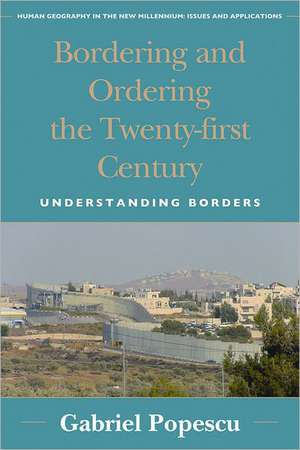
Bordering and Ordering the Twenty-first Century: Understanding Borders: Human Geography in the Twenty-First Century: Issues and Applications
Autor Gabriel Popescuen Limba Engleză Paperback – 29 sep 2011



Preț: 327.44 lei
Preț vechi: 405.98 lei
-19%
Puncte Express: 491
Carte tipărită la comandă
Livrare economică 09-23 noiembrie
Livrare prin curier în România Termenul estimat este afișat lângă disponibilitate.
Transport gratuit de la 400.00 lei Plată online sau ramburs, în funcție de opțiunile comenzii.
Retur gratuit în 14 zile Comandă securizată și suport în română.
Specificații
ISBN-13: 9780742556225
ISBN-10: 0742556220
Pagini: 183
Ilustrații: black & white illustrations, maps, figures
Dimensiuni: 148 x 226 x 14 mm
Greutate: 0.27 kg
Editura: Bloomsbury Publishing
Colecția Rowman & Littlefield
Seria Human Geography in the Twenty-First Century: Issues and Applications
Locul publicării:New York, United States
ISBN-10: 0742556220
Pagini: 183
Ilustrații: black & white illustrations, maps, figures
Dimensiuni: 148 x 226 x 14 mm
Greutate: 0.27 kg
Editura: Bloomsbury Publishing
Colecția Rowman & Littlefield
Seria Human Geography in the Twenty-First Century: Issues and Applications
Locul publicării:New York, United States
Cuprins
Preface
Introduction
Chapter 1: Making Sense of Borders
Chapter 2: Borders Before and During the Modern Era
Chapter 3: Borders in the Era of Globalization
Chapter 4: Producing Global Border Spaces
Chapter 5: Controlling Mobility
Chapter 6: Bridging Borders
Conclusion
Introduction
Chapter 1: Making Sense of Borders
Chapter 2: Borders Before and During the Modern Era
Chapter 3: Borders in the Era of Globalization
Chapter 4: Producing Global Border Spaces
Chapter 5: Controlling Mobility
Chapter 6: Bridging Borders
Conclusion
Recenzii
This book provides an excellent classification of borders as viewed by various disciplines as well as providing a framework to understanding the changing nature of borders. In this manner, the work by Popescu is reminiscent of the work of Ellwyn R. Stoddard. Understanding the spatial characteristics of borders and reviewing its impact on the formation and transformation of borders is innovative. Finally, the author offers an excellent review of modern attempts to control mobility across borders. The final chapter reviews, within the framework constructed, the various types of cross-border cooperation. His review of this cross-border cooperation is as innovative as the work of Remigio Ratti and Shalom Reichman, Theory and Practice of Transborder Cooperation, was in 1993. This book will be useful to students as well as seasoned researchers.
Clearly written, extremely informative and well structured, Gabriel Popescu's work provides a theoretical insight into the changing nature of borders, particularly in the past two decades and, at the same time, can serve as a useful guide through the maze of multidisciplinary border studies. It can be recommended to students of geography, political science and international relations, to social scientists interested in borders, transnationality, mobility and geopolitics, and to experts dealing with cross-border cooperation and migration in government, business, international organizations and NGOs.
A very readable account of contemporary theoretical approaches in border studies across a range of disciplines. It emphasizes how borders are and will remain central factors in contemporary international affairs and directly affect our daily lives. The bibliography is also a valuable tool for further reading.
This is simply the best up-to-date survey of border studies I have seen. Popescu shows easy command of a wide range of sources in a number of languages. The approach and writing are such that a wide array of readers will find this book absolutely necessary for understanding how borders are being rethought and how this matters in a world of anti-immigration panics and the inability of popular ideologies to come to terms with the shifting practices and meanings of 'bordering' in the twenty-first century.
How and why do borders endure? The business of borders and the objectives of those who seek variously to secure, manage, cross, or transcend them are illuminated in this fluent and accessible cross-disciplinary guide to borders and border studies.
Clearly written, extremely informative and well structured, Gabriel Popescu's work provides a theoretical insight into the changing nature of borders, particularly in the past two decades and, at the same time, can serve as a useful guide through the maze of multidisciplinary border studies. It can be recommended to students of geography, political science and international relations, to social scientists interested in borders, transnationality, mobility and geopolitics, and to experts dealing with cross-border cooperation and migration in government, business, international organizations and NGOs.
A very readable account of contemporary theoretical approaches in border studies across a range of disciplines. It emphasizes how borders are and will remain central factors in contemporary international affairs and directly affect our daily lives. The bibliography is also a valuable tool for further reading.
This is simply the best up-to-date survey of border studies I have seen. Popescu shows easy command of a wide range of sources in a number of languages. The approach and writing are such that a wide array of readers will find this book absolutely necessary for understanding how borders are being rethought and how this matters in a world of anti-immigration panics and the inability of popular ideologies to come to terms with the shifting practices and meanings of 'bordering' in the twenty-first century.
How and why do borders endure? The business of borders and the objectives of those who seek variously to secure, manage, cross, or transcend them are illuminated in this fluent and accessible cross-disciplinary guide to borders and border studies.