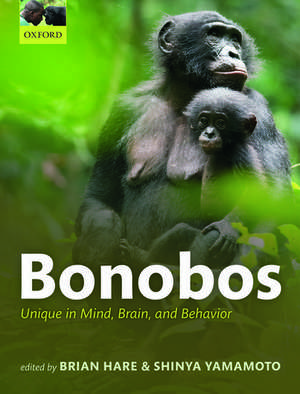
Bonobos: Unique in Mind, Brain, and Behavior
Editat de Brian Hare, Shinya Yamamotoen Limba Engleză Paperback – 12 oct 2017
Preț: 528.84 lei
Preț vechi: 672.93 lei
-21%
Puncte Express: 793
Carte tipărită la comandă
Livrare economică 27 noiembrie-02 decembrie
Livrare prin curier în România Termenul estimat este afișat lângă disponibilitate.
Transport gratuit pentru acest produs Plată online sau ramburs, în funcție de opțiunile comenzii.
Retur gratuit în 14 zile Comandă securizată și suport în română.
Specificații
ISBN-13: 9780198728528
ISBN-10: 0198728522
Pagini: 304
Ilustrații: 66 illustrations
Dimensiuni: 202 x 247 x 16 mm
Greutate: 0.7 kg
Editura: OUP OXFORD
Colecția OUP Oxford
Locul publicării:Oxford, United Kingdom
ISBN-10: 0198728522
Pagini: 304
Ilustrații: 66 illustrations
Dimensiuni: 202 x 247 x 16 mm
Greutate: 0.7 kg
Editura: OUP OXFORD
Colecția OUP Oxford
Locul publicării:Oxford, United Kingdom
Recenzii
I believe this volume will contribute to establishing bonobos as a species of interest on their own, which can inform our understanding of human evolution asmuch as chimpanzees. It is certainly an excellent entrance to the fascinating world of bonobos.
Hare and Yamamoto present a timely update to understandings of this unique ape by curating field and captive research...Authors use new genetic, demographic, and geospatial technology and modeling to test alternative hypotheses, pointing readers to areas of future research... Recommended.
Hare and Yamamoto present a timely update to understandings of this unique ape by curating field and captive research...Authors use new genetic, demographic, and geospatial technology and modeling to test alternative hypotheses, pointing readers to areas of future research... Recommended.
Notă biografică
Dr Brian Hare is an associate professor of Evolutionary Anthropology and a member of the Center for Cognitive Neuroscience at Duke University in the United States. Since 2007, he has published over two dozen peer-reviewed empirical papers on the cognition, behavior, physiology, morphology, and evolution of the bonobo. He has studied bonobos in zoos, African sanctuaries and in the wild. His research focuses on identifying unique cognitive traits as well as understanding evolutionary processes that produce them.Dr Shinya Yamamoto is an associate professor at Kobe University in Japan. He has published research on both wild and captive chimpanzees. More recently he began studying the behavior of wild bonobos at the Wamba field site in the Democratic Republic of Congo. His research concentrates on the evolution of cooperation, culture, and understanding others.
Cuprins
- FOREWORD
- 1: Brian Hare and Shinya Yamamoto: Minding the bonobo mind
- 2: Takeshi Furuichi: Female contributions to the peaceful nature of bonobo society
- 3: Martin Surbeck and Gottfried Hohmann: Affiliations, aggressions and an adoption: male-male relationships in wild bonobos
- 4: Kara Walker and Brian Hare: Bonobo baby dominance: did female defense of offspring lead to reduced male aggression?
- 5: Elisabetta Palagi and Elisa Demuru: Pan Paniscus or Pan Ludens? Bonobos, playful attitude and social tolerance
- 6: Christopher Krupenye, Evan L. MacLean, and Brian Hare: Does the bonobo have a (chimpanzee-like) theory of mind?
- 7: Michael Tomasello: What did we learn from the ape language studies?
- 8: Zanna Clay and Emilie Genty: Natural communication in bonobos: insights into social awareness and the evolution of language
- 9: Shinya Yamamoto and Takeshi Furuichi: Courtesy food sharing characterized by begging for social bonds in wild bonobos
- 10: Jingzhi Tan and Brian Hare: Prosociality among non-kin in bonobos and chimpanzees compared
- 11: Alexandra G. Rosati: Ecological variation in cognition: insights from bonobos and chimpanzees
- 12: Josep Call: Bonobos, chimpanzees and tools: integrating species-specific psychological biases and socio-ecology
- 13: Nicky Staes, Marcel Eens, Alexander Weiss, and Jeroen M.G. Stevens: Bonobo personality: age and sex effects and links with behavior and dominance
- 14: William D. Hopkins, Cheryl D. Stimpson, and Chet C. Sherwood: Social cognition and brain organization in chimpanzees (Pan troglodytes) and bonobos (Pan paniscus)
- 15: Brian Hare and Vanessa Woods: Cognitive comparisons of genus Pan support bonobo self-domestication
- 16: Hiroyuki Takemoto, Yoshi Kawamoto, and Takeshi Furuichi: The formation of Congo river and the origin of bonobos: a new hypothesis
- 17: J. Nackoney, J. Hickey, D. Williams, C. Facheux, T. Furuichi, and J. Dupain: Geospatial information informs bonobo conservation efforts
- 18: Lisa J. Faust, Claudine André, Raphaël Belais, Fanny Minesi, Zjef Pereboom, Kerri Rodriguez, and Brian Hare: Bonobo population dynamics: past patterns and future predictions for the Lola ya Bonobo population using demographic modeling
- AFTERWORD