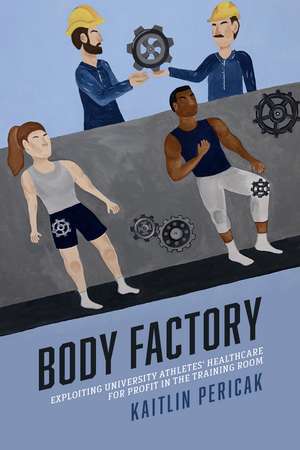
Body Factory: Exploiting University Athletes' Healthcare for Profit in the Training Room: Sporting
Autor Kaitlin Pericaken Limba Engleză Paperback – 10 ian 2025
Body Factory enters an NCAA Division I athletic training room to examine the disconnect between what the NCAA states as its goal of athlete healthcare and what is actually happening. Kaitlin Pericak conducts observations in this space and interviews injured athletes and sports medicine staff members to show how institutional control over “best interests” often ends up exploiting the individual athlete. The influences at work are part of a neoliberal paradigm that explains why interest in an athlete’s care is greatly diminished once they are injured and can no longer play.
Body Factory considers how race, gender, and health before and after injury are deciding factors in these university training centers. The bureaucratic organization has a goal of maintaining power to generate profit, and Pericak shows this is almost always at the expense of the athlete.
| Toate formatele și edițiile | Preț | Express |
|---|---|---|
| Paperback (1) | 132.30 lei 22-36 zile | +8.90 lei 6-12 zile |
| Temple University Press – 10 ian 2025 | 132.30 lei 22-36 zile | +8.90 lei 6-12 zile |
| Hardback (1) | 457.68 lei 22-36 zile | |
| Temple University Press – 10 ian 2025 | 457.68 lei 22-36 zile |







Preț: 132.30 lei
Puncte Express: 198
Preț estimativ în valută:
23.42€ • 27.20$ • 20.29£
23.42€ • 27.20$ • 20.29£
Carte disponibilă
Livrare economică 09-23 februarie
Livrare express 24-30 ianuarie pentru 18.89 lei
Preluare comenzi: 021 569.72.76
Specificații
ISBN-13: 9781439924945
ISBN-10: 1439924945
Pagini: 156
Ilustrații: 4
Dimensiuni: 140 x 210 x 15 mm
Greutate: 0.2 kg
Editura: Temple University Press
Colecția Temple University Press
Seria Sporting
ISBN-10: 1439924945
Pagini: 156
Ilustrații: 4
Dimensiuni: 140 x 210 x 15 mm
Greutate: 0.2 kg
Editura: Temple University Press
Colecția Temple University Press
Seria Sporting
Recenzii
“Body Factory makes a strong case that ‘collegiate jock capitalism’—the incredible pressure within gendered and racialized big-time college athletic departments to protect their power to generate revenue—consistently overwhelms the standard of care that should be provided to college athletes. The organizational issues identified in Body Factory result in athletic administrators, coaches, athletic trainers, and even athletes redefining what it means to be ‘injured’—negatively affecting the care college athletes receive. This book is a must-read for anyone who purportedly cares about and cares for college athletes.”—Richard M. Southall, Director of the College Sport Research Institute at the University of South Carolina
“For anyone questioning if college sports have gone too far, Kaitlin Pericak artfully illustrates the extensive colonial terrain of the neoliberal campus, then reveals deeply hidden roots that belie the overgrown enterprise of college sports today. Careful observations and interviews are woven together, skillfully illuminating the assumptions about football that silently ripple unnoticed throughout athletic programs. The result is a powerful case study, bringing to the surface a wake of control permeating the entire college sports landscape. In this moment, when athletes are challenging generations of practices over financial control in the courts, Body Factory vividly captures the most visceral characteristic of control—control over the health of their bodies.”—Jennifer Lee Hoffman, Professor of Educational Foundations, Leadership, and Policy at the University of Washington, and author of College Sports and Institutional Values in Competition: Leadership Challenges
"Body Factory offers a rare and critical academic investigation into the inner workings of a National Collegiate Athletic Association (NCAA) Division I athletic training room.... [T]he author critically examines how race, gender, and health status intersect within the high-stakes environment of collegiate athletics. Her findings suggest that a rigid institutional bureaucracy—what is being described here as a 'stone wall'—ultimately privileges financial and competitive interests over the long-term health and recovery of student-athletes. Summing Up: Recommended."—Choice
“For anyone questioning if college sports have gone too far, Kaitlin Pericak artfully illustrates the extensive colonial terrain of the neoliberal campus, then reveals deeply hidden roots that belie the overgrown enterprise of college sports today. Careful observations and interviews are woven together, skillfully illuminating the assumptions about football that silently ripple unnoticed throughout athletic programs. The result is a powerful case study, bringing to the surface a wake of control permeating the entire college sports landscape. In this moment, when athletes are challenging generations of practices over financial control in the courts, Body Factory vividly captures the most visceral characteristic of control—control over the health of their bodies.”—Jennifer Lee Hoffman, Professor of Educational Foundations, Leadership, and Policy at the University of Washington, and author of College Sports and Institutional Values in Competition: Leadership Challenges
"Body Factory offers a rare and critical academic investigation into the inner workings of a National Collegiate Athletic Association (NCAA) Division I athletic training room.... [T]he author critically examines how race, gender, and health status intersect within the high-stakes environment of collegiate athletics. Her findings suggest that a rigid institutional bureaucracy—what is being described here as a 'stone wall'—ultimately privileges financial and competitive interests over the long-term health and recovery of student-athletes. Summing Up: Recommended."—Choice
Notă biografică
Kaitlin Pericak is Assistant Professor of Adult and Higher Education at the University of Oklahoma.