Bodies complexioned
Autor Mark Dawsonen Limba Engleză Hardback – 13 mai 2019
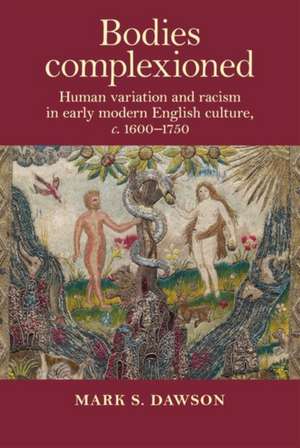
The book demonstrates that individuals' distinctive features were thought to be innate, even as discrete populations were believed to have fleshly characteristics in common - whether similarities in skin-tone, facial profile, hair colour, or demeanour. According to most scholarship, bodies constituted from the same four elemental fluids as Adam and Eve's - the phlegmatic, sanguine, choleric, and melancholic humours - were not the stuff of visceral inequality or racism. But this book contends that people routinely judged others on sight according to the ostensible balance, or complexion, their humours.
Complexions vouched for distinctions in social status, physical cum moral fitness, national allegiance, and religious affiliation. But to establish whether this scrutiny had a racist potential, we need to determine if the people of the day had an entirely naturalistic view of themselves and the world they inhabited.
Preț: 610.79 lei
Preț vechi: 793.23 lei
-23%
Puncte Express: 916
Carte indisponibilă temporar
Livrare prin curier în România Termenul estimat este afișat lângă disponibilitate.
Transport gratuit pentru acest produs Plată online sau ramburs, în funcție de opțiunile comenzii.
Retur gratuit în 14 zile Comandă securizată și suport în română.
Specificații
ISBN-13: 9781526134486
ISBN-10: 1526134489
Pagini: 282
Dimensiuni: 161 x 240 x 20 mm
Greutate: 0.54 kg
Editura: MANCHESTER UNIVERSITY PRESS
ISBN-10: 1526134489
Pagini: 282
Dimensiuni: 161 x 240 x 20 mm
Greutate: 0.54 kg
Editura: MANCHESTER UNIVERSITY PRESS
Notă biografică
Mark S. Dawson is Lecturer in Early Modern History at the Australian National University, Canberra
Cuprins
Introduction 1 Contemplating Christian temperaments 2 Nativities established 3 Bodies emblazoned 4 Identifying the differently humoured 5 Distempered skin and the English abroad 6 National identities, foreign physiognomies, and the advent of whiteness Conclusion Index
Descriere
Descriere de la o altă ediție sau format:
Skin-tones mattered in early modern England. Indexing health, social status, religious affiliation and national allegiance, they helped explain (away) poverty, colonialism, war and slavery. Drawing physical distinctions as a means to power has a complex history - one belying racism's assumption that such distinctions are natural or timeless. -- .
Skin-tones mattered in early modern England. Indexing health, social status, religious affiliation and national allegiance, they helped explain (away) poverty, colonialism, war and slavery. Drawing physical distinctions as a means to power has a complex history - one belying racism's assumption that such distinctions are natural or timeless. -- .