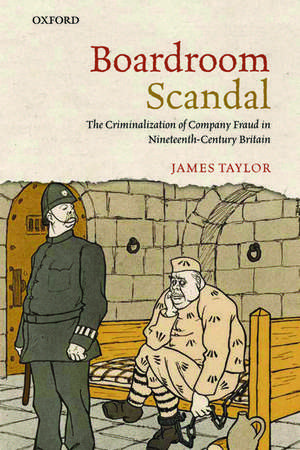
Boardroom Scandal: The Criminalization of Company Fraud in Nineteenth-Century Britain
Autor James Tayloren Limba Engleză Hardback – 25 apr 2013
Preț: 932.86 lei
Preț vechi: 1355.75 lei
-31%
Puncte Express: 1399
Carte tipărită la comandă
Livrare economică 10-15 decembrie
Livrare prin curier în România Termenul estimat este afișat lângă disponibilitate.
Transport gratuit pentru acest produs Plată online sau ramburs, în funcție de opțiunile comenzii.
Retur gratuit în 14 zile Comandă securizată și suport în română.
Specificații
ISBN-13: 9780199695799
ISBN-10: 0199695792
Pagini: 312
Ilustrații: Ten black and white images
Dimensiuni: 162 x 240 x 25 mm
Greutate: 0.64 kg
Editura: OUP OXFORD
Colecția OUP Oxford
Locul publicării:Oxford, United Kingdom
ISBN-10: 0199695792
Pagini: 312
Ilustrații: Ten black and white images
Dimensiuni: 162 x 240 x 25 mm
Greutate: 0.64 kg
Editura: OUP OXFORD
Colecția OUP Oxford
Locul publicării:Oxford, United Kingdom
V-ar putea interesa
-
 Having It So GoodPeter Hennessy-18%Preț: 118.06 lei143.62 lei
 -
 State of EmergencyDominic Sandbrook-21%Preț: 115.33 lei146.13 lei
 -
 -28%Preț: 378.37 lei528.47 lei
 -
 The Long Peace: Inquiries into the History of the Cold WarJohn Lewis Gaddis-15%Preț: 191.53 lei226.28 lei
 -
 The Romans: From Village to EmpireMary T. BoatwrightPreț: 317.43 lei
 -
 King James VI/I and his English ParliamentsConrad Russell-30%Preț: 961.32 lei1377.94 lei
 -
 Women in a Celtic Church: Ireland 450-1150Christina Harrington-33%Preț: 1295.80 lei1930.77 lei
 -
 Lordship and Society in the March of Wales 1282-1400R. R. Davies-32%Preț: 1523.08 lei2232.34 lei
 -
 Field Marshal Sir Henry Wilson: A Political SoldierKeith Jeffery-27%Preț: 429.97 lei587.86 lei
 -
 -32%Preț: 1469.44 lei2157.30 lei
 -
 -31%Preț: 675.35 lei982.38 lei
 -
 -29%Preț: 496.63 lei696.78 lei
 -
 -27%Preț: 495.68 lei681.02 lei
 -
 England on Edge: Crisis and Revolution 1640-1642David Cressy-17%Preț: 293.07 lei354.93 lei
 -
 Lives of the CaesarsSuetonius-14%Preț: 71.69 lei83.48 lei
 -
 Colossus: The secrets of Bletchley Park's code-breaking computersB. Jack Copeland-16%Preț: 111.00 lei132.88 lei
 -
 The London Underworld in the Victorian Period: v. 1Henry Mayhew-17%Preț: 96.97 lei116.49 lei
 -
 The Discovery of IslandsJ. G. A. PocockPreț: 335.34 lei
 -
 Through The Window, A CollectionJames TaylorPreț: 104.18 lei
 -
 -20%Preț: 109.60 lei137.00 lei
 -
 Jaguar Mks 1 and 2, S-Type and 420James TaylorPreț: 211.00 lei
 -
 Range Rover First GenerationJames TaylorPreț: 299.17 lei
 -
 The London HangedPeter LinebaughPreț: 260.56 lei
 -
 DazzleJames TaylorPreț: 146.63 lei
Recenzii
James Taylor has established himself as one of the leading historians of corporate capitalism in nineteenth-century Britain, and his new monograph further augments his reputation. As with Taylor's previous work, this book is very readable because the author uses engaging and sometimes humorous vignettes to trace the evolution of the criminalization of company fraud.
Boardroom Scandal is both a thought-provoking and engaging book, a substantial work of historical recovery which will push future studies of both the nineteenth-century economy and criminal justice history in new directions.
This book by James Taylor is an excellent example of an emerging approach to the study of the past that could be called forensic history.
Taylor sets corporate fraud in a broader perspective, which encompasses the evolution of the law, political economy, and contemporary perceptions of who was right and who was wrong. He deserves to be congratulated for this excellent piece of scholarship.
Boardroom Scandal is both a thought-provoking and engaging book, a substantial work of historical recovery which will push future studies of both the nineteenth-century economy and criminal justice history in new directions.
This book by James Taylor is an excellent example of an emerging approach to the study of the past that could be called forensic history.
Taylor sets corporate fraud in a broader perspective, which encompasses the evolution of the law, political economy, and contemporary perceptions of who was right and who was wrong. He deserves to be congratulated for this excellent piece of scholarship.
Notă biografică
James Taylor is a senior lecturer in the Department of History at Lancaster University. He is the author of Creating Capitalism and co-author of Shareholder Democracies.