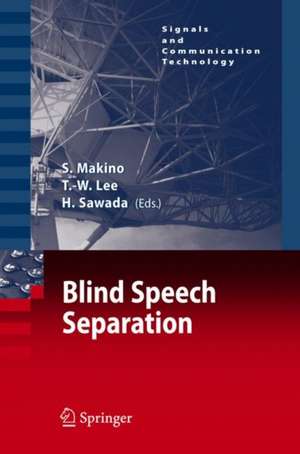
Blind Speech Separation
Editat de Shoji Makino, Te-Won Lee, Hiroshi Sawadaen Limba Engleză Hardback – 20 sep 2007
| Toate formatele și edițiile | Preț | Express |
|---|---|---|
| Paperback (1) | 914.83 lei 6-8 săpt. | |
| SPRINGER NETHERLANDS – 30 noi 2010 | 914.83 lei 6-8 săpt. | |
| Hardback (1) | 920.88 lei 6-8 săpt. | |
| Springer – 20 sep 2007 | 920.88 lei 6-8 săpt. |
Preț: 920.88 lei
Preț vechi: 1123.02 lei
-18%
Puncte Express: 1381
Preț estimativ în valută:
162.88€ • 190.40$ • 141.60£
162.88€ • 190.40$ • 141.60£
Carte tipărită la comandă
Livrare economică 07-21 martie
Specificații
ISBN-13: 9781402064784
ISBN-10: 1402064780
Pagini: 432
Ilustrații: XVI, 432 p.
Dimensiuni: 156 x 234 x 25 mm
Greutate: 0.81 kg
Ediția:2007 edition
Editura: Springer
Locul publicării:Dordrecht, Netherlands
ISBN-10: 1402064780
Pagini: 432
Ilustrații: XVI, 432 p.
Dimensiuni: 156 x 234 x 25 mm
Greutate: 0.81 kg
Ediția:2007 edition
Editura: Springer
Locul publicării:Dordrecht, Netherlands
V-ar putea interesa
-
 -20%Preț: 620.82 lei776.03 lei
 -
 -18%Preț: 1208.71 lei1474.04 lei
 -
 Fundamentals of Bidirectional Transmission over a Single Optical FibreM.O. van Deventer-18%Preț: 1179.60 lei1438.53 lei
 -
 Vision Models and Applications to Image and Video ProcessingChristian J. van den Branden Lambrecht-18%Preț: 912.09 lei1112.30 lei
 -
 Towards an Optical InternetAdmela Jukan-18%Preț: 919.21 lei1120.99 lei
 -
 -20%Preț: 950.88 lei1188.60 lei
 -
 Passive Imaging with Ambient NoiseJosselin Garnier-20%Preț: 852.29 lei1065.37 lei
 -
 Modern MeasurementsAlessandro Ferrero-9%Preț: 831.90 lei914.17 lei
 -
 Combining Pattern ClassifiersLudmila I Kuncheva-9%Preț: 693.13 lei761.68 lei
 -
 An Introduction to 3D PrintingVictoria ZukasPreț: 225.45 lei
 -
 -15%Preț: 636.42 lei748.73 lei
 -
 Dense Image Correspondences for Computer VisionTal Hassner-15%Preț: 622.29 lei732.10 lei
 -
 Image Processing and Communications Challenges 7Ryszard S. Choraś-20%Preț: 949.94 lei1187.42 lei
 -
 Advances in Face Detection and Facial Image AnalysisMichal KawulokPreț: 388.93 lei
 -
 Preț: 360.47 lei
 -
 Computer Music Modeling and RetrievalUffe K. Wiil-15%Preț: 615.28 lei723.86 lei
 -
 Sound Capture for Human / Machine InterfacesWolfgang Herbordt-15%Preț: 670.74 lei789.10 lei
 -
 Speech EnhancementJacob Benesty-15%Preț: 626.06 lei736.54 lei
 -
 Processing of Multidimensional SignalsAlexandre Smirnov-18%Preț: 913.32 lei1113.81 lei
 -
 Hyperspectral Image ProcessingLiguo Wang-15%Preț: 628.73 lei739.68 lei
 -
 -20%Preț: 1243.97 lei1554.95 lei
Public țintă
ResearchCuprins
Multiple Microphone Blind Speech Separation with ICA.- Convolutive Blind Source Separation for Audio Signals.- Frequency-Domain Blind Source Separation.- Blind Source Separation using Space–Time Independent Component Analysis.- TRINICON-based Blind System Identification with Application to Multiple-Source Localization and Separation.- SIMO-Model-Based Blind Source Separation – Principle and its Applications.- Independent Vector Analysis for Convolutive Blind Speech Separation.- Relative Newton and Smoothing Multiplier Optimization Methods for Blind Source Separation.- Underdetermined Blind Speech Separation with Sparseness.- The DUET Blind Source Separation Algorithm.- K-means Based Underdetermined Blind Speech Separation.- Underdetermined Blind Source Separation of Convolutive Mixtures by Hierarchical Clustering and L1-Norm Minimization.- Bayesian Audio Source Separation.- Single Microphone Blind Speech Separation.- Monaural Source Separation.- Probabilistic Decompositions of Spectra for Sound Separation.- Sparsification for Monaural Source Separation.- Monaural Speech Separation by Support Vector Machines: Bridging the Divide Between Supervised and Unsupervised Learning Methods.
Notă biografică
Dr. Shoji Makino is an IEEE Fellow, Associate Editor of the IEEE Transactions on Speech & Audio Processing, and Executive Manager NTT Communication Science Laboratories. Dr. Makino was also co-editor on the succesful 2005 Springer book: Benesty - Speech Enhancement.
Textul de pe ultima copertă
This is the first book to provide a cutting edge reference to the fascinating topic of blind source separation (BSS) for convolved speech mixtures. Through contributions by the foremost experts on the subject, the book provides an up-to-date account of research findings, explains the underlying theory, and discusses potential applications. The individual chapters are designed to be tutorial in nature with specific emphasis on an in-depth treatment of state of the art techniques.
Blind Speech Separation is divided into three parts:
Part 1 presents overdetermined or critically determined BSS. Here the main technology is independent component analysis (ICA). ICA is a statistical method for extracting mutually independent sources from their mixtures. This approach utilizes spatial diversity to discriminate between desired and undesired components, i.e., it reduces the undesired components by forming a spatial null towards them. It is, in fact, a blind adaptive beamformer realized by unsupervised adaptive filtering.
Part 2 addresses underdetermined BSS, where there are fewer microphones than source signals. Here, the sparseness of speech sources is very useful; we can utilize time-frequency diversity, where sources are active in different regions of the time-frequency plane.
Part 3 presents monaural BSS where there is only one microphone. Here, we can separate a mixture by using the harmonicity and temporal structure of the sources. We can build a probabilistic framework by assuming a source model, and separate a mixture by maximizing the a posteriori probability of the sources.
Blind Speech Separation is divided into three parts:
Part 1 presents overdetermined or critically determined BSS. Here the main technology is independent component analysis (ICA). ICA is a statistical method for extracting mutually independent sources from their mixtures. This approach utilizes spatial diversity to discriminate between desired and undesired components, i.e., it reduces the undesired components by forming a spatial null towards them. It is, in fact, a blind adaptive beamformer realized by unsupervised adaptive filtering.
Part 2 addresses underdetermined BSS, where there are fewer microphones than source signals. Here, the sparseness of speech sources is very useful; we can utilize time-frequency diversity, where sources are active in different regions of the time-frequency plane.
Part 3 presents monaural BSS where there is only one microphone. Here, we can separate a mixture by using the harmonicity and temporal structure of the sources. We can build a probabilistic framework by assuming a source model, and separate a mixture by maximizing the a posteriori probability of the sources.
Caracteristici
cutting edge topic on blind source separation top researchers from all over the world tutorial in nature and in-depth treatment