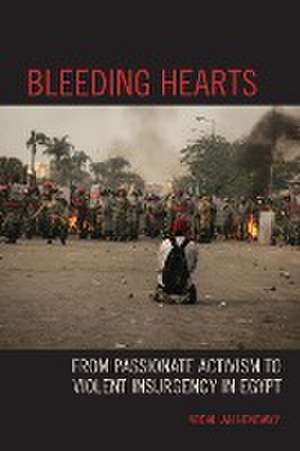
Bleeding Hearts: From Passionate Activism to Violent Insurgency in Egypt
Autor Abdallah Hendawyen Limba Engleză Paperback – 12 apr 2023
The book ultimately concludes that repressive political environments, particularly the systematic authoritarian practices by state security agencies against political activists, are largely responsible for radicalization. Abusive state practices traumatized the activists and created a litany of unsettled grievances without recourse, giving rise to a formidable desire for revenge against those who violated them - both individuals and the institutions they represent.
Preț: 217.87 lei
Preț vechi: 305.37 lei
-29%
Puncte Express: 327
Carte tipărită la comandă
Livrare economică 25 noiembrie-09 decembrie
Livrare prin curier în România Termenul estimat este afișat lângă disponibilitate.
Transport gratuit de la 400.00 lei Plată online sau ramburs, în funcție de opțiunile comenzii.
Retur gratuit în 14 zile Comandă securizată și suport în română.
Specificații
ISBN-13: 9781793613066
ISBN-10: 1793613060
Pagini: 146
Ilustrații: 2 b/w illustrations;2 tables;
Dimensiuni: 151 x 229 x 9 mm
Greutate: 0.2 kg
Editura: Bloomsbury Publishing
Colecția Lexington Books
Locul publicării:New York, United States
ISBN-10: 1793613060
Pagini: 146
Ilustrații: 2 b/w illustrations;2 tables;
Dimensiuni: 151 x 229 x 9 mm
Greutate: 0.2 kg
Editura: Bloomsbury Publishing
Colecția Lexington Books
Locul publicării:New York, United States
Cuprins
Preface
Acknowledgments
Introduction
Chapter One
Chapter Two
Chapter Three
Conclusion
References
Acknowledgments
Introduction
Chapter One
Chapter Two
Chapter Three
Conclusion
References
Recenzii
From January to February 2011, the world watched as a wave of peaceful, organized protests swept through Egypt, ending the nearly 30-year dictatorship of former President Hosni Mubarak. In Bleeding Hearts, Hendawy seeks answers to the question: why did some peaceful advocates of change switch tactics and later adopt violence? He eschews the terms terrorism and extremism because of their ambiguity and frequent misuse by Middle Eastern governments, preferring the simplicity of "violent insurgents" (p. 53), and offers ethnographic profiles of various insurgents who peacefully protested in 2011 but changed tactics by 2013. Hendawy argues that their radicalization was the result of government-sponsored torture, marked by its penchant for humiliation. As he elaborates, "the combination of trauma, guilt, anger, and despondency put these individuals in a trigger state . [that] comprised the perfect storm . to resolve unsettled grievances" (p. 77). Although the author's sample is relatively small, it is backed by more substantial secondary literature on radicalization and Egypt generally. Recommended. General readers through faculty; professionals.
In Egypt, during 'Arab Spring' 2011, pro-democracy activists committed to non-violent tactics filled Tahrir Square for the eighteen days that culminated in the overthrow of an autocratic president who had ruled the country for thirty years. How do we explain the sudden shift in allegiance among many of these very activists who subsequently joined the ranks of the violent movement against the state? In Bleeding Hearts, Abdallah Hendawy, a pro-democracy activist in Egypt at the time and since a trained sociologist and scholar, offers a most insightful and compelling explanation of this transformation. Based on his own fieldwork and engaging interviews with those who resorted to violence , there is no better introduction to this topic. Bleeding Hearts is essential reading for scholars, activists, policymakers, and anyone who wants to understand the fine line we all tread between democracy and autocracy.
In Egypt, during 'Arab Spring' 2011, pro-democracy activists committed to non-violent tactics filled Tahrir Square for the eighteen days that culminated in the overthrow of an autocratic president who had ruled the country for thirty years. How do we explain the sudden shift in allegiance among many of these very activists who subsequently joined the ranks of the violent movement against the state? In Bleeding Hearts, Abdallah Hendawy, a pro-democracy activist in Egypt at the time and since a trained sociologist and scholar, offers a most insightful and compelling explanation of this transformation. Based on his own fieldwork and engaging interviews with those who resorted to violence , there is no better introduction to this topic. Bleeding Hearts is essential reading for scholars, activists, policymakers, and anyone who wants to understand the fine line we all tread between democracy and autocracy.