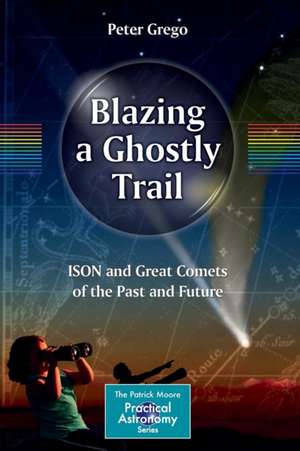
Blazing a Ghostly Trail: The Patrick Moore Practical Astronomy Series
Autor Peter Gregoen Limba Engleză Paperback – 30 oct 2013
Bazându-ne pe datele furnizate de editura Springer în cadrul prestigioasei serii The Patrick Moore Practical Astronomy Series, descoperim în Blazing a Ghostly Trail un ghid esențial pentru înțelegerea fenomenelor cometare care au marcat începutul deceniului trecut. Lucrarea a fost concepută într-un moment de maximă efervescență astronomică, anticipând trecerea cometei C/2012 S1 (ISON), considerată atunci una dintre cele mai strălucitoare apariții din istoria modernă. Considerăm că valoarea acestui volum rezidă în echilibrul dintre rigoarea științifică și abordarea practică, oferind cititorului nu doar context istoric, ci și instrumente concrete de observație. Structura narativă și tehnică a cărții este organizată progresiv: pornește de la originea cometelor în norul Oort, trece prin miturile și superstițiile istorice și ajunge la analiza detaliată a misiunilor spațiale precum Giotto sau Deep Impact. Găsim aici hărți cerești intuitive și diagrame orbitale care facilitează localizarea acestor „vizitatori” înghețați. Peter Grego integrează natural utilizarea tehnologiei moderne, recomandând aplicații și surse online pentru planificarea sesiunilor de urmărire. Acoperă aceeași arie tematică ca Comets! de David J Eicher, dar cu o abordare mai orientată către astronomia practică de teren și către colaborarea dintre amatori și profesioniști. În contextul operei sale, Blazing a Ghostly Trail continuă linia metodologică stabilită în The Moon and How to Observe It și Mars and How to Observe It. Dacă în lucrările anterioare se concentra pe obiecte cerești cu poziții previzibile, aici autorul explorează natura dinamică și uneori imprevizibilă a cometelor. Stilul este unul precis, adaptat curriculei de astronomie observațională, fiind o resursă excelentă pentru cei care doresc să treacă de la simpla contemplare la documentarea științifică a cerului nocturn.
Din seria The Patrick Moore Practical Astronomy Series
-
 Preț: 436.11 lei
 -
 Preț: 305.52 lei
 -
 Preț: 277.52 lei
 -
 Preț: 213.41 lei
 -
 Preț: 282.88 lei
 -
 Preț: 273.10 lei
 -
 Preț: 405.61 lei
 -
 Preț: 263.53 lei
 -
 Preț: 224.90 lei
 -
 Preț: 263.19 lei
 -
 Preț: 214.14 lei
 -
 Preț: 329.73 lei
 -
 Preț: 221.60 lei
 -
 Preț: 304.67 lei
 -
 Preț: 224.06 lei
 -
 Preț: 316.36 lei
 -
 Preț: 268.75 lei
 -
 Preț: 291.13 lei
 -
 Preț: 230.13 lei
 -
 Preț: 327.23 lei
 -
 Preț: 337.31 lei
 -
 Preț: 252.09 lei
 -
 Preț: 181.15 lei
 -
 Preț: 375.55 lei
 -
 Preț: 261.18 lei
 -
 Preț: 206.17 lei
 -
 Preț: 210.79 lei
 -
 Preț: 215.71 lei
 -
 Preț: 255.50 lei
 -
 Preț: 300.59 lei
 -
 Preț: 192.70 lei
 -
 Preț: 215.80 lei
 -
 Preț: 326.80 lei
 -
 Preț: 207.33 lei
 -
 Preț: 329.33 lei
 -
 Preț: 304.01 lei
 -
 Preț: 208.50 lei
 - 15%
 Preț: 676.73 lei
 -
 Preț: 349.34 lei
 -
 Preț: 242.32 lei
 -
 Preț: 302.01 lei
 -
 Preț: 150.27 lei
 -
 Preț: 267.37 lei
 -
 Preț: 280.62 lei
 -
 Preț: 254.09 lei
 -
 Preț: 317.82 lei
 -
 Preț: 284.03 lei
 -
 Preț: 304.84 lei
 -
 Preț: 213.61 lei
 -
 Preț: 326.80 lei
Preț: 222.09 lei
Carte tipărită la comandă
Livrare economică 23 noiembrie-07 decembrie
Specificații
ISBN-10: 3319017748
Pagini: 308
Ilustrații: XIV, 294 p. 221 illus., 136 illus. in color.
Dimensiuni: 155 x 235 x 16 mm
Greutate: 0.53 kg
Ediția:2014
Editura: Springer
Colecția The Patrick Moore Practical Astronomy Series
Seria The Patrick Moore Practical Astronomy Series
Locul publicării:Cham, Switzerland
V-ar putea interesa
-
 David Levy's Guide Variable StarsDavid H. LevyPreț: 426.14 lei
 -
 Astrophotography for the AmateurMichael A. Covington-11%Preț: 488.76 lei549.16 lei
 -
 After the First Three MinutesT. R. Padmanabhan-11%Preț: 438.28 lei492.45 lei
 -
 Astronomer Intro Celestial SphereWilliam Millar-11%Preț: 507.36 lei570.06 lei
 -
 David Levy's Guide to the Night SkyDavid LevyPreț: 395.68 lei
 -
 MeteoritesMuseum National D'Histoire Naturelle (Fr-11%Preț: 405.54 lei455.66 lei
 -
 The Cambridge Encyclopedia of Amateur AstronomyMichael E. Bakich-23%Preț: 693.47 lei900.62 lei
 -
 Cornwall's Strangest TalesPeter GregoPreț: 111.77 lei
Public țintă
Popular/generalDe ce să citești această carte
Această carte este ideală pentru astronomii amatori care doresc să înțeleagă fizica și istoria cometelor, beneficiind în același timp de sfaturi practice pentru observații vizuale. Cititorul câștigă o perspectivă clară asupra modului în care pot fi utilizate hărțile și aplicațiile moderne pentru a identifica obiecte cerești difuze. Este o resursă valoroasă pentru cei care vor să contribuie la colectarea de date științifice, învățând cum să înregistreze corect aparițiile cometare.
Despre autor
Peter Grego este un astronom britanic renumit, specializat în observarea Lunii și a planetelor, fiind un membru activ al comunității astronomice internaționale. Expertiza sa este reflectată în numeroasele volume publicate în serii de specialitate, unde pune accent pe accesibilitatea instrumentelor de observație pentru publicul larg. Pe lângă lucrările tehnice precum Galileo and 400 Years of Telescopic Astronomy, interesele sale diverse includ și istoria locală, fapt demonstrat de volumul Cornwall's Strangest Tales. Prin scrierile sale, Grego reușește să pună în legătură rigoarea academică a editurii Springer cu pasiunea practică a observatorului de ocazie.
Descriere scurtă
Skywatchers have already been primed for C/2012 (ISON) earlier in 2013 with the apparition of another naked-eye comet, C/2011 L4 (PanSTARRS), and following C/2012 S1 (ISON) there is the prospect of 2012 K1 (PanSTARRS) reaching naked eye visibility in August 2014. Future bright cometary prospects are also discussed, taking into account the latest predictions.
Examining the origin and nature of comets using examples of great comets from the past, this book sets the scene for the arrival of Comet C/2012 S1 and those following it over the next few years in the inner Solar System. Skywatchers and amateur astronomers can learn how to follow, observe and record comets. There is also a guide on how to keep abreast of the latest cometary discoveries and how to use a variety of reputable sources, including publications, websites, programs and apps to visualize and plan observations. The role of the amateur in cometary discovery also is featured, as well as details on how professional astronomers plan to get the most ‘science’ out of cometary apparitions, how and why professionals go about discovering comets, and upcoming plans to visit comets with space probes (and later, perhaps, human visits). Illustrations provide historic images of comets, images from space probes and images of the latest bright comets. Orbital plots and easy-to-follow sky charts are also included.
This book is a unique guide that sets the scene by giving a comprehensive history of comets and examples of great comets throughout history and informs the reader about the nature and originsof this spectacular occurence. Expectations are fully covered by explaining not only what the regular person can expect to see, but how amateur astronomers can plan observations and what steps the professionals are taking to ‘get the most science’ from this exciting event.
Cuprins
Notă biografică
He currently edits the following astronomy publications: Luna, journal of the SPA Lunar Section (since 1984); The SPA News Circulars (since 2000); Popular Astronomy magazine (since 2000); The New Moon, journal of the BAA Lunar Section; and the BAA Lunar Section Circulars and the Bulletin of the Society for the History of Astronomy.
Peter also finds time to write and illustrate the monthly “MoonWatch” page for Astronomy Now magazine (since 1997) and is the astronomical observing expert and observing Q&A writer for Sky at Night magazine. He has given many talks to astronomical societies around the UK and has been featured on a number of radio and television broadcasts.
Finally, Grego is the author of numerous astronomy books, including Collision: Earth! (Cassell, 1998), Moon Observer’s Guide (Philips/Firefly, 2004), The Moon and How to Observe It (Springer, 2005), Need to Know? Stargazing (Collins, 2005), Need to Know? Universe (Collins, 2006), Solar System Observer’s Guide (Philips/Firefly, 2005), Exploring the Earth/Exploring the Moon/ Discovering theSolar System/ Voyage Through Space/ Discovering the Universe (five books in the QED Space Guides series, 2007), Venus and Mercury and How to Observe Them (Springer, 2008), The Great Big Book of Space (QED 2010), Galileo and 400 Years of Telescopic Astronomy (Springer, 2010), and Mars and How to Observe It (Springer, 2012).
Textul de pe ultima copertă
Sky watchers will have already been primed for C/2012 (ISON) earlier in 2013 with the apparition of another naked-eye comet, C/2011 L4 (PanSTARRS), and following C/2012 S1 (ISON) there is the prospect of 2012 K1 (PanSTARRS) reaching naked-eye visibility in August 2014. And there will be other bright cometary prospects in the near future, if we take into account the latest predictions.
This book sets the scene for the arrival of Comet C/2012 S1 and those comets following it over the next few years. It explains how sky watchers and amateur astronomers can practically follow comets, observe them, and record them. This is also a guide on how to keep abreast of the latest cometary discoveries and how to use publications, websites, programs, and apps to visualize and plan observations. The book includes:
· descriptions of the nature, origins and observing history of comets
· a detailed guide to seeing and studying what could be the greatest comet of modern times
· specially prepared maps covering bright cometary apparitions of the next few years.
· Illustrations of recent naked-eye comets and space probe images of large comets.