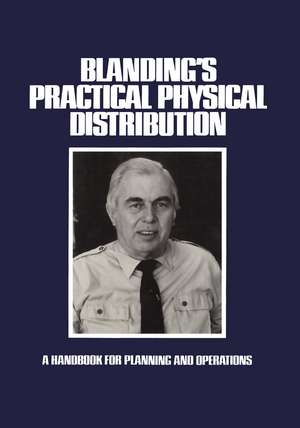
Blanding's Practical Physical Distribution
Autor Warren Blandingen Limba Engleză Hardback – 30 noi 1990
Preț: 459.97 lei
Puncte Express: 690
Carte tipărită la comandă
Livrare economică 25 noiembrie-09 decembrie
Livrare prin curier în România Termenul estimat este afișat lângă disponibilitate.
Transport gratuit pentru acest produs Plată online sau ramburs, în funcție de opțiunile comenzii.
Retur gratuit în 14 zile Comandă securizată și suport în română.
Specificații
ISBN-13: 9780874080100
ISBN-10: 087408010X
Pagini: 860
Ilustrații: XV, 822 p.
Dimensiuni: 183 x 260 x 52 mm
Greutate: 1.72 kg
Ediția:1978
Editura: Springer Us
Locul publicării:New York, NY, United States
ISBN-10: 087408010X
Pagini: 860
Ilustrații: XV, 822 p.
Dimensiuni: 183 x 260 x 52 mm
Greutate: 1.72 kg
Ediția:1978
Editura: Springer Us
Locul publicării:New York, NY, United States
Public țintă
ResearchCuprins
Section One Physical Distribution.- A Working Definition.- Section Two Warehousing.- General Introduction.- Effective Use of Public Warehouses.- Techniques for Improving Methods in Warehouse Operations.- New Trends and Services in the Public Warehouse Industry.- Ten Mistaken Assumptions About Automated Warehousing.- Controlling Shortages in the Warehouse—Honest and Otherwise.- Selecting a Public Warehouse.- Processing and Assembling Orders in the Warehouse.- Order Assembly Systems.- Section Three Materials Handling.- Some Basic Principles and Rules.- Carton Clamp Handling Equipment—Where, Why and How?.- Materials Handling Tradeoffs.- Planning the Shipping Room for Maximum Handling Efficiency.- The ‘Best’ Materials Handling System.- Management of Physical Distribution Automation.- Section Four Protective Packaging.- The Systems Approach.- Guidelines for Packaging to Meet Marketing Requirements and Increase Physical Distribution System Efficiency.- Packaging Rules and Transportation.- Some Practical Economies in Packaging.- Some Key Developments in P. D. Packaging.- Understanding the Packaging Interface.- The Two Faces of Packaging.- Section Five Unit Loads and Distribution Costs.- How to Get a Unit Load Program Started, and Some of the Pitfalls to Avoid.- Package Dimensions and Unit Load Efficiency.- Unit Loads: Three Pitfalls in the Search for a Standard.- Modularity and Unit Loads.- Section six Moneysavers.- Reducing Clerical Costs in the Smaller Company.- Ten Ways to Stretch Distribution Dollars.- Getting the Most from Your Common Carriers.- Getting More for Less: Practical Productivity Improvement.- Coming to Grips with the Meaningful Distribution Costs.- Belt-Tighteners for Hard Times.- Selling Your Cost Reduction Proposal.- Productivity, Mistakes and theCase for Supervision.- The Dangers of Sightseeing or, Things Aren’t Always What They Seem.- Section Seven Systems and Procedures.- The Transportation Factor in Plant and Warehouse Location.- Carriers and Computerization.- Accounting Concepts for Physical Distribution Activities.- Practical Computerization.- Modern Management Operating and Planning Tools.- Creative Computerization (I).- Creative Computerization (II).- Training the New Traffic Employee.- Marketing Research Techniques Applicable to Transportation and Distribution Management.- A Systems Approach to the Shipper-Carrier Interface.- Background on Safety Management.- Getting Ready for the Metric System.- Basic Considerations in Physical Distribution Security.- Measuring and Controlling Customer Service Performance.- Section Eight Distribution Economics.- Order Analysis: Key to Reduced Marketing Costs.- Ten Pitfalls in the “Total Cost Approach”.- Distribution Studies: The Probing That Pays Dividends.- Distribution Studies, Part II.- Translating Expenses into Costs.- Needed: Credible Measures of Customer Service Costs and Penalties.- Measuring Customer Service Costs and Profit Contributions.- Returning to “Go:” Can Zero-Base Budgeting Be Applied to Transportation/Distribution Functions?.- Banking’s Interface with Physical Distribution.- Section Nine Management Methods and Communications.- Defining the Traffic Management Function.- The Role of the Committee in Effective Distribution Management.- Understanding and Applying Principles of Information Flow.- How a Computerized Information System Works: A Non-Technical Approach.- Salesmanship for Shippers: Notes on Giving a Carrier Seminar.- The Traffic Manager as Distribution Manager.- Self-Measures of Performance.- Why Traffic Managers Should Become MoreClosely Involved with Computer Applications.- The Case for In-Depth Traffic Research.- Preparing an Employee Handbook for Traffic/Distribution Personnel.- Making Your Point with Pictures: Some Elements of Graphic Presentation.- The Ingredients of Customer Service: Developing the Proper Mix.- Mind-Stretching for Modern Managers: Prof. Blue Sky, Meet Mr. Nitty-Gritty.- Some Pointers on Managing Employee Transfers.- The Management of Shortages.- Centralization vs. Decentralization in Traffic, Distribution and Customer Service.- The Boomerang Effects of Consumerism on Transportation and Distribution.- Strategies for Uncertainty.- Planning and Managing a Product Recall Program.- The Four Kinds of Customer Service as They Relate to Transportatiori and Distribution.- The Traffic Manager and the Law Beyond Transportation.- About the Author.