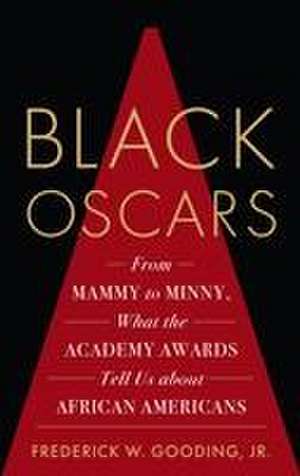
Black Oscars: From Mammy to Minny, What the Academy Awards Tell Us about African Americans
Autor professor Frederick Gooding Jr.en Limba Engleză Paperback – 26 noi 2022
In Black Oscars: From Mammy to Minny, What the Academy Awards Tell Us about African Americans, Frederick W. Gooding Jr. draws on American, African American, and film history to reflect on how the Oscars have recognized Black actors from the award's inception to the present. Starting in the 1920s, the chapters provide a thorough overview and analysis of Black actors nominated for their Hollywood roles during each decade, with special attention paid to the winners. Historical patterns are scrutinized to reveal racial trends and open the question of whether race relations have truly changed substantively or only superficially over time.
Given the Oscars' presence and popularity, it begs the question of what these awards reflect and reinforce about larger society. In the meticulously-researched Black Oscars, we see how the Academy Awards are an indispensable guide to understanding race in mainstream Hollywood and beyond.
Preț: 147.60 lei
Preț vechi: 183.46 lei
-20%
Puncte Express: 221
Carte tipărită la comandă
Livrare economică 30 noiembrie-14 decembrie
Livrare prin curier în România Termenul estimat este afișat lângă disponibilitate.
Transport gratuit de la 400.00 lei Plată online sau ramburs, în funcție de opțiunile comenzii.
Retur gratuit în 14 zile Comandă securizată și suport în română.
Specificații
ISBN-13: 9781538175682
ISBN-10: 1538175681
Pagini: 320
Ilustrații: 40 b/w photos; 6 tables
Dimensiuni: 151 x 228 x 18 mm
Greutate: 0.47 kg
Editura: Bloomsbury Publishing
Colecția Rowman & Littlefield
Locul publicării:New York, United States
ISBN-10: 1538175681
Pagini: 320
Ilustrații: 40 b/w photos; 6 tables
Dimensiuni: 151 x 228 x 18 mm
Greutate: 0.47 kg
Editura: Bloomsbury Publishing
Colecția Rowman & Littlefield
Locul publicării:New York, United States
Cuprins
PART I: INTRODUCTION
Introduction: Setting the Stage: What's So Oscar Worthy?
Chapter 1: Lights, Camera, Analysis!
Chapter 2: Early Drama behind Early Black Images (1927-1939)
PART II: CONFLICT & CLIMAX
Chapter 3: Oscar's Uneasy Breakthrough (1940-1949)
Chapter 4: New Roles Not Leading Anywhere (1950-1959)
Chapter 5: Sidney in the Sixties (1960-1969)
Chapter 6: The Blaxploitation Effect (1970-1979)
Chapter 7: The Color Purple through the Bluest Eye (1980-1989)
Chapter 8: The Denzel Effect (1990-1999)
Chapter 9: New Century, New Beginning? (2000-2009)
Chapter 10: Oscars So White (2010-2019)
PART III: CONCLUSION
Conclusion: Have We Seen This Movie Before? A Critical Analysis
Appendices
Appendix A, Black Oscar Nomination and Wins Overview, by Decade
Appendix B, List of All Movies with Black Oscar Nominations
Appendix C, List of All Black Oscar Acting Nominees and Wins
Appendix D, List of All Black, Non-Acting Oscar Winners
Introduction: Setting the Stage: What's So Oscar Worthy?
Chapter 1: Lights, Camera, Analysis!
Chapter 2: Early Drama behind Early Black Images (1927-1939)
PART II: CONFLICT & CLIMAX
Chapter 3: Oscar's Uneasy Breakthrough (1940-1949)
Chapter 4: New Roles Not Leading Anywhere (1950-1959)
Chapter 5: Sidney in the Sixties (1960-1969)
Chapter 6: The Blaxploitation Effect (1970-1979)
Chapter 7: The Color Purple through the Bluest Eye (1980-1989)
Chapter 8: The Denzel Effect (1990-1999)
Chapter 9: New Century, New Beginning? (2000-2009)
Chapter 10: Oscars So White (2010-2019)
PART III: CONCLUSION
Conclusion: Have We Seen This Movie Before? A Critical Analysis
Appendices
Appendix A, Black Oscar Nomination and Wins Overview, by Decade
Appendix B, List of All Movies with Black Oscar Nominations
Appendix C, List of All Black Oscar Acting Nominees and Wins
Appendix D, List of All Black, Non-Acting Oscar Winners
Recenzii
Highly Recommended . . . [Gooding] views the process of nominating films and actors for Academy Awards in the context of color. With the exception of chapter 1, the book is arranged chronologically by decade-from 1927-39 to 2000-19. Gooding starts with solid background on early Black roles in film and goes on to discuss the nominations and wins, starting of course with Hattie McDaniel, whose moving and quite humble acceptance speech has inspired actors of color since her 1939 win for her role in Gone with the Wind. Including an extensive bibliography, this book is noteworthy for its solid research and readability.
This rigorous and lively examination of the Black Oscar-winning experience with Hollywood's exploitation and oppression can easily be one of the most comprehensive [books] for anyone who is interested in the African American experience in film. Brimming with compelling examples and critical analyses, this text not only shows how the industry reinforces and perpetuates racism but also illuminates the ways in which Black artists tirelessly resist such forces in multiple forms of filmic presentation.
[Gooding] approaches the subject with clarity and compassion . . . refusing to judge ambitious performers for accepting roles as mammies and slaves or branching out from other fields into acting, while acknowledging that the prevalence of these characterizations and the failure of studios to hire trained black actors causes harm. He not only understands the complexity of the matter, but is able to pick apart the various elements and present them in a compelling matter. His thinking is academic, but he writes with fluidity, making the subject accessible.
This rigorous and lively examination of the Black Oscar-winning experience with Hollywood's exploitation and oppression can easily be one of the most comprehensive [books] for anyone who is interested in the African American experience in film. Brimming with compelling examples and critical analyses, this text not only shows how the industry reinforces and perpetuates racism but also illuminates the ways in which Black artists tirelessly resist such forces in multiple forms of filmic presentation.
[Gooding] approaches the subject with clarity and compassion . . . refusing to judge ambitious performers for accepting roles as mammies and slaves or branching out from other fields into acting, while acknowledging that the prevalence of these characterizations and the failure of studios to hire trained black actors causes harm. He not only understands the complexity of the matter, but is able to pick apart the various elements and present them in a compelling matter. His thinking is academic, but he writes with fluidity, making the subject accessible.