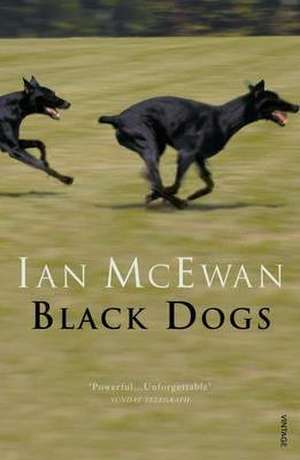
Black Dogs
Autor Ian McEwanen Limba Engleză Paperback – 3 sep 1998
In 1946, June and Bernard set off on their honeymoon. Fired by their ideals and passion for one another, they had planned an idyllic holiday, but in France they witness an event that alters the course of their lives entirely.
Forty years on, their son-in-law is trying to uncover the cause of their estrangement and is led back to this moment on honeymoon and an experience of such darkness it was to wrench the couple apart.
'Brilliant... A meditation on the intoxications of violence and the redemptive power of love' New Yorker
'Superbly evocative... The novel's of vision of Europe is acute and alive, vivid in its moral complexities' New York Times
'Powerful... Unforgettable' Sunday Telegraph
'Thoughtful and compassionate' London Review of Books
Preț: 58.21 lei
Preț vechi: 78.78 lei
-26%
Puncte Express: 87
Carte disponibilă
Livrare economică 30 octombrie-10 noiembrie
Livrare express 13-17 octombrie pentru 39.95 lei
Livrare prin curier în România Termenul estimat este afișat lângă disponibilitate.
Transport gratuit de la 400.00 lei Plată online sau ramburs, în funcție de opțiunile comenzii.
Retur gratuit în 14 zile Comandă securizată și suport în română.
Specificații
ISBN-13: 9780099277088
ISBN-10: 0099277085
Pagini: 208
Dimensiuni: 128 x 198 x 20 mm
Greutate: 0.2 kg
Editura: Random House
Colecția Vintage
Locul publicării:United Kingdom
ISBN-10: 0099277085
Pagini: 208
Dimensiuni: 128 x 198 x 20 mm
Greutate: 0.2 kg
Editura: Random House
Colecția Vintage
Locul publicării:United Kingdom
V-ar putea interesa
-
 A Lightning ARC Changed This ManC. B. CrosbyPreț: 80.00 lei
 -
 Waking the Tiger: A Novel of Sri LankaLeonard FeinbergPreț: 146.04 lei
 -
 Existential TrashX. J. StormPreț: 77.90 lei
 -
 Her Priorities His Options Part 1Miles, YolandaPreț: 66.28 lei
 -
 I'm Always by Your SideGates, SylvannahPreț: 86.27 lei
 -
 The Savage in My HeartWhitney WilliamsPreț: 78.07 lei
 -
 BenedictionFrancis Scott FitzgeraldPreț: 59.48 lei
 -
 Obsession TooS. K. LesslyPreț: 114.06 lei
 -
 Her Thickness Was His Weakness 2Nichole DecariPreț: 98.66 lei
 -
 No Peace for KimMcDonald, R. C.Preț: 83.59 lei
 -
 Be Careful What You Wish forCheryl Faye-35%Preț: 110.08 lei169.04 lei
 -
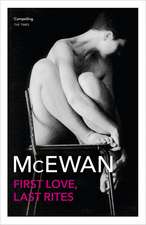 First Love, Last RitesIan McEwan-19%Preț: 57.14 lei70.92 lei
 -
 NutshellIan McEwan-20%Preț: 56.49 lei70.55 lei
 -
 HonigIan McEwanPreț: 108.39 lei
 -
 KindeswohlIan McEwanPreț: 100.82 lei
 -
 NussschaleIan McEwanPreț: 102.09 lei
 -
 SaturdayIan McEwanPreț: 89.44 lei
 -
 Das HeinerlePeter ClausPreț: 178.12 lei
 -
 Kaugummi für eine LeicheKlaus SchukerPreț: 111.18 lei
 -
 BølgegangSandra LüpkesPreț: 100.24 lei
Notă biografică
Ian McEwan is the critically acclaimed author of nineteen novels and two short story collections. His first published work, a collection of short stories, First Love, Last Rites, won the Somerset Maugham Award. His novels include The Child in Time, which won the 1987 Whitbread Novel of the Year Award; The Cement Garden; Enduring Love; Amsterdam, which won the 1998 Booker Prize; Atonement; Saturday; On Chesil Beach; Solar; Sweet Tooth; The Children Act; Nutshell; Machines Like Me; and Lessons. Atonement, Enduring Love, The Children Act and On Chesil Beach have all been adapted for the big screen.
Descriere
Black Dogs is a dark and brooding masterpiece from Booker-prize winning Sunday Times bestselling author Ian McEwan. In 1946, June and Bernard set off on their honeymoon.
Recenzii
"Brilliant. . . . [A] meditation on . . . the intoxications and the redemptive power of love." —The New Yorker
"Subtle and unforgettable." —Voice Literary Supplement
"The novel's vision of Europe is acute and alive, vivid in its moral complexities . . . we are conquered by the humanity, the urgency, of the novel's characters." —The New York Times Book Review
"Each scene is brilliantly lit, and has a characteristically strange fascination as Ian McEwan juxtaposes 'huge and tiny currents' to show the ways in which individuals react to history." —The New York Review of Books
"Subtle and unforgettable." —Voice Literary Supplement
"The novel's vision of Europe is acute and alive, vivid in its moral complexities . . . we are conquered by the humanity, the urgency, of the novel's characters." —The New York Times Book Review
"Each scene is brilliantly lit, and has a characteristically strange fascination as Ian McEwan juxtaposes 'huge and tiny currents' to show the ways in which individuals react to history." —The New York Review of Books