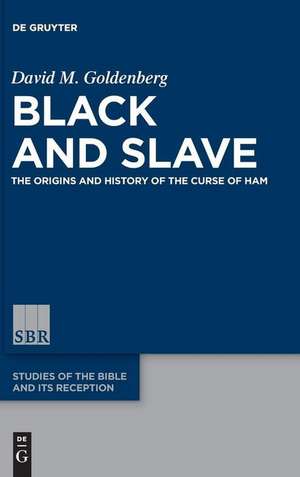
Black and Slave: Studies of the Bible and Its Reception (Sbr), cartea 10
Autor David M. Goldenbergen Limba Engleză Hardback – vârsta de la 22 ani
Preț: 855.07 lei
Preț vechi: 1110.48 lei
-23%
Puncte Express: 1283
Carte tipărită la comandă
Livrare economică 26 octombrie-09 noiembrie
Livrare prin curier în România Termenul estimat este afișat lângă disponibilitate.
Transport gratuit pentru acest produs Plată online sau ramburs, în funcție de opțiunile comenzii.
Retur gratuit în 14 zile Comandă securizată și suport în română.
Specificații
ISBN-13: 9783110521665
ISBN-10: 3110521660
Pagini: 200
Greutate: 0.69 kg
Seria Studies of the Bible and Its Reception (Sbr)
ISBN-10: 3110521660
Pagini: 200
Greutate: 0.69 kg
Seria Studies of the Bible and Its Reception (Sbr)
V-ar putea interesa
-
 HeavenPeter StanfordPreț: 78.80 lei
 -
 The Magdalene LegacyLaurence GardnerPreț: 115.80 lei
 -
 The Dead Sea Scrolls DeceptionMichael BaigentPreț: 132.36 lei
 -
 From Eden To ExileDavid RohlPreț: 134.43 lei
 -
 Some Aspects of Hittite ReligionOr GurneyPreț: 170.84 lei
 -
 Continuity and Change in Roman ReligionJ. H. W. G. Liebeschuetz-11%Preț: 379.05 lei425.16 lei
 -
 Preț: 193.23 lei
 -
 Religion and the Rise of Western CultureChristopher DawsonPreț: 112.35 lei
 -
 The New Stations of the CrossMegan MckennaPreț: 81.45 lei
 -
 Archaeology, Ritual, ReligionTimothy InsollPreț: 394.56 lei
 -
 Preț: 217.89 lei
 -
 Preț: 253.62 lei
 -
 A Short History of SecularismGraeme Smith-45%Preț: 110.99 lei200.33 lei
 -
 Islam: A Short historyW. Montgomery Watt-46%Preț: 79.81 lei148.19 lei
Notă biografică
David M. Goldenberg, University of Pennsylvania, Philadelphia, PA, U.S.A.
Descriere
Descriere de la o altă ediție sau format:
Studies of the Curse of Ham, the belief that the Bible consigned blacks to everlasting servitude, confuse and conflate two separate origins stories (etiologies), one of black skin and the other of black slavery. This work unravels the etiologies and shows how the Curse, an etiology of black slavery, evolved from an earlier etiology explaining the existence of dark-skinned people. We see when, where, why, and how an original mythic tale of black origins morphed into a story of the origins of black slavery, and how, in turn, the second then supplanted the first as an explanation for black skin. In the process we see how formulations of the Curse changed over time, depending on the historical and social contexts, reflecting and refashioning the way blackness and blacks were perceived. In particular, two significant developments are uncovered. First, a curse of slavery, originally said to affect various dark-skinned peoples, was eventually applied most commonly to black Africans. Second, blackness, originally incidental to the curse, in time became part of the curse itself. Dark skin now became an intentional marker of servitude, the visible sign of the blacks’ degradation, and in the process deprecating black skin itself.
Studies of the Curse of Ham, the belief that the Bible consigned blacks to everlasting servitude, confuse and conflate two separate origins stories (etiologies), one of black skin and the other of black slavery. This work unravels the etiologies and shows how the Curse, an etiology of black slavery, evolved from an earlier etiology explaining the existence of dark-skinned people. We see when, where, why, and how an original mythic tale of black origins morphed into a story of the origins of black slavery, and how, in turn, the second then supplanted the first as an explanation for black skin. In the process we see how formulations of the Curse changed over time, depending on the historical and social contexts, reflecting and refashioning the way blackness and blacks were perceived. In particular, two significant developments are uncovered. First, a curse of slavery, originally said to affect various dark-skinned peoples, was eventually applied most commonly to black Africans. Second, blackness, originally incidental to the curse, in time became part of the curse itself. Dark skin now became an intentional marker of servitude, the visible sign of the blacks’ degradation, and in the process deprecating black skin itself.