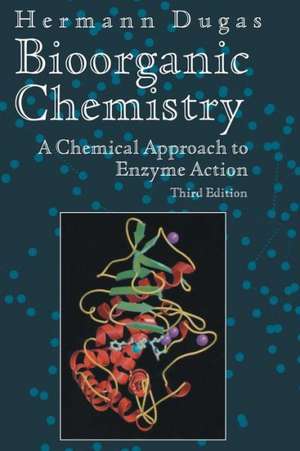
Bioorganic Chemistry: Springer Advanced Texts in Chemistry
Autor Hermann Dugasen Limba Engleză Paperback – 27 aug 1999
Preț: 401.84 lei
Puncte Express: 603
Carte tipărită la comandă
Livrare economică 08-22 decembrie
Livrare prin curier în România Termenul estimat este afișat lângă disponibilitate.
Transport gratuit pentru acest produs Plată online sau ramburs, în funcție de opțiunile comenzii.
Retur gratuit în 14 zile Comandă securizată și suport în română.
Specificații
ISBN-13: 9780387989105
ISBN-10: 0387989102
Pagini: 724
Ilustrații: XVIII, 700 p. 119 illus., 6 illus. in color.
Dimensiuni: 155 x 235 x 39 mm
Greutate: 1.08 kg
Ediția:Third Edition 1996
Editura: Springer
Colecția Springer Advanced Texts in Chemistry
Seria Springer Advanced Texts in Chemistry
Locul publicării:New York, NY, United States
ISBN-10: 0387989102
Pagini: 724
Ilustrații: XVIII, 700 p. 119 illus., 6 illus. in color.
Dimensiuni: 155 x 235 x 39 mm
Greutate: 1.08 kg
Ediția:Third Edition 1996
Editura: Springer
Colecția Springer Advanced Texts in Chemistry
Seria Springer Advanced Texts in Chemistry
Locul publicării:New York, NY, United States
V-ar putea interesa
-
 -23%Preț: 558.74 lei725.64 lei
 -
 The Machinery of LifeDavid S. GoodsellPreț: 220.59 lei
 -
 Real-time PCRM Dorak-15%Preț: 623.23 lei733.21 lei
 -
 Van der Waals ForcesV. Adrian Parsegian-11%Preț: 575.42 lei646.54 lei
 -
 Chemistry for the Life SciencesRaul Sutton-15%Preț: 438.96 lei516.43 lei
 -
 cGMP: Generators, Effectors and Therapeutic ImplicationsHarald H. H. W. Schmidt-18%Preț: 1904.62 lei2322.71 lei
 -
 Essentials of BiochemistryHerbert J. FrommPreț: 414.64 lei
 -
 Bioelectronic Vision: Retina Models, Evaluation Metrics and System DesignJOAO CARLOS MARTINS-18%Preț: 705.65 lei860.55 lei
Public țintă
GraduateCuprins
1 Introduction to Bioorganic Chemistry.- 1.1 Basic Considerations.- 1.2 Proximity Effects in Organic Chemistry.- 1.3 Molecular Adaptation.- 1.4 Molecular Recognition and the Supramolecular Level.- 2 Bioorganic Chemistry of Amino Acids and Polypeptides.- 2.1 Chemistry of the Living Cells.- 2.2 Analogy Between Organic Reactions and Biochemical Transformations.- 2.3 Chemistry of the Peptide Bond.- 2.4 Nonribosomal Peptide Bond Formation.- 2.5 Asymmetric Synthesis of ?-Amino Acids.- 2.6 Asymmetric Synthesis with Chiral Organometallic Catalysts.- 2.7 Transition State Analogs.- 2.8 Antibodies as Enzymes.- 2.9 Chemical Mutations.- 2.10 Molecular Recognition and Drug Design.- 3 Bioorganic Chemistry of the Phosphate Groups and Polynucleotides.- 3.1 Basic Considerations.- 3.2 Energy Storage.- 3.3 Hydrolytic Pathways and Pseudorotation.- 3.4 DNA Intercalants.- 4 Enzyme Chemistry.- 4.1 Introduction to Catalysis.- 4.2 Introduction to Enzymes.- 4.3 Multifunctional Catalysis and Simple Models.- 4.4 ?-Chymotrypsin.- 4.5 Other Hydrolytic Enzymes.- 4.6 Stereoelectronic Control in Hydrolytic Reactions.- 4.7 Immobilized Enzymes and Enzyme Technology.- 4.8 Enzymes in Synthetic Organic Chemistry.- 4.9 Enzyme-Analog-Built Polymers.- 4.10 Design of Molecular Clefts.- 5 Enzyme Models.- 5.1 Host-Guest Complexation Chemistry.- 5.2 New Developments in Crown Ether Chemistry.- 5.3 Membrane Chemistry and Micelles.- 5.4 Polymers.- 5.5 Cyclodextrins.- 5.6 Enzyme Design Using Steroid Template.- 5.7 Remote Functionalization Reactions.- 5.8 Biomimetic Polyene Cyclizations.- 6 Metal Ions.- 6.1 Metal Ions in Proteins and Biological Molecules.- 6.2 Carboxypeptidase A and the Role of Zinc.- 6.3 Hydrolysis of Amino Acid Esters and Amides and Peptides.- 6.4 Iron and Oxygen Transport.- 6.5 Copper Ion.- 6.6Biomodels of Photosynthesis and Energy Transfer.- 6.7 Cobalt and Vitamin B12 Action.- 7 Coenzyme Chemistry.- 7.1 Oxidoreduction.- 7.2 Pyridoxal Phosphate.- 7.3 Suicide Enzyme Inactivators and Affinity Labels.- 7.4 Thiamine Pyrophosphate.- 7.5 Biotin.- 8 Molecular Devices.- 8.1 Introduction to Self-Organization and Self-Assembly.- 8.2 General Overview of the Approach.- 8.3 Specific Examples.- References.