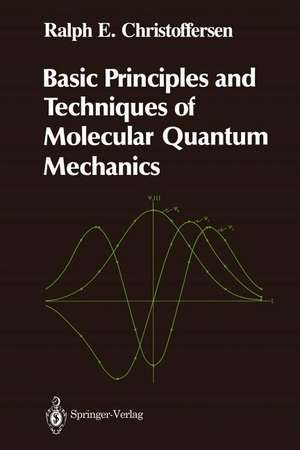
Basic Principles and Techniques of Molecular Quantum Mechanics: Springer Advanced Texts in Chemistry
Autor Ralph E. Christoffersenen Limba Engleză Paperback – 21 mar 2012






Preț: 416.33 lei
Puncte Express: 624
Carte tipărită la comandă
Livrare economică 08-22 decembrie
Livrare prin curier în România Termenul estimat este afișat lângă disponibilitate.
Transport gratuit pentru acest produs Plată online sau ramburs, în funcție de opțiunile comenzii.
Retur gratuit în 14 zile Comandă securizată și suport în română.
Specificații
ISBN-13: 9781468463620
ISBN-10: 1468463624
Pagini: 704
Ilustrații: XIV, 686 p.
Dimensiuni: 155 x 235 x 38 mm
Greutate: 1.05 kg
Ediția:Softcover reprint of the original 1st ed. 1989
Editura: Springer
Colecția Springer Advanced Texts in Chemistry
Seria Springer Advanced Texts in Chemistry
Locul publicării:New York, NY, United States
ISBN-10: 1468463624
Pagini: 704
Ilustrații: XIV, 686 p.
Dimensiuni: 155 x 235 x 38 mm
Greutate: 1.05 kg
Ediția:Softcover reprint of the original 1st ed. 1989
Editura: Springer
Colecția Springer Advanced Texts in Chemistry
Seria Springer Advanced Texts in Chemistry
Locul publicării:New York, NY, United States
V-ar putea interesa
-
 Introducing Biological Energetics: How Energy and Information Control the Living WorldNorman W. H. Cheetham-20%Preț: 454.38 lei570.73 lei
 -
 -30%Preț: 963.71 lei1379.37 lei
 -
 Chemical BiophysicsDaniel A. BeardPreț: 511.37 lei
 -
 BiophysicsPatrick F. Dillon-19%Preț: 547.25 lei675.62 lei
 -
 The Physics of Living ProcessesThomas Andrew Waigh-15%Preț: 689.52 lei811.20 lei
 -
 Biophysics For DummiesKen VosPreț: 126.26 lei
 -
 Biomechanics For DummiesSteve MccawPreț: 135.04 lei
 -
 Fundamentals of BiophysicsAndrey B Rubin-9%Preț: 1250.81 lei1374.52 lei
 -
 Ecological MicrocosmsRobert J. BeyersPreț: 408.37 lei
 -
 Continuum Mechanics of Anisotropic MaterialsStephen C. CowinPreț: 418.25 lei
 -
 -11%Preț: 430.95 lei484.20 lei
 -
 Design in NatureClaus Mattheck-18%Preț: 926.24 lei1129.56 lei
Public țintă
ResearchCuprins
1 Experimental Basis of Quantum Theory.- 1-1. Introductory Remarks.- 1-2. Classical Concepts of Linear Momentum, Angular Momentum, and Energy.- 1-3. Energy Levels and Photons.- 1-4. Electron Impact Experiments.- 1-5. Atomic Spectra.- 1-6. Quantization of Angular Momentum.- 1-7. Momentum of a Photon.- 1-8. Wave-Particle Duality.- Problems.- 2 Vector Spaces and Linear Transformations.- 2-1. Vector Spaces.- 2-2. Linear Independence, Bases, and Dimensionality.- 2-3. Inner Product Spaces.- 2-4. Orthonormality and Complete Sets.- 2-5. Hilbert Space.- 2-6. Function Space and Generalized Fourier Series.- 2-7. Isomorphism between Hilbert Space and Function Space.- 2-8. Examples of Complete Sets of Functions.- 2-9. Extension to Continuum Functions.- 2-10. Function Minimization with Constraints.- 2-11. Linear Operators.- 2-12. Algebra of Linear Operators.- 2-13. Special Kinds of Linear Operators.- 2-14. Eigenvalues and Eigenvectors.- Problems.- 3 Matrix Theory.- 3-1. Elements of Matrix Algebra.- 3-2. Determinants.- 3-3. Characterization of Square Matrices.- 3-4. Matrix Inversion.- 3-5. Matrices Having Special Properties.- 3-6. Matrix Representations of Linear Operators and Matrix Transformations.- 3-7. Changes of Basis and Similarity Transformations.- 3-8. Matrix Eigenvalue Problems.- 3-9. Infinite Matrices and Linear Transformations on Hilbert Space.- 3-10. Dirac Notation.- Problems.- 4 Postulates of Quantum Mechanics and Initial Considerations.- 4-1. Quantum Mechanical States and Observables.- 4-2. Time Evolution of a Quantum State.- 4-3. Quantum Theory of Measurement and Expectation Values.- 4-4. Compatible Observables and Commuting Operators.- 4-5. Constants of Motion and Transition Probabilities.- 4-6. Different Pictures of Quantum Phenomena.- 4-7. Hamiltonian Operator Construction: Initial Considerations.- Problems.- 5 One-Dimensional Model Problems.- 5-1. General Comments.- 5-2. Wavefunction Criteria and Boundary Conditions.- 5-3. The Nondegeneracy Theorem.- 5-4. Particle on a Ring.- 5-5. Particle Trapped in a Box.- 5-6. Parity of Eigenfunctions.- 5-7. Square Well Potential.- 5-8. Double Wells and Tunneling.- 5-9. The Harmonic Oscillator.- 5-10. Zero Point Energy and the Uncertainty Principle.- Problems.- 6 Angular Momentum.- 6-1. Introduction.- 6-2. General Angular Momentum Considerations.- 6-3. Orbital Angular Momentum.- 6-4. Spin Angular Momentum.- Problems.- 7 The Hydrogen Atom, Rigid Rotor, and the H2+ Molecule.- 7-1. Separation of Motion of Center of Mass.- 7-2. Solution of Equation for Relative Electron Motion of the Hydrogen Atom and Hydrogen-Like Atoms.- 7-3. Wavefunction Shapes.- 7-4. Rigid Rotor.- 7-5. The H2+ Molecule.- Problems.- 8 The Molecular Hamiltonian.- 8-1. General Principles and Discussion.- 8-2. Introduction of External Fields.- 8-3. Introduction of Relativistic Effects.- 8-4. The Born-Oppenheimer Approximation.- Problems.- 9 Approximation Methods for Stationary States.- 9-1. The Variation Principle.- 9-2. Accuracy Considerations.- 9-3. Example: The Hydrogen Atom.- 9-4. Example: Variational Treatment of the Helium Atom.- 9-5. The Linear Variation Method.- 9-6. Example: The Hydrogen Atom Revisited.- 9-7. Lower Bounds.- 9-8. Rayleigh-Schrödinger Perturbation Theory.- 9-9. Brillouin-Wigner Perturbation Theory.- Problems.- 10 General Considerations for Many Electron Systems.- 10-1. Early Computational Concepts and Procedures.- 10-2. Symmetry Considerations and Group Theory.- 10-3. Antisymmetry and the Pauli Exclusion Principle.- 10-4. Multielectron Systems and Slater Determinants.- 10-5. Expansion Theorem and SlaterDeterminant Expansions.- 10-6. Matrix Elements between Slater Determinants.- 10-7. Virial Theorem, Hypervirial Theorem, and Hellmann-Feynman Theorem.- 10-8. Scaling.- 10-9. Coupling of Angular Momenta.- 10-10. Orbital Transformations.- Problems.- 11 Computational Techniques for Many-Electron Systems Using Single Configuration Wavefunctions.- 11-1. Hartree-Fock Theory for Closed Shell Systems.- 11-2. Hall-Roothaan LCAO-MO-SCF Theory for Closed Shell Systems.- 11-3. Hartree-Fock Theory for Open Shell Systems.- Problems.- 12 Beyond Hartree—Fock Theory.- 12-1. Electron Correlation: General Comments.- 12-2. Configuration Interaction.- 12-3. Specialized CI Approaches.- 12-4. Many-Body Perturbation Theory and Coupled Cluster Theory.- Problems.- Appendix 1.- References.