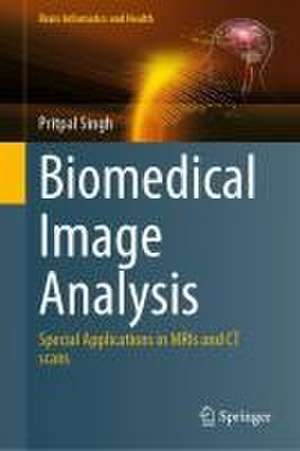
Biomedical Image Analysis: Brain Informatics and Health
Autor Pritpal Singhen Limba Engleză Hardback – 29 feb 2024
reviews and summarizes previous research work in biomedical image analysis and
also provides a brief introduction to other computation techniques, such as
fuzzy sets, neutrosophic sets, clustering algorithm and fast forward quantum
optimization algorithm, focusing on how these techniques can be integrated into
different phases of the biomedical image analysis. In particular, this book
describes novel methods resulting from the fuzzy sets, neutrosophic sets,
clustering algorithm and fast forward quantum optimization algorithm. It also
demonstrates how a new quantum-clustering based model can be successfully
applied in the context of clustering the COVID-19 CT scans. Thanks to its
easy-to-read style and the clear explanations of the models, the book can be
used as a concise yet comprehensive reference guide to biomedical image
analysis, and will be valuable not only for graduate students, but also for
researchers and professionals working for academic, business and government institutes and medical colleges.
Preț: 933.77 lei
Preț vechi: 1167.21 lei
-20%
Puncte Express: 1401
Carte tipărită la comandă
Livrare economică 06-20 noiembrie
Livrare prin curier în România Termenul estimat este afișat lângă disponibilitate.
Transport gratuit pentru acest produs Plată online sau ramburs, în funcție de opțiunile comenzii.
Retur gratuit în 14 zile Comandă securizată și suport în română.
Specificații
ISBN-13: 9789819999385
ISBN-10: 9819999383
Pagini: 180
Ilustrații: XI, 166 p. 1 illus.
Dimensiuni: 160 x 241 x 16 mm
Greutate: 0.43 kg
Ediția:2024
Editura: Springer
Colecția Brain Informatics and Health
Seria Brain Informatics and Health
Locul publicării:Singapore, Singapore
ISBN-10: 9819999383
Pagini: 180
Ilustrații: XI, 166 p. 1 illus.
Dimensiuni: 160 x 241 x 16 mm
Greutate: 0.43 kg
Ediția:2024
Editura: Springer
Colecția Brain Informatics and Health
Seria Brain Informatics and Health
Locul publicării:Singapore, Singapore
V-ar putea interesa
-
 Head and Neck Imaging - 2 Volume SetPeter M. Som-40%Preț: 1937.04 lei3242.03 lei
 -
 -5%Preț: 656.48 lei691.03 lei
 -
 Breast Imaging: The Core RequisitesBonnie N. Joe-28%Preț: 487.81 lei676.00 lei
 -
 Fundamentals of Body MRIChristopher G. Roth-28%Preț: 637.44 lei882.46 lei
 -
 Sectional Anatomy by MRI and CTMark W. Anderson-29%Preț: 1795.94 lei2520.33 lei
 -
 Obstetric Imaging: Fetal Diagnosis and CareJoshua A. Copel-28%Preț: 1710.43 lei2377.75 leiRecomandat
 -
 Anatomy for Diagnostic ImagingStephanie Ryan-29%Preț: 414.43 lei582.61 lei
 -
 The Physics of Clinical MR Taught Through ImagesVal M. Runge-5%Preț: 623.08 lei655.87 lei
 -
 -24%Preț: 822.10 lei1081.71 lei
 -
 The Latest Developments and Challenges in Biomedical EngineeringPawe¿ Strumi¿¿o-18%Preț: 1234.02 lei1504.90 lei
 -
 Advances in Intelligent Disease Diagnosis and TreatmentChee-Peng Lim-20%Preț: 1236.64 lei1545.80 lei
 -
 -20%Preț: 1169.68 lei1462.10 lei
 -
 -20%Preț: 534.25 lei667.82 lei
 -
 The NeuronomiconGrayson W. Hooper-5%Preț: 434.27 lei457.12 lei
 -
 Classification in BioAppsNilanjan Dey-15%Preț: 661.36 lei778.08 lei
 -
 Clinical MR ImagingPeter Reimer-5%Preț: 1400.83 lei1474.56 lei
 -
 -18%Preț: 702.65 lei856.89 lei
 -
 Intelligent Analysis of Optical ImagesZhengjun Liu-18%Preț: 902.47 lei1100.58 lei
 -
 -5%Preț: 1240.38 lei1305.66 lei
 -
 Digital Molecular Magnetic Resonance ImagingBamidele O. Awojoyogbe-18%Preț: 1124.56 lei1371.42 lei
Cuprins
Chapter 1 Parkinson's disease MRIs analysis using fuzzy clustering approach.- Chapter 2 Parkinson's disease MRIs analysis using neutrosophic segmentation approach.- Chapter 3 Parkinson's disease MRIs analysis using neutrosophic clustering approach.- Chapter 4 Brain tumor segmentation using type-2 neutrosophic thresholding approach.- Chapter 5 COVID-19 scan image segmentation using quantum-clustering approach.- Chapter 6 Empirical Analyses.
Notă biografică
PRITPAL SINGH, assistant professor in Central
University of Rajasthan, India.He has an academic experience of more than 7
years.
He served as
a Senior Postdoctoral Fellow in the Department of Electrical Engineering at the
Taipei National University of Technology, Taiwan, from 2019-2020. He is working as an
Adjunct Professor (Research) from November, 2020 in
the Institute of Theoretical Physics, Jagiellonian University,
Poland. He is an active research
member of Bio-Data Research Group (under TEAM-NET Program) in the Institute of Theoretical
Physics, Jagiellonian UniversityHis
His research interests include ambiguous set theory,
soft computing, optimization algorithms (especially quantum-based
optimization), time series forecasting, image analysis, fMRI data analysis,
machine learning, mathematical modeling and simulation. He has published
numerous papers in refereedSCI journals, conference proceedings, book chapters
and book.
University of Rajasthan, India.He has an academic experience of more than 7
years.
He served as
a Senior Postdoctoral Fellow in the Department of Electrical Engineering at the
Taipei National University of Technology, Taiwan, from 2019-2020. He is working as an
Adjunct Professor (Research) from November, 2020 in
the Institute of Theoretical Physics, Jagiellonian University,
Poland. He is an active research
member of Bio-Data Research Group (under TEAM-NET Program) in the Institute of Theoretical
Physics, Jagiellonian UniversityHis
His research interests include ambiguous set theory,
soft computing, optimization algorithms (especially quantum-based
optimization), time series forecasting, image analysis, fMRI data analysis,
machine learning, mathematical modeling and simulation. He has published
numerous papers in refereedSCI journals, conference proceedings, book chapters
and book.
Textul de pe ultima copertă
This book provides an in-depth study of biomedical image analysis. It reviews and summarizes previous research work in biomedical image analysis and
also provides a brief introduction to other computation techniques, such as
fuzzy sets, neutrosophic sets, clustering algorithm and fast forward quantum
optimization algorithm, focusing on how these techniques can be integrated into
different phases of the biomedical image analysis. In particular, this book
describes novel methods resulting from the fuzzy sets, neutrosophic sets,
clustering algorithm and fast forward quantum optimization algorithm. It also
demonstrates how a new quantum-clustering based model can be successfully
applied in the context of clustering the COVID-19 CT scans. Thanks to its
easy-to-read style and the clear explanations of the models, the book can be
used as a concise yet comprehensive reference guide to biomedical image
analysis, and will be valuable not only for graduate students, but also for
researchers and professionals working for academic, business and government institutes and medical colleges.
also provides a brief introduction to other computation techniques, such as
fuzzy sets, neutrosophic sets, clustering algorithm and fast forward quantum
optimization algorithm, focusing on how these techniques can be integrated into
different phases of the biomedical image analysis. In particular, this book
describes novel methods resulting from the fuzzy sets, neutrosophic sets,
clustering algorithm and fast forward quantum optimization algorithm. It also
demonstrates how a new quantum-clustering based model can be successfully
applied in the context of clustering the COVID-19 CT scans. Thanks to its
easy-to-read style and the clear explanations of the models, the book can be
used as a concise yet comprehensive reference guide to biomedical image
analysis, and will be valuable not only for graduate students, but also for
researchers and professionals working for academic, business and government institutes and medical colleges.
Caracteristici
Provides in-depth description of algorithms Discusses various biomedical image segmentation and clustering algorithms Investigates different image analysis methods applied to MRIs and CT scans