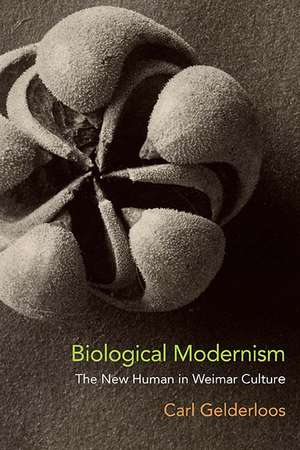
Biological Modernism: The New Human in Weimar Culture
Autor Carl Gelderloosen Limba Engleză Paperback – 15 dec 2019
Honorable Mention for the DAAD/GSA Book Prize for the Best Book in Germanistik or Cultural Studies
Biological Modernism identifies an intellectual current in the Weimar Republic that drew on biology, organicism, vitalism, and other discourses associated with living nature in order to redefine the human being for a modern, technological age. Contrary to the assumption that any turn toward the organic indicated a reactionary flight from modernity or a longing for wholeness, Carl Gelderloos shows that biology and other discourses of living nature offered a nuanced way of theorizing modernity rather than fleeing from it. Organic life, instead of representing a stabilizing sense of wholeness, by the 1920s had become a scientific, philosophical, and disciplinary problem. In their work, figures such as Alfred Döblin, Ernst Jünger, Helmuth Plessner, and August Sander interrogated the relationships between technology, nature, and the human and radically reconsidered the relationship between the disciplines as well as the epistemological and political consequences for defining the human being. Biological Modernism will be of interest to scholars of German literature and culture, literary modernism, photography, philosophical anthropology, twentieth-century intellectual history, the politics of culture, and the history of science.
Biological Modernism identifies an intellectual current in the Weimar Republic that drew on biology, organicism, vitalism, and other discourses associated with living nature in order to redefine the human being for a modern, technological age. Contrary to the assumption that any turn toward the organic indicated a reactionary flight from modernity or a longing for wholeness, Carl Gelderloos shows that biology and other discourses of living nature offered a nuanced way of theorizing modernity rather than fleeing from it. Organic life, instead of representing a stabilizing sense of wholeness, by the 1920s had become a scientific, philosophical, and disciplinary problem. In their work, figures such as Alfred Döblin, Ernst Jünger, Helmuth Plessner, and August Sander interrogated the relationships between technology, nature, and the human and radically reconsidered the relationship between the disciplines as well as the epistemological and political consequences for defining the human being. Biological Modernism will be of interest to scholars of German literature and culture, literary modernism, photography, philosophical anthropology, twentieth-century intellectual history, the politics of culture, and the history of science.
| Toate formatele și edițiile | Preț | Express |
|---|---|---|
| Paperback (1) | 260.53 lei 6-8 săpt. | |
| Northwestern University Press – 15 dec 2019 | 260.53 lei 6-8 săpt. | |
| Hardback (1) | 753.45 lei 6-8 săpt. | |
| Northwestern University Press – 15 dec 2019 | 753.45 lei 6-8 săpt. |
Preț: 260.53 lei
Puncte Express: 391
Preț estimativ în valută:
46.09€ • 54.03$ • 40.09£
46.09€ • 54.03$ • 40.09£
Carte tipărită la comandă
Livrare economică 05-19 martie
Preluare comenzi: 021 569.72.76
Specificații
ISBN-13: 9780810141322
ISBN-10: 0810141329
Pagini: 240
Ilustrații: 12 b-w images
Dimensiuni: 152 x 229 x 30 mm
Greutate: 0.31 kg
Editura: Northwestern University Press
Colecția Northwestern University Press
ISBN-10: 0810141329
Pagini: 240
Ilustrații: 12 b-w images
Dimensiuni: 152 x 229 x 30 mm
Greutate: 0.31 kg
Editura: Northwestern University Press
Colecția Northwestern University Press
Notă biografică
CARL GELDERLOOS is an associate professor of German studies at Binghamton University.
Cuprins
Introduction: Modern German Culture in a Life Crisis
1. Helmuth Plessner’s Eccentric Human among the Disciplines
2. Photography's Natural Histories in the Weimar Republic
3. Döblin’s Epic Embodied
4. Organic Modernization: Wholeness and Development in Ernst Jünger’s The Worker
Conclusion
Notes
Index
1. Helmuth Plessner’s Eccentric Human among the Disciplines
2. Photography's Natural Histories in the Weimar Republic
3. Döblin’s Epic Embodied
4. Organic Modernization: Wholeness and Development in Ernst Jünger’s The Worker
Conclusion
Notes
Index
Recenzii
“An important contribution to the ongoing reassessment of modernism across the disciplines. Through close readings of Plessner, Blossfeldt, Döblin, and Jünger, Gelderloos develops a compelling argument about the centrality of the discourse of organicism to the reconceptualization of life, form, and the work of art. In so doing, he liberates the organic from the embrace of right-wing thought and makes it available for a new understanding of the critique of bourgeois humanism in Weimar culture.” —Sabine Hake, author of The Proletarian Dream: Socialism, Culture, and Emotion in Germany, 1863–1933
“Gelderloos dismantles the dualities so often used to define Weimar Culture, and offers a series of incisive close-readings to present the many ways in which intellectuals and artists imagined modernity through the contested site of organic life. The book is a model of transdisciplinary scholarship that emphasizes the interconnectedness of the humanities and science studies, and it is a significant contribution to an exciting area of research that asks us to rethink our understanding of European modernism.” —Stefanie Harris, author of Mediating Modernity: German Literature and the “New” Media, 1895–1930
"A thoughtful and versatile scholar at home in biology, philosophy, photography, literature, and the social and political history of Weimar Germany, Carl Gelderloos adroitly identifies a 'biological modernism' at play in Weimar organicism, one that can be seen not only in the science of the period but also across the arts and humanities." —Mark S. Morrisson, author of Modernism, Science, and Technology
“Biological Modernism: The New Human in Weimar Culture is a thought-provoking reexamination of some of the most entrenched narratives we have about modernity in the Weimar Republic.” —June J. Hwang, author of Lost in Time: Locating the Stranger in German Modernity
". . . a richly revealing and thought-provoking study . . ." —David Midgley, Modern Language Review
". . . represents an original, new lens on the aesthetic and intellectual project of modernity. By emphasizing the significance of organicism and biological thinking to the project of modernity, Biological Modernism shows how Weimar‐era thinkers challenged deep‐seated dualisms to renegotiate both what it meant to be human, and also what it meant to be modern." —Katie Sutton, The German Quarterly
"In the careful and nuanced close readings across its four chapters, Biological Modernism itself performs some of the interdisciplinarity that it locates in Weimar culture." —Joela Jacobs, The Germanic Review
“Gelderloos dismantles the dualities so often used to define Weimar Culture, and offers a series of incisive close-readings to present the many ways in which intellectuals and artists imagined modernity through the contested site of organic life. The book is a model of transdisciplinary scholarship that emphasizes the interconnectedness of the humanities and science studies, and it is a significant contribution to an exciting area of research that asks us to rethink our understanding of European modernism.” —Stefanie Harris, author of Mediating Modernity: German Literature and the “New” Media, 1895–1930
"A thoughtful and versatile scholar at home in biology, philosophy, photography, literature, and the social and political history of Weimar Germany, Carl Gelderloos adroitly identifies a 'biological modernism' at play in Weimar organicism, one that can be seen not only in the science of the period but also across the arts and humanities." —Mark S. Morrisson, author of Modernism, Science, and Technology
“Biological Modernism: The New Human in Weimar Culture is a thought-provoking reexamination of some of the most entrenched narratives we have about modernity in the Weimar Republic.” —June J. Hwang, author of Lost in Time: Locating the Stranger in German Modernity
". . . a richly revealing and thought-provoking study . . ." —David Midgley, Modern Language Review
". . . represents an original, new lens on the aesthetic and intellectual project of modernity. By emphasizing the significance of organicism and biological thinking to the project of modernity, Biological Modernism shows how Weimar‐era thinkers challenged deep‐seated dualisms to renegotiate both what it meant to be human, and also what it meant to be modern." —Katie Sutton, The German Quarterly
"In the careful and nuanced close readings across its four chapters, Biological Modernism itself performs some of the interdisciplinarity that it locates in Weimar culture." —Joela Jacobs, The Germanic Review
Descriere
Biological Modernism details how German writers during the Weimar Republic drew on discourses and tropes from the biological sciences to redefine the human being for a modern, technological age.