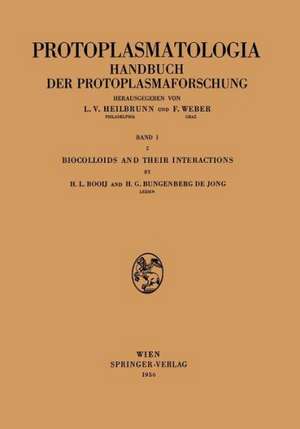
Biocolloids and their Interactions: With Special Reference to Coacervates and Related Systems: Protoplasmatologia Cell Biology Monographs, cartea 1 / 2
Autor Heinerle L. Booij, Hendrik G. Bungenberg de Jongen Limba Engleză Paperback – 1956
Din seria Protoplasmatologia Cell Biology Monographs
-
 Preț: 393.27 lei
 -
 Preț: 363.41 lei
 - 5%
 Preț: 378.72 lei
 - 15%
 Preț: 482.75 lei
 -
 Preț: 396.46 lei
 - 15%
 Preț: 476.16 lei
 -
 Preț: 396.46 lei
 -
 Preț: 394.58 lei
 -
 Preț: 406.04 lei
 - 15%
 Preț: 612.38 lei
 -
 Preț: 365.09 lei
 -
 Preț: 408.65 lei
 -
 Preț: 400.87 lei
 -
 Preț: 396.25 lei
 -
 Preț: 395.52 lei
 -
 Preț: 363.99 lei
 -
 Preț: 374.69 lei
 -
 Preț: 364.92 lei
 -
 Preț: 396.83 lei
 -
 Preț: 370.10 lei
 -
 Preț: 364.35 lei
 -
 Preț: 364.35 lei
 - 15%
 Preț: 609.39 lei
 -
 Preț: 399.60 lei
 -
 Preț: 362.15 lei
 -
 Preț: 372.50 lei
 -
 Preț: 369.16 lei
 -
 Preț: 370.62 lei
 -
 Preț: 365.45 lei
 -
 Preț: 395.89 lei
 - 15%
 Preț: 476.16 lei
 -
 Preț: 400.33 lei
 -
 Preț: 378.95 lei
 -
 Preț: 405.14 lei
 -
 Preț: 364.35 lei
 - 15%
 Preț: 612.68 lei
 -
 Preț: 395.68 lei
 -
 Preț: 366.19 lei
 -
 Preț: 397.35 lei
 -
 Preț: 400.87 lei
 -
 Preț: 394.78 lei
 - 15%
 Preț: 472.56 lei
 - 15%
 Preț: 479.76 lei
 -
 Preț: 397.19 lei
Preț: 368.79 lei
Puncte Express: 553
Carte tipărită la comandă
Livrare economică 07-21 decembrie
Livrare prin curier în România Termenul estimat este afișat lângă disponibilitate.
Transport gratuit de la 400.00 lei Plată online sau ramburs, în funcție de opțiunile comenzii.
Retur gratuit în 14 zile Comandă securizată și suport în română.
Specificații
ISBN-13: 9783211804216
ISBN-10: 3211804218
Pagini: 168
Ilustrații: IV, 164 p.
Dimensiuni: 178 x 254 x 9 mm
Greutate: 0.3 kg
Editura: SPRINGER VIENNA
Colecția Springer
Seriile Protoplasmatologia Cell Biology Monographs, Grundlagen
Locul publicării:Vienna, Austria
ISBN-10: 3211804218
Pagini: 168
Ilustrații: IV, 164 p.
Dimensiuni: 178 x 254 x 9 mm
Greutate: 0.3 kg
Editura: SPRINGER VIENNA
Colecția Springer
Seriile Protoplasmatologia Cell Biology Monographs, Grundlagen
Locul publicării:Vienna, Austria
V-ar putea interesa
-
 Principles and Practice of Clinical ResearchJohn I. Gallin-24%Preț: 674.01 lei887.05 lei
 -
 The Frailty ModelLuc Duchateau-15%Preț: 671.62 lei790.14 lei
 -
 Bioconductor Case StudiesFlorian Hahne-15%Preț: 702.45 lei826.42 lei
 -
 -5%Preț: 408.84 lei430.35 lei
 -
 Qualitative Research Methods iThompson-5%Preț: 379.78 lei399.77 lei
 -
 Clinical Research in Complementary and Integrative MedicineClaudia M Witt-5%Preț: 292.81 lei308.21 lei
 -
 Designing and Conducting Gender, Sex, and Health ResearchJohn L. Oliffe-27%Preț: 790.45 lei1082.82 lei
 -
 Bone-Implant Interface in Orthopedic SurgeryTheofilos Karachalios-5%Preț: 1151.17 lei1211.75 lei
 -
 -11%Preț: 876.36 lei984.28 lei
 -
 Pharmacological Basis of Acute CareYoo Kuen Chan-5%Preț: 813.09 lei855.88 lei
 -
 Ovulation Stimulation with GonadotropinsJean-Claude Emperaire-5%Preț: 739.26 lei778.17 lei
 -
 -5%Preț: 848.73 lei893.39 lei
 -
 -5%Preț: 1146.56 lei1206.90 lei
Public țintă
ResearchCuprins
1. The Rôle of Colloids in Biological Systems.- References.- 2. Colloid Systems.- References.- 3. Colloids with Electrolytic Nature.- Antagonism of ions.- References.- 4. Complex Systems.- a) Unicomplex systems.- b) Dicomplex systems.- c) Tricomplex systems.- d) Some biological examples.- References.- 5. Association Colloids.- a) Introduction; micelle types.- b) Colloid systems of simple detergents, characterised by the presence of sandwich micelles.- c) The binding of the oppositely charged ion (The sandwich micelle regarded as a complex system).- d) Phosphatides regarded as association colloids.- e) Suitability of phosphatides for biological purposes.- References.- 6. Elastic-Viscous Systems of Association Colloids.- a) Introduction.- b) Viscosity.- c) Elastic-viscous systems are in thermodynamic equilibrium.- d) Characteristic quantities describing the elastic properties.- e) G, ? and ? as a function of the oleate concentration.- f) A comparison of the elastic behaviour of elastic-viscous systems of various soaps.- g) Elastic-viscous systems of long chain electrolytes of the second and third categories (phosphatides).- References.- 7. The Interaction between Organic Substances and Lipophilic Colloid Systems.- a) Introduction.- b) Methods.- c) The activity of aliphatic substances.- d) The activity of aromatic (and heterocyclic) substances.- e) The distribution of organic substances in the soap/salt/water system.- f) The influence of alcohols on the fixation of ions.- g) The influence of organic substances on elastic-viscous systems.- h) Biological perspectives.- References.- 8. Interaction between Long Chain Electrolytes and Proteins.- a) Introduction. The coacervation gelatin + detergent + salt.- b) The binding between protein and detergent according to thehypothesis of Pankhurst.- c) The rôle of the salt necessary for coacervation.- d) The realisation of the coacervation gelatin + cetyltrimethyl-ammonium-bromide + salt.- e) The coacervation gelatin + oleate + K-salt.- f) Particulars of the coacervation gelatin + CTAB + KCNS.- g) Structure and composition of the detergent-rich associations.- h) The loosening effect of alcohols on the association gelatin + detergent.- References.- 9. Biological Membranes.- a) Introduction.- b) Models of the protoplasmic membrane.- c) Theoretical aspects of permeability.- d) Some experiments on the problem of the protoplasmic membrane.- References.- 10. Some Remarks on the Colloid Chemistry of Protoplasm.- a) Colloid morphology.- b) The submicroscopical structure of cytoplasm.- c) Protoplasmic flow.- References.