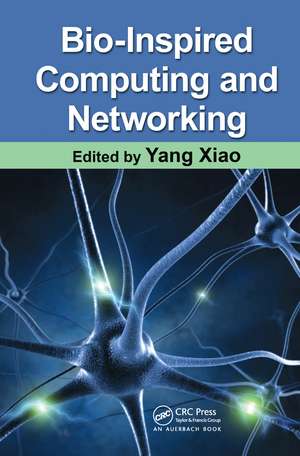
Bio-Inspired Computing and Networking
Autor Yang Xiaoen Limba Engleză Hardback – 15 mar 2011
Containing contributions from leading researchers from around the world, the book investigates the fundamental aspects and applications of bio-inspired computing and networking. Presenting the latest advances in bio-inspired communication, computing, networking, clustering, optimization, and robotics, the book considers state-of-the-art approaches, novel technologies, and experimental studies, including bio-inspired:
- Optimization of dynamic NP-hard problems
- Top-down controller design for distributing a robot swarm among multiple tasks
- Self-organizing data and signals cellular systems
- Dynamic spectrum access in cognitive radio networks
- QoS-aware architecture for scalable, adaptive, and survivable network systems
- Locomotion control of the Hexapod Robot Gregor III
Preț: 1682.76 lei
Preț vechi: 2103.45 lei
-20%
Puncte Express: 2524
Carte tipărită la comandă
Livrare economică 03-17 decembrie
Livrare prin curier în România Termenul estimat este afișat lângă disponibilitate.
Transport gratuit pentru acest produs Plată online sau ramburs, în funcție de opțiunile comenzii.
Retur gratuit în 14 zile Comandă securizată și suport în română.
Specificații
ISBN-13: 9781420080322
ISBN-10: 1420080326
Pagini: 552
Ilustrații: 262 b/w images, 13 tables and at least 230 equations
Dimensiuni: 156 x 234 x 30 mm
Greutate: 0.9 kg
Ediția:New.
Editura: CRC Press
Colecția CRC Press
ISBN-10: 1420080326
Pagini: 552
Ilustrații: 262 b/w images, 13 tables and at least 230 equations
Dimensiuni: 156 x 234 x 30 mm
Greutate: 0.9 kg
Ediția:New.
Editura: CRC Press
Colecția CRC Press
V-ar putea interesa
-
 BiomimicryJanine M BenyusPreț: 119.55 lei
 -
 Computer Networks: A Systems ApproachLarry L. Peterson-41%Preț: 558.53 lei941.05 lei
 -
 Biological Intelligence for Biomimetic RobotsJoseph Ayers-14%Preț: 532.70 lei619.41 lei
 -
 Evolutionary Computing in Advanced ManufacturingManoj Tiwari-5%Preț: 939.67 lei989.13 lei
 -
 The Network of Life - A New View of EvolutionDavid P. MindellPreț: 211.13 lei
 -
 Networking All-In-One for DummiesDoug Lowe-20%Preț: 258.11 lei322.63 lei
 -
 Preț: 123.51 lei
 -
 Nature-Inspired ComputationMario DAcunto-36%Preț: 1187.01 lei1842.37 lei
 -
 The Nature of Code: Simulating Natural Systems with JavaScriptDaniel Shiffman-34%Preț: 216.37 lei325.94 lei
 -
 Web, Artificial Intelligence and Network ApplicationsLeonard Barolli-20%Preț: 1255.62 lei1569.53 lei
 -
 -20%Preț: 1925.36 lei2406.70 lei
 -
 Networked SystemsSalem Lahlou-20%Preț: 996.76 lei1245.95 lei
 -
 -18%Preț: 1387.48 lei1692.04 lei
 -
 Nature-Inspired Computation in EngineeringXin She Yang-20%Preț: 510.13 lei637.67 lei
 -
 -20%Preț: 317.05 lei396.31 lei
 -
 -20%Preț: 662.85 lei828.56 lei
 -
 -20%Preț: 331.30 lei414.13 lei
 -
 Modeling Complex Processes Through Nature-Analogous MethodsChristina Klüver-15%Preț: 511.58 lei601.85 lei
 -
 -20%Preț: 1210.01 lei1512.52 lei
 -
 -20%Preț: 1199.62 lei1499.52 lei
Public țintă
Academic, Professional, and Professional Practice & DevelopmentCuprins
Animal Behaviors and Animal Communications. Animal Models for Computing and Communications: Past Approaches and Future Challenges. Social Behaviors of the California Sea Lion, Bottlenose Dolphin, and Orca Whale. Bio-Inspired Computing and Robots. Social Insect Societies for the Optimization of Dynamic NP-Hard Problems. Bio-Inspired Locomotion Control of the Hexapod Robot Gregor III. BEECLUST: A Swarm Algorithm Derived from Honeybees: Derivation of the Algorithm, Analysis by Mathematical Models, and Implementation on a Robot Swarm. Self-Organizing Data and Signals Cellular Systems. Bio-Inspired Process Control. Multirobot Search Using Bio-Inspired Cooperation and Communication Paradigms. Abstractions for Planning and Control of Robotic Swarms. Ant-Inspired Allocation: Top-Down Controller Design for Distributing A Robot Swarm among Multiple Tasks. Human Peripheral Nervous System Controlling Robots. Bio-Inspired Communications and Networks. Adaptive Social Hierarchies: From Nature to Networks. Chemical Relaying Protocols. Attractor Selection as Self-Adaptive Control Mechanism for Communication Networks. Topological Robustness of Biological Systems for Information Networks—Modularity. Biologically Inspired Dynamic Spectrum Access in Cognitive Radio Networks. Weakly Connected Oscillatory Networks for Information Processing. Modeling the Dynamics of Cellular Signaling for Communication Networks. A Biologically Inspired QoS-Aware Architecture for Scalable, Adaptive, and Survivable Network Systems.
Notă biografică
Dr. Yang Xiao worked in the industry as a medium access control (MAC) architect and was involved in the IEEE 802.11 standard enhancement work before joining the Department of Computer Science at the University of Memphis in 2002. He is currently with the Department of Computer Science (with tenure) at the University of Alabama.
Dr. Xiao was a voting member of the IEEE 802.11 Working Group from 2001 to 2004. He is also a senior member of the IEEE. Dr. Xiao serves as a panelist for the U.S. National Science Foundation (NSF), the Canada Foundation for Innovation (CFI)’s Telecommunications Expert Committee, and the American Institute of Biological Sciences (AIBS). He also serves as a referee/reviewer for many national and international funding agencies. His research interests include security, communications/networks, robotics, and telemedicine. He has published more than 160 refereed journal papers and over 200 refereed conference papers and book chapters related to these areas. His research has been supported by the U.S. National Science Foundation (NSF), U.S. Army Research the Global Environment for Network Innovations (GENI), Fleet Industrial Supply Center–San Diego (FISCSD), FIATECH, and the University of Alabama’s Research Grants Committee. He currently serves as editor-in-chief for the International Journal of Security and Networks (IJSN) and the International Journal of Sensor Networks (IJSNet). He was also the founding editor-in-chief for the International Journal of Telemedicine and Applications (IJTA) (2007–2009).
Dr. Xiao was a voting member of the IEEE 802.11 Working Group from 2001 to 2004. He is also a senior member of the IEEE. Dr. Xiao serves as a panelist for the U.S. National Science Foundation (NSF), the Canada Foundation for Innovation (CFI)’s Telecommunications Expert Committee, and the American Institute of Biological Sciences (AIBS). He also serves as a referee/reviewer for many national and international funding agencies. His research interests include security, communications/networks, robotics, and telemedicine. He has published more than 160 refereed journal papers and over 200 refereed conference papers and book chapters related to these areas. His research has been supported by the U.S. National Science Foundation (NSF), U.S. Army Research the Global Environment for Network Innovations (GENI), Fleet Industrial Supply Center–San Diego (FISCSD), FIATECH, and the University of Alabama’s Research Grants Committee. He currently serves as editor-in-chief for the International Journal of Security and Networks (IJSN) and the International Journal of Sensor Networks (IJSNet). He was also the founding editor-in-chief for the International Journal of Telemedicine and Applications (IJTA) (2007–2009).
Descriere
From ant-inspired allocation to a swarm algorithm derived from honeybees, this book explains how the study of biological systems can significantly improve computing, networking, and robotics. Containing contributions from leading researchers from around the world, the book investigates the fundamental aspects and applications of bio-inspired computing and networking. Presenting the latest advances in bio-inspired communication, computing, networking, clustering, optimization, and robotics, the book considers state-of-the art approaches, novel technologies, and experimental studies.