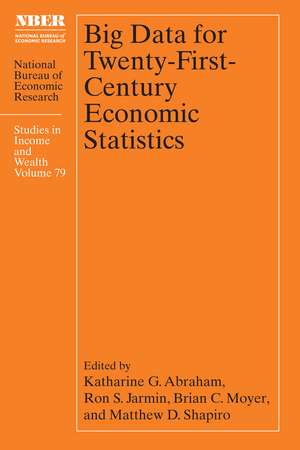
Big Data for Twenty-First-Century Economic Statistics: National Bureau of Economic Research Studies in Income and Wealth, cartea 79
Editat de Katharine G. Abraham, Ron S. Jarmin, Brian C. Moyer, Matthew D. Shapiroen Limba Engleză Hardback – 11 mar 2022
Notăm cu interes apariția volumului Big Data for Twenty-First-Century Economic Statistics, o lucrare de referință ce poartă girul unor editori de prestigiu precum Katharine G. Abraham și Matthew D. Shapiro. Credibilitatea acestui volum derivă din experiența directă a autorilor în gestionarea infrastructurii statistice naționale, oferind acces la metodologii care depășesc cadrul teoretic. Suntem de părere că această lucrare reprezintă un punct de cotitură pentru econometria modernă, documentând eforturile agențiilor de statistică de a integra fluxuri de date masive în calculul indicatorilor economici fundamentali.
Remarcăm o organizare riguroasă a conținutului, debutând cu o analiză a necesității reingineriei indicatorilor naționali și continuând cu secțiuni tehnice despre Indicele Prețurilor de Consum și măsurarea în timp real a cheltuielilor de consum. Cartea nu se limitează la teorie; cele 115 diagrame și 64 de tabele oferă o bază empirică solidă pentru înțelegerea modului în care datele de scanare sau înregistrările de carduri pot înlocui sau completa sondajele tradiționale, a căror viabilitate este tot mai scăzută. Ca și Robert C. Feenstra în Scanner Data and Price Indexes, autorii distilează experiența reală în principii acționabile, însă extind spectrul analizei către datele de salarizare și tehnicile de web scraping pentru prețuri online. Față de abordările din Big Data Meets Survey Science, acest volum pune un accent mai puternic pe statistica oficială de stat și pe provocările instituționale ale implementării acestor noi surse în aparatul birocratic și academic.
Din seria National Bureau of Economic Research Studies in Income and Wealth
- 9%
 Preț: 931.02 lei
 - 9%
 Preț: 868.52 lei
 - 9%
 Preț: 932.76 lei
 - 9%
 Preț: 830.44 lei
 - 9%
 Preț: 784.85 lei
 - 9%
 Preț: 928.64 lei
 - 9%
 Preț: 667.12 lei
 - 8%
 Preț: 612.61 lei
 - 9%
 Preț: 1016.58 lei
 - 23%
 Preț: 533.06 lei
 - 34%
 Preț: 859.04 lei
 - 26%
 Preț: 667.59 lei
 - 26%
 Preț: 809.62 lei
 - 26%
 Preț: 682.81 lei
 - 26%
 Preț: 688.46 lei
 - 26%
 Preț: 689.72 lei
Preț: 781.22 lei
Preț vechi: 908.39 lei
-14%
Carte disponibilă
Livrare economică 02-16 noiembrie
Livrare express 16-22 octombrie pentru 51.79 lei
Specificații
ISBN-10: 022680125X
Pagini: 488
Ilustrații: 115 line drawings, 64 tables
Dimensiuni: 152 x 229 x 46 mm
Greutate: 0.86 kg
Ediția:First Edition
Editura: University of Chicago Press
Colecția University of Chicago Press
Seria National Bureau of Economic Research Studies in Income and Wealth
De ce să citești această carte
Recomandăm această carte economiștilor și analiștilor de date care doresc să înțeleagă viitorul măsurării economice. Cititorul va câștiga o perspectivă tehnică asupra modului în care datele administrative și cele din sectorul privat sunt transformate în statistici oficiale precise. Este o resursă esențială pentru a învăța cum să navighezi între rigoarea metodologică a econometriei clasice și oportunitățile oferite de fluxurile de date de înaltă frecvență.
Despre autor
Echipa editorială este formată din figuri centrale ale economiei americane. Katharine G. Abraham este profesor la University of Maryland și fost comisar al Bureau of Labor Statistics, recunoscută pentru expertiza sa în piața muncii și măsurători economice. Ron S. Jarmin ocupă funcții de conducere în cadrul U.S. Census Bureau, fiind un pionier în utilizarea datelor administrative pentru cercetare. Brian C. Moyer și Matthew D. Shapiro completează acest colectiv cu o vastă experiență academică și practică în analiza macroeconomică și administrarea datelor la nivel federal, asigurând o viziune echilibrată între mediul universitar și cel guvernamental.
Descriere scurtă
The existing infrastructure for the production of key economic statistics relies heavily on data collected through sample surveys and periodic censuses, together with administrative records generated in connection with tax administration. The increasing difficulty of obtaining survey and census responses threatens the viability of existing data collection approaches. The growing availability of new sources of Big Data—such as scanner data on purchases, credit card transaction records, payroll information, and prices of various goods scraped from the websites of online sellers—has changed the data landscape. These new sources of data hold the promise of allowing the statistical agencies to produce more accurate, more disaggregated, and more timely economic data to meet the needs of policymakers and other data users. This volume documents progress made toward that goal and the challenges to be overcome to realize the full potential of Big Data in the production of economic statistics. It describes the deployment of Big Data to solve both existing and novel challenges in economic measurement, and it will be of interest to statistical agency staff, academic researchers, and serious users of economic statistics.
Notă biografică
Cuprins
Introduction: Big Data for Twenty- First- Century Economic Statistics: The Future Is Now
Katherine G. Abraham, Ron S. Jarmin, Brian C. Moyer, and Matthew D. Shapiro
I. TOWARD COMPREHENSIVE USE OF BIG DATA IN ECONOMIC STATISTICS
1. Reengineering Key National Economic Indicators
Gabriel Ehrlich, John C. Haltiwanger, Ron S. Jarmin, David Johnson, and Matthew D. Shapiro
2. Big Data in the US Consumer Price Index: Experiences and Plans
Crystal G. Konny, Brendan K. Williams, and David M. Friedman
3. Improving Retail Trade Data Products Using Alternative Data Sources
Rebecca J. Hutchinson
4. From Transaction Data to Economic Statistics: Constructing Real-Time, High-Frequency, Geographic Measures of Consumer Spending
Aditya Aladangady, Shifrah Aron-Dine, Wendy Dunn, Laura Feiveson, Paul Lengermann, and Claudia Sahm
5. Improving the Accuracy of Economic Measurement with Multiple Data Sources: The Case of Payroll Employment Data
Tomaz Cajner, Leland D. Crane, Ryan A. Decker, Adrian Hamins-Puertolas, and Christopher Kurz
II. USES OF BIG DATA FOR CLASSIFICATION
6. Transforming Naturally Occurring Text Data into Economic Statistics: The Case of Online Job Vacancy Postings
Arthur Turrell, Bradley Speigner, Jyldyz Djumalieva, David Copple, and James Thurgood
7. Automating Response Evaluation for Franchising Questions on the 2017 Economic Census
Joseph Staudt, Yifang Wei, Lisa Singh, Shawn Klimek, J. Bradford Jensen, and Andrew Baer
8. Using Public Data to Generate Industrial Classification Codes
John Cuffe, Sudip Bhattacharjee, Ugochukwu Etudo, Justin C. Smith, Nevada Basdeo, Nathaniel Burbank, and Shawn R. Roberts
III. USES OF BIG DATA FOR SECTORAL MEASUREMENT
9. Nowcasting the Local Economy: Using Yelp Data to Measure Economic Activity
Edward L. Glaeser, Hyunjin Kim, and Michael Luca
10. Unit Values for Import and Export Price Indexes: A Proof of Concept
Don A. Fast and Susan E. Fleck
11. Quantifying Productivity Growth in the Delivery of Important Episodes of Care within the Medicare Program Using Insurance Claims and Administrative Data
John A. Romley, Abe Dunn, Dana Goldman, and Neeraj Sood
12. Valuing Housing Services in the Era of Big Data: A User Cost Approach Leveraging Zillow Microdata
Marina Gindelsky, Jeremy G. Moulton, and Scott A. Wentland
IV. METHODOLOGICAL CHALLENGES AND ADVANCES
13. Off to the Races: A Comparison of Machine Learning and Alternative Data for Predicting Economic Indicators
Jeffrey C. Chen, Abe Dunn, Kyle Hood, Alexander Driessen, and Andrea Batch
14. A Machine Learning Analysis of Seasonal and Cyclical Sales in Weekly Scanner Data
Rishab Guha and Serena Ng
15. Estimating the Benefits of New Products
W. Erwin Diewert and Robert C. Feenstra
Contributors
Author Index
Subject Index