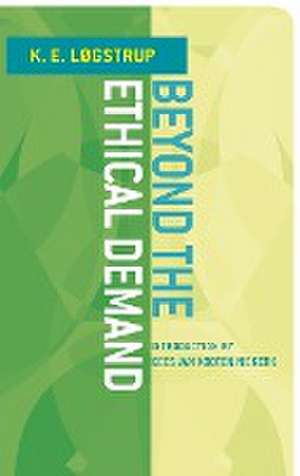
Beyond the Ethical Demand
Autor K. E. Løgstrup, Kees Van Kooten Nieken Limba Engleză Hardback – 31 iul 2022
| Toate formatele și edițiile | Preț | Express |
|---|---|---|
| Paperback (1) | 303.17 lei 6-8 săpt. | |
| MR – University of Notre Dame Press – 31 oct 2007 | 303.17 lei 6-8 săpt. | |
| Hardback (1) | 564.24 lei 6-8 săpt. | |
| MR – University of Notre Dame Press – 31 iul 2022 | 564.24 lei 6-8 săpt. |
Preț: 564.24 lei
Preț vechi: 732.78 lei
-23%
Puncte Express: 846
Preț estimativ în valută:
99.82€ • 117.69$ • 86.70£
99.82€ • 117.69$ • 86.70£
Carte tipărită la comandă
Livrare economică 23 martie-06 aprilie
Specificații
ISBN-13: 9780268205799
ISBN-10: 0268205795
Pagini: 208
Dimensiuni: 157 x 235 x 19 mm
Greutate: 0.45 kg
Editura: MR – University of Notre Dame Press
ISBN-10: 0268205795
Pagini: 208
Dimensiuni: 157 x 235 x 19 mm
Greutate: 0.45 kg
Editura: MR – University of Notre Dame Press
V-ar putea interesa
-
 -20%Preț: 65.61 lei82.37 lei
 -
 Responsibility and Distributive JusticeCarl Knight-16%Preț: 282.05 lei334.74 lei
 -
 Nature, Reason, and the Good Life: Ethics for Human BeingsRoger TeichmannPreț: 218.67 lei
 -
 From Rationality to EqualityJames P. Sterba-19%Preț: 219.50 lei270.54 lei
 -
 Oxford Studies in Metaethics, Volume 8Russ Shafer-Landau-28%Preț: 781.31 lei1085.25 lei
 -
 Whose Justice? Which Rationality?Alasdair MacintyrePreț: 273.27 lei
 -
 CourageBarbara Darling-SmithPreț: 176.87 lei
 -
 After Virtue – A Study in Moral Theory, Third EditionAlasdair MacintyrePreț: 234.12 lei
 -
 Reclaiming Goodness – Education and the Spiritual QuestHanan A. Alexander-23%Preț: 565.92 lei734.96 lei
 -
 -26%Preț: 88.32 lei119.05 lei
 -
 Moral Matters: A Philosophy of HomecomingMark Dooley-13%Preț: 293.07 lei335.94 lei
 -
 Liquid EvilZygmunt BaumanPreț: 166.83 lei
 -
 Endeavor for Renewal: Droplets of Wisdom from the HeartFethullah GülenPreț: 77.29 lei
 -
 BushidoInazô NitobePreț: 115.45 lei
 -
 -13%Preț: 82.00 lei93.78 lei
 -
 Unravelling EncountersCaitlin JanzenPreț: 313.75 lei
 -
 -29%Preț: 62.95 lei88.26 lei
 -
 On ForgivenessRichard HollowayPreț: 67.12 lei
 -
 -22%Preț: 130.17 lei167.23 lei
 -
 Nothing but WickednessTheodore Dalrymple-19%Preț: 88.73 lei109.88 lei
Notă biografică
Descriere scurtă
Recenzii
“This collection of essays by the late Danish philosopher and theologian Logstrup presents his theory of using phenomenology in understanding our ethical decisions. According to Logstrup, phenomenology not only provides an understanding of human existence but also of ethics, through examination of the phenomena of ethical concepts. . . . These essays will be valuable to scholars and students in philosophy and ethics.” —Library Journal
“. . . The University of Notre Dame Press is to be congratulated for publishing . . . [this book] . . . as well as The Ethical Demand. . . . Løgstrup's work remains mostly unknown among Anglophone moral philosophers. It is, however, filled with significant moral psychological and ethical insights. Løgstrup is especially incisive in noting and analyzing matters of moral phenomenology, and the overall thrust of his view has great interest as well. Moreover, . . . Løgstrup was himself engaged with mid-twentieth-century British moral philosophers like Nowell-Smith and Hare. Twenty-first-century Anglophone ethical philosophy would engage him to its profit.” —Notre Dame Philosophical Review