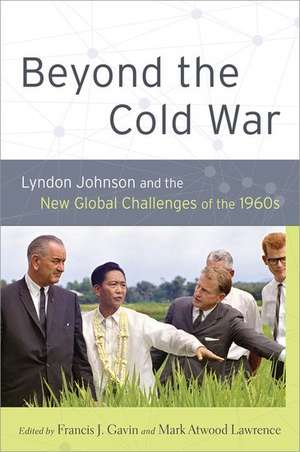
Beyond the Cold War: Lyndon Johnson and the New Global Challenges of the 1960s: Reinterpreting History: How Historical Assessments Change over Time
Editat de Francis J. Gavin, Mark Atwood Lawrenceen Limba Engleză Paperback – 30 ian 2014

Preț: 303.36 lei
Preț vechi: 381.35 lei
-20%
Puncte Express: 455
Carte tipărită la comandă
Livrare economică 27 noiembrie-08 decembrie
Livrare prin curier în România Termenul estimat este afișat lângă disponibilitate.
Transport gratuit de la 400.00 lei Plată online sau ramburs, în funcție de opțiunile comenzii.
Retur gratuit în 14 zile Comandă securizată și suport în română.
Specificații
ISBN-13: 9780199790708
ISBN-10: 0199790701
Pagini: 320
Dimensiuni: 155 x 231 x 23 mm
Greutate: 0.43 kg
Editura: Oxford University Press
Colecția OUP USA
Seria Reinterpreting History: How Historical Assessments Change over Time
Locul publicării:New York, United States
ISBN-10: 0199790701
Pagini: 320
Dimensiuni: 155 x 231 x 23 mm
Greutate: 0.43 kg
Editura: Oxford University Press
Colecția OUP USA
Seria Reinterpreting History: How Historical Assessments Change over Time
Locul publicării:New York, United States
V-ar putea interesa
-
 The Sewing Circles of HeratChristina LambPreț: 116.51 lei
 -
 The Argumentative IndianAmartya Sen-30%Preț: 65.82 lei94.04 lei
 -
 Cuba ConfidentialAnn Louise BardachPreț: 117.90 lei
 -
 Another Day of LifeRyszard Kapuscinski-27%Preț: 56.90 lei77.92 lei
 -
 Hippies, Indians, and the Fight for Red PowerSherry L. Smith-20%Preț: 302.85 lei380.66 lei
 -
 Heart of Europe: The Past in Poland's PresentNorman Davies-19%Preț: 128.36 lei158.03 lei
 -
 Modern Spain, 1875-1980Raymond Carr-20%Preț: 95.85 lei120.12 lei
 -
 France Since 1945Robert GildeaPreț: 79.37 lei
 -
 Restless Giant: The United States from Watergate to Bush vs. GoreJames T. Patterson-17%Preț: 144.44 lei175.01 lei
 -
 Europe Since 1945Mary Fulbrook-11%Preț: 359.75 lei405.90 lei
 -
 Mandela: A Critical LifeTom Lodge-20%Preț: 121.83 lei153.21 lei
 -
 -28%Preț: 391.52 lei547.51 lei
 -
 -13%Preț: 251.65 lei288.48 lei
 -
 Barbarossa: The Russian German ConflictAlan Clark-24%Preț: 95.10 lei125.19 lei
 -
 Tales By Japanese SoldiersKazuo Tamayama-27%Preț: 66.98 lei91.64 lei
 -
 The First Vietnam War – Colonial Conflict and Cold War CrisisMark Atwood LawrencePreț: 298.85 lei
 -
 First They Killed My FatherLoung Ung-19%Preț: 70.02 lei86.21 lei
 -
 Conspiracy to MurderLinda MelvernPreț: 216.62 lei
Recenzii
Distinguished historians Frank Gavin and Mark Lawrence have assembled an all-star cast of young scholars of U.S. foreign relations to shed new light on the 1960s, a decade we thought we already knew perhaps too well. These excellent essays focus on contemporary global issues of the greatest importance - environmental change, energy, poverty and disease, human rights, religion, globalization - and trace them back to their emergence as policy concerns during the Lyndon Johnson administration. The authors challenge and expand our understanding of national security in a global age. This is some of the best of the new U.S. international history.
Notă biografică
Francis J. Gavin is the Frank Stanton Chair in Nuclear Security Policy Studies in the Security Studies Program at the Massachusetts Institute of Technology. He is the author of Gold, Dollars, and Power: The Politics of International Monetary Relations, 1958-1971 and Nuclear Statecraft: History and Strategy in Americas Atomic Age. Mark Atwood Lawrence is Associate Professor of History at the University of Texas at Austin. He is author of Assuming the Burden: Europe and the American Commitment to War in Vietnam and The Vietnam War: A Concise International History.