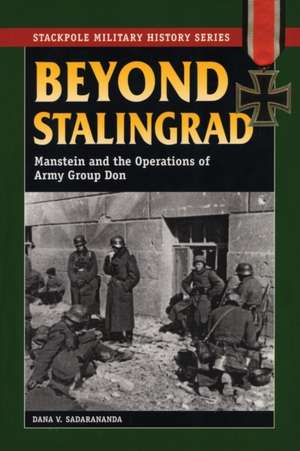
Beyond Stalingrad: Stackpole Military History Series
Autor Dana V. Sadaranandaen Limba Engleză Paperback – 22 iun 2009






Preț: 141.49 lei
Puncte Express: 212
Carte tipărită la comandă
Livrare economică 18 august-01 septembrie
Livrare prin curier în România Termenul estimat este afișat lângă disponibilitate.
Transport gratuit de la 400.00 lei Plată online sau ramburs, în funcție de opțiunile comenzii.
Retur gratuit în 14 zile Comandă securizată și suport în română.
Specificații
ISBN-13: 9780811735742
ISBN-10: 0811735745
Pagini: 167
Ilustrații: b/w illus
Dimensiuni: 150 x 226 x 18 mm
Greutate: 0.34 kg
Editura: TRADE SELECT
Seria Stackpole Military History Series
ISBN-10: 0811735745
Pagini: 167
Ilustrații: b/w illus
Dimensiuni: 150 x 226 x 18 mm
Greutate: 0.34 kg
Editura: TRADE SELECT
Seria Stackpole Military History Series
V-ar putea interesa
-
 The SweetheartsLynn RussellPreț: 112.40 lei
 -
 National ServiceRichard VinenPreț: 121.91 lei
 -
 -12%Preț: 298.96 lei339.20 lei
 -
 Smith, D: Former PeopleDouglas Smith-33%Preț: 62.88 lei93.95 lei
 -
 Keeping Up With the GermansPhilip OltermannPreț: 91.87 lei
 -
 The Tudor Garden: 1485–1603Twigs Way-33%Preț: 45.64 lei68.04 lei
 -
 Royal CoronationsLucinda Gosling-33%Preț: 45.72 lei68.10 lei
 -
 Gypsies of BritainJanet Keet-Black-33%Preț: 40.67 lei60.53 lei
 -
 Churchill: The Power of WordsMartin Gilbert-18%Preț: 89.42 lei108.92 lei
 -
 Kiev 1941David StahelPreț: 235.94 lei
 -
 The Forgetting RiverDoreen CarvajalPreț: 137.38 lei
 -
 The Baroness: The Search for Nica the Rebellious RothschildHannah Rothschild-28%Preț: 65.76 lei91.59 lei
 -
 French Scientific and Cultural DiplomacyPhilippe LanePreț: 371.02 lei
 -
 The Last CrusadeNigel CliffPreț: 122.69 lei
 -
 The Devil's CarnivalJohn Mason SneddonPreț: 105.89 lei
Notă biografică
Dana V. Sadarananda lives near Harrisburg, Pennsylvania.
Descriere
Descriere de la o altă ediție sau format:
This study fills a void in the military history of World War II by focusing attention upon individual battles and operations on the Eastern Front--a subject largely neglected in the literature. Basing his study on in-depth analysis of contemporary war diaries, author Dana Sadarananda examines Field Marshal Erich von Manstein's conduct of operations as the commander of the German Army Group Don from November 1942-March 1943. Sadarananda traces the course of the Winter campaign of 1942-43--the aftermath of the Soviet counteroffensive that trapped the German 6th Army in the city of Stalingrad--and illuminates the reasons why the Army Group Don was able to achieve a dramatic reversal of fortune and enable the German Army to regain the initiative along the critical Eastern Front. He concludes that the German successes during the period in question were largely due to the perceptive and decisive leadership of Field Marshal von Manstein.
Sadarananda demonstrates that the battles that Manstein directed during the winter of 1942-43 were among the most critical of the entire war. In fact, he shows, failure to succeed would have meant the collapse of the entire Eastern front and an earlier victory for the Allies. Piecing together the course of the campaign, Sadarananda identifies four distinct phases of the operations, beginning in November 1942 when the 4th Panzer Army aborted its relieve drive on Stalingrad and culminating in the elimination of Russian forces and the German recapture of the Donets River line. Throughout, the author analyzes Manstein's military decisions as well as his relationship with Hitler during a period in which the German leader's behavior was characterized by uncertainty and indecision. Sadarananda argues that Manstein's genius was not only his ability to anticipate enemy moves but also his effectiveness in dealing with Hitler.
This study fills a void in the military history of World War II by focusing attention upon individual battles and operations on the Eastern Front--a subject largely neglected in the literature. Basing his study on in-depth analysis of contemporary war diaries, author Dana Sadarananda examines Field Marshal Erich von Manstein's conduct of operations as the commander of the German Army Group Don from November 1942-March 1943. Sadarananda traces the course of the Winter campaign of 1942-43--the aftermath of the Soviet counteroffensive that trapped the German 6th Army in the city of Stalingrad--and illuminates the reasons why the Army Group Don was able to achieve a dramatic reversal of fortune and enable the German Army to regain the initiative along the critical Eastern Front. He concludes that the German successes during the period in question were largely due to the perceptive and decisive leadership of Field Marshal von Manstein.
Sadarananda demonstrates that the battles that Manstein directed during the winter of 1942-43 were among the most critical of the entire war. In fact, he shows, failure to succeed would have meant the collapse of the entire Eastern front and an earlier victory for the Allies. Piecing together the course of the campaign, Sadarananda identifies four distinct phases of the operations, beginning in November 1942 when the 4th Panzer Army aborted its relieve drive on Stalingrad and culminating in the elimination of Russian forces and the German recapture of the Donets River line. Throughout, the author analyzes Manstein's military decisions as well as his relationship with Hitler during a period in which the German leader's behavior was characterized by uncertainty and indecision. Sadarananda argues that Manstein's genius was not only his ability to anticipate enemy moves but also his effectiveness in dealing with Hitler.
Cuprins
Preface
Acknowledgments
The Front Collapses . . . Manstein Is Called
Winter Storm and the Disaster on the Chir Front
Disaster on the Left, Decision on the Right
The Backhand Blow
Recovery
The Genius of Manstein
Bibliography
Index
Acknowledgments
The Front Collapses . . . Manstein Is Called
Winter Storm and the Disaster on the Chir Front
Disaster on the Left, Decision on the Right
The Backhand Blow
Recovery
The Genius of Manstein
Bibliography
Index