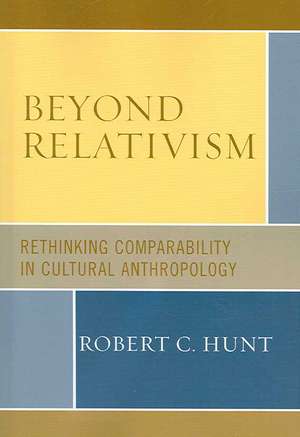
Beyond Relativism: Comparability in Cultural Anthropology
Autor Robert C. Hunten Limba Engleză Paperback – 14 mar 2007
Preț: 220.15 lei
Preț vechi: 300.39 lei
-27%
Puncte Express: 330
Carte tipărită la comandă
Livrare economică 13-27 noiembrie
Livrare prin curier în România Termenul estimat este afișat lângă disponibilitate.
Transport gratuit de la 400.00 lei Plată online sau ramburs, în funcție de opțiunile comenzii.
Retur gratuit în 14 zile Comandă securizată și suport în română.
Specificații
ISBN-13: 9780759110809
ISBN-10: 0759110808
Pagini: 185
Dimensiuni: 148 x 226 x 14 mm
Greutate: 0.31 kg
Editura: Bloomsbury Publishing
Colecția AltaMira Press
Locul publicării:New York, United States
ISBN-10: 0759110808
Pagini: 185
Dimensiuni: 148 x 226 x 14 mm
Greutate: 0.31 kg
Editura: Bloomsbury Publishing
Colecția AltaMira Press
Locul publicării:New York, United States
V-ar putea interesa
-
 White Men's Magic: Scripturalization as SlaveryVincent L. Wimbush-21%Preț: 373.50 lei473.89 lei
 -
 Intangible Cultural Heritage in International LawLucas Lixinski-31%Preț: 679.40 lei988.51 lei
 -
 The Mormon Quest for Glory: The Religious World of the Latter-Day SaintsMelvyn Hammarberg-19%Preț: 380.14 lei466.97 lei
 -
 -28%Preț: 511.18 lei714.90 lei
 -
 -13%Preț: 279.30 lei320.96 lei
 -
 -11%Preț: 326.16 lei365.84 lei
 -
 MalignantS. Lochlann JainPreț: 210.25 lei
 -
 A History of AnthropologyThomas Hylland EriksenPreț: 229.99 lei
 -
 On the UniversalFrançois JullienPreț: 186.71 lei
 -
 Understanding Children¿s Development 6eHelen Cowie-19%Preț: 457.62 lei564.97 lei
 -
 Transforming CitizenshipsIsaac WestPreț: 269.70 lei
Cuprins
Part 1 Are Cultures Like Apples and Oranges?
Chapter 2 A Scientific Cultural Anthropology?
Chapter 3 Challenges to Comparability
Part 4 Comparability in Natural Science
Chapter 5 Dimensions in Natural Science: Length and Temperature
Chapter 6 The Problem of Objects
Part 7 Comparability in Culture: Dimensions and Objects
Chapter 8 Phonology/Phonetics
Chapter 9 Ethnobiology
Chapter 10 Labor Productivity in Agriculture
Chapter 11 Social Organization in Canal Irrigation
Chapter 12 Kinship and Marriage
Part 13 Can We Compare Apples and Oranges?
Chapter 14 We Can Compare Apples and Oranges
15 References
Chapter 2 A Scientific Cultural Anthropology?
Chapter 3 Challenges to Comparability
Part 4 Comparability in Natural Science
Chapter 5 Dimensions in Natural Science: Length and Temperature
Chapter 6 The Problem of Objects
Part 7 Comparability in Culture: Dimensions and Objects
Chapter 8 Phonology/Phonetics
Chapter 9 Ethnobiology
Chapter 10 Labor Productivity in Agriculture
Chapter 11 Social Organization in Canal Irrigation
Chapter 12 Kinship and Marriage
Part 13 Can We Compare Apples and Oranges?
Chapter 14 We Can Compare Apples and Oranges
15 References
Recenzii
Hunt's book should be read by all anthropologists and other researchers using cross-cultural data. He side-steps phony debates, discarding the "essentialist" rhetoric ("East vs. West," "indigenous vs. foreign,"etc.) that is so precious to poseurs in both academic and political milieus. He uses clear examples to explain how the natural sciences have been constructed step by step, century by century. He shows how this construction, of necessity, requires that we compare apples and oranges - that is, objects (and events) which are both similar and dissimilar in important ways. He demonstrates how the social sciences have necessarily followed the same path and have approached, to varying degrees in different domains, the construction of valid and comparative analytic frameworks. This book is particularly appropriate for intermediate and advanced classes on "methods" (meaning, in fact, on research design).
One of the main arguments for the contention that a scientific cultural anthropology is not possible is that cultures are incommensurable. In this impressive volume Robert Hunt convincingly argues that cultures are not incommensurable, and he explicates amethod by which valid cultural comparison can be and has been achieved. On both accounts he has clearly demonstrated that if a scientific cultural anthropology is not possible, it cannot be because of cultural incommensurability....
Summing Up: Recommended. Graduate students/faculty.
Robert Hunt's Beyond Relativism addresses an issue of extreme importance to all of the sciences - How do we compare widely divergent theories and paradigms? Hunt paves the way for researchers to render seemingly incommensurable theories into comparable theories that can be evaluated. Hunt's hopeful book should be required reading for anyone interested in advancing science instead of simply rehashing old debates.
The book is clearly written, and chapters go through a variety of arguments intended to clarify Hunt's main points.
One of the main arguments for the contention that a scientific cultural anthropology is not possible is that cultures are incommensurable. In this impressive volume Robert Hunt convincingly argues that cultures are not incommensurable, and he explicates amethod by which valid cultural comparison can be and has been achieved. On both accounts he has clearly demonstrated that if a scientific cultural anthropology is not possible, it cannot be because of cultural incommensurability....
Summing Up: Recommended. Graduate students/faculty.
Robert Hunt's Beyond Relativism addresses an issue of extreme importance to all of the sciences - How do we compare widely divergent theories and paradigms? Hunt paves the way for researchers to render seemingly incommensurable theories into comparable theories that can be evaluated. Hunt's hopeful book should be required reading for anyone interested in advancing science instead of simply rehashing old debates.
The book is clearly written, and chapters go through a variety of arguments intended to clarify Hunt's main points.