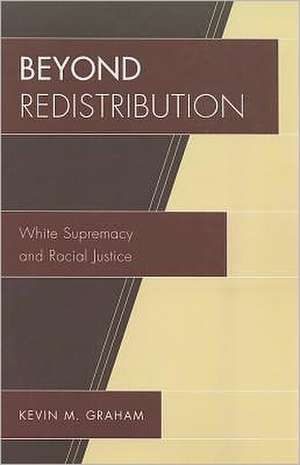
Beyond Redistribution: White Supremacy and Racial Justice: Lexington Books
Autor Kevin M. Grahamen Limba Engleză Paperback – 16 noi 2011
In Beyond Redistribution, Kevin M. Graham argues that political theories operating on a distributive understanding of social justice fail to address adequately certain forms of social injustice related to race. Graham argues that political philosophy could understand race-related injustice more fully by shifting its focus away from distributive inequities between whites and nonwhites and toward white supremacy, the unfair power relationships that allow whites to dominate and oppress nonwhites. Beyond Redistribution offers a careful, detailed critique of the positions of leading contemporary liberal political philosophers on race-related issues of social justice. Graham's analysis of the racial politics of police violence and public education in Omaha, Nebraska, vividly illustrates why the search for racial justice in the United States must move beyond redistribution.
Din seria Lexington Books
- 32%
 Preț: 729.63 lei
 - 59%
 Preț: 427.24 lei
 - 35%
 Preț: 574.44 lei
 - 22%
 Preț: 341.76 lei
 - 31%
 Preț: 437.25 lei
 - 28%
 Preț: 352.50 lei
 - 23%
 Preț: 321.53 lei
 - 23%
 Preț: 333.36 lei
 - 23%
 Preț: 327.54 lei
 - 35%
 Preț: 593.04 lei
 - 33%
 Preț: 358.06 lei
 - 26%
 Preț: 363.28 lei
 - 25%
 Preț: 362.03 lei
 - 22%
 Preț: 330.56 lei
 - 28%
 Preț: 346.74 lei
 - 24%
 Preț: 308.07 lei
 - 23%
 Preț: 321.63 lei
 - 27%
 Preț: 263.04 lei
 - 24%
 Preț: 369.89 lei
 - 25%
 Preț: 884.44 lei
 - 36%
 Preț: 730.77 lei
 - 29%
 Preț: 345.71 lei
 - 34%
 Preț: 537.45 lei
 - 33%
 Preț: 428.79 lei
 - 34%
 Preț: 616.07 lei
 - 29%
 Preț: 342.12 lei
 - 26%
 Preț: 362.85 lei
 - 22%
 Preț: 338.89 lei
 - 28%
 Preț: 356.18 lei
 - 23%
 Preț: 321.63 lei
 - 28%
 Preț: 346.74 lei
 - 22%
 Preț: 340.40 lei
 - 29%
 Preț: 345.71 lei
 - 23%
 Preț: 318.96 lei
 - 37%
 Preț: 660.07 lei
 - 27%
 Preț: 355.41 lei
 - 32%
 Preț: 727.58 lei
 - 24%
 Preț: 313.51 lei
 - 29%
 Preț: 599.98 lei
 - 24%
 Preț: 309.62 lei
 - 34%
 Preț: 630.22 lei
 - 34%
 Preț: 575.26 lei
 - 34%
 Preț: 607.70 lei
 - 33%
 Preț: 639.19 lei
 - 33%
 Preț: 642.37 lei
 - 33%
 Preț: 640.95 lei
 - 25%
 Preț: 369.74 lei
Preț: 341.30 lei
Preț vechi: 441.66 lei
-23%
Puncte Express: 512
Carte tipărită la comandă
Livrare economică 30 noiembrie-14 decembrie
Livrare prin curier în România Termenul estimat este afișat lângă disponibilitate.
Transport gratuit de la 400.00 lei Plată online sau ramburs, în funcție de opțiunile comenzii.
Retur gratuit în 14 zile Comandă securizată și suport în română.
Specificații
ISBN-13: 9780739130971
ISBN-10: 0739130978
Pagini: 146
Dimensiuni: 148 x 228 x 12 mm
Greutate: 0.2 kg
Editura: Bloomsbury Publishing
Colecția Lexington Books
Seria Lexington Books
Locul publicării:New York, United States
ISBN-10: 0739130978
Pagini: 146
Dimensiuni: 148 x 228 x 12 mm
Greutate: 0.2 kg
Editura: Bloomsbury Publishing
Colecția Lexington Books
Seria Lexington Books
Locul publicării:New York, United States
Cuprins
Introduction
Chapter 1. Racism or White Supremacy? Understanding Race-Related Injustice
Chapter 2. Police Violence and the White Supremacist State
Chapter 3. The Political Significance of Social Identity
Chapter 4. Autonomy, Individualism, and Social Justice
Chapter 5. Distributive Justice and the Injustice of Hate Speech
Chapter 6. After the Buses Stop Running: Distributive Justice or Dialogue?
Chapter 1. Racism or White Supremacy? Understanding Race-Related Injustice
Chapter 2. Police Violence and the White Supremacist State
Chapter 3. The Political Significance of Social Identity
Chapter 4. Autonomy, Individualism, and Social Justice
Chapter 5. Distributive Justice and the Injustice of Hate Speech
Chapter 6. After the Buses Stop Running: Distributive Justice or Dialogue?
Recenzii
In Beyond Redistribution, Kevin Graham argues that the system of white supremacy still prevailing in the United States is characterized not only by an unfair distribution of economic resources, but also by derogatory controlling images of non-white persons. Graham contends that distributive liberalism is incapable of fully understanding the injustice of this white supremacist system; for instance, it can neither fully comprehend nor remedy the serious harms perpetrated by hate speech. In Graham's view, philosophers concerned to address white supremacy should begin by developing an understanding of participatory democracy, since schemes for distributing social resources can be devised only in a context of pluralistic deliberation. Graham's book makes a substantive contribution both to critical liberal and critical race theory and will be a valuable teaching tool. It is short, clear, incisive and full of examples of white supremacy, especially as this operates in Graham's own city of Omaha, Nebraska.
In this thought-provoking new work, Graham (Creighton Univ.) explores the limits of distributive justice for understanding race relations in the US. He argues that white supremacy is a more complicated phenomenon than theories of distributive justice, which are animated by the protection of individual rights, can address. Graham discusses the work of John Rawls and John Stuart Mill to illuminate his argument that the assumptions that impact distributive policies can have disparate impacts without being obviously discriminatory. He advocates a broader approach that undermines the legitimacy of white supremacist attitudes through discussions of education, hate speech, and what he terms "controlling images," which are widely held stereotypes that affect who is perceived as morally and socially worthy of public benefits. Graham argues for a theory that makes all citizens equal participants in the polity. This illuminating work challenges the assumptions of philosophers and political theorists in regard to race. Highly recommended.
Discussions of justice in American philosophy continue to neglect race, that most salient and enduring American injustice. In this brief but compelling book, written with exemplary clarity, Kevin Graham challenges white liberalism to deal with the ongoing reality of white supremacy.
In this thought-provoking new work, Graham (Creighton Univ.) explores the limits of distributive justice for understanding race relations in the US. He argues that white supremacy is a more complicated phenomenon than theories of distributive justice, which are animated by the protection of individual rights, can address. Graham discusses the work of John Rawls and John Stuart Mill to illuminate his argument that the assumptions that impact distributive policies can have disparate impacts without being obviously discriminatory. He advocates a broader approach that undermines the legitimacy of white supremacist attitudes through discussions of education, hate speech, and what he terms "controlling images," which are widely held stereotypes that affect who is perceived as morally and socially worthy of public benefits. Graham argues for a theory that makes all citizens equal participants in the polity. This illuminating work challenges the assumptions of philosophers and political theorists in regard to race. Highly recommended.
Discussions of justice in American philosophy continue to neglect race, that most salient and enduring American injustice. In this brief but compelling book, written with exemplary clarity, Kevin Graham challenges white liberalism to deal with the ongoing reality of white supremacy.