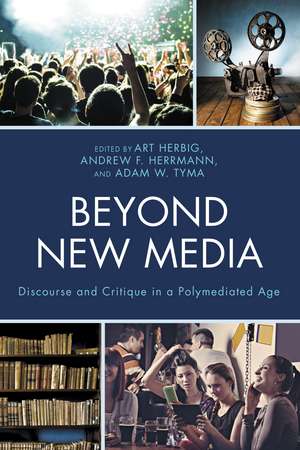
Beyond New Media: Discourse and Critique in a Polymediated Age: Studies in New Media
Editat de Art Herbig, Andrew F. Herrmann, Adam W. Tyma Contribuţii de Michelle Calka, Katherine J. Denker, Robert Andrew Dunn, Chelsea Henderson, Jimmie Manning, Danielle M. Stern, Michael D. D. Willitsen Limba Engleză Paperback – 26 apr 2016
Din seria Studies in New Media
- 28%
 Preț: 346.52 lei
 - 23%
 Preț: 328.98 lei
 - 19%
 Preț: 321.15 lei
 - 34%
 Preț: 567.53 lei
 - 33%
 Preț: 550.78 lei
 - 26%
 Preț: 285.87 lei
 - 26%
 Preț: 286.75 lei
 - 27%
 Preț: 262.43 lei
 - 27%
 Preț: 269.45 lei
 - 36%
 Preț: 524.99 lei
 - 27%
 Preț: 254.41 lei
 - 32%
 Preț: 491.13 lei
 - 32%
 Preț: 491.39 lei
 - 27%
 Preț: 273.28 lei
 - 32%
 Preț: 556.08 lei
 - 32%
 Preț: 491.49 lei
 - 33%
 Preț: 518.19 lei
 - 38%
 Preț: 545.40 lei
 - 33%
 Preț: 617.02 lei
 - 30%
 Preț: 536.59 lei
Preț: 351.00 lei
Preț vechi: 482.99 lei
-27%
Puncte Express: 527
Carte tipărită la comandă
Livrare economică 19 noiembrie-03 decembrie
Livrare prin curier în România Termenul estimat este afișat lângă disponibilitate.
Transport gratuit de la 400.00 lei Plată online sau ramburs, în funcție de opțiunile comenzii.
Retur gratuit în 14 zile Comandă securizată și suport în română.
Specificații
ISBN-13: 9781498507370
ISBN-10: 1498507379
Pagini: 226
Dimensiuni: 152 x 230 x 17 mm
Greutate: 0.34 kg
Editura: Bloomsbury Publishing
Colecția Lexington Books
Seria Studies in New Media
Locul publicării:New York, United States
ISBN-10: 1498507379
Pagini: 226
Dimensiuni: 152 x 230 x 17 mm
Greutate: 0.34 kg
Editura: Bloomsbury Publishing
Colecția Lexington Books
Seria Studies in New Media
Locul publicării:New York, United States
Descriere
Beyond New Media: Discourse and Critique in a Polymediated Age examines a host of differing positions on media in order to explore how those positions can inform one another and build a basis for future engagements with media theory, research, and practice. Herbig, Herrmann, and Tyma have brought together a number of media scholars with differing paradigmatic backgrounds to debate the relative applicability of existing theories and in doing so develop a new approach: polymediation. Each contributor's disciplinary background is diverse, spanning interpersonal communication, media studies, organizational communication, instructional design, rhetoric, mass communication, gender studies, popular culture studies, informatics, and persuasion. Although each of these scholars brings with them a unique perspective on media's role in people's lives, what binds them together is the belief that meaningful discourse about media must be an ongoing conversation that is open to critique and revision in a rapidly changing mediated culture. By studying media in a polymediated way, Beyond New Media addresses more completely our complex relationship to media(tion) in our everyday lives.
Cuprins
Introduction: The Beginnings: #WeNeedaWord, Adam W. Tyma, Andrew F. Herrmann, and Art Herbig
Chapter 1: I am you and you are we and we are all.me? Understanding Media and/as Context (The Road to Polymediation), Adam W. Tyma
Chapter 2: Polymediation: The Relationship between Self and Media, Michelle Calka
Chapter 3: Rhetoric and Polymediation: Using Fragments to Understand the Relationship between "Text" and Discourse, Art Herbig
Chapter 4: Communicating, Sensemaking and (Dis)Organizing: An Existential Phenomenological Framework for Polymediating, Andrew F. Herrmann
Chapter 5: Ipsedixitism, Ipseity, and Ipsilateral Identity: The Fear of Finding Ourselves in Catfish, Jimmie Manning
Chapter 6: Polyreality, Robert Andrew Dunn
Chapter 7: Hashtagging Feminism: Tetradic Polymediated Activism, Danielle M. Stern and Chelsea Henderson
Chapter 8: Technology as Engagement: How We Learn and Teach while Polymediating the Classroom, Katherine J. Denker, Andrew F. Herrmann, and Michael D. D. Willits
Conclusion: Conc
Chapter 1: I am you and you are we and we are all.me? Understanding Media and/as Context (The Road to Polymediation), Adam W. Tyma
Chapter 2: Polymediation: The Relationship between Self and Media, Michelle Calka
Chapter 3: Rhetoric and Polymediation: Using Fragments to Understand the Relationship between "Text" and Discourse, Art Herbig
Chapter 4: Communicating, Sensemaking and (Dis)Organizing: An Existential Phenomenological Framework for Polymediating, Andrew F. Herrmann
Chapter 5: Ipsedixitism, Ipseity, and Ipsilateral Identity: The Fear of Finding Ourselves in Catfish, Jimmie Manning
Chapter 6: Polyreality, Robert Andrew Dunn
Chapter 7: Hashtagging Feminism: Tetradic Polymediated Activism, Danielle M. Stern and Chelsea Henderson
Chapter 8: Technology as Engagement: How We Learn and Teach while Polymediating the Classroom, Katherine J. Denker, Andrew F. Herrmann, and Michael D. D. Willits
Conclusion: Conc
Recenzii
This edited collection is the third in the 'Studies in New Media' series (begun in 2012). Herbig, Herrmann, and Tyma offer eight essays that focus on and forward polymedia, a concept introduced by Mirca Madianou and Daniel Miller. The editors begin by defining polymedia (a noun that also has verb, adjective, and adverb forms) as a means of moving past convergence. The breadth of the term allows the editors to bring together essays from many disciplines, including rhetoric, phenomenology, feminist studies, and media studies. . . .The editors offer the collection as an opening salvo in a conversation around polymedia, and they suggest that the conversation be continued on social media resources (e.g., Twitter). Summing Up: . . . Graduate students, researchers, faculty.
Beyond New Media makes a noteworthy contribution to the study of communication and media. It is a conversational, exploratory, and accessible text that offers wise insights into/about contemporary media use. It is an important resource for researchers interested in technology, social media, and interaction, as well as an ideal text to use in courses covering these areas.
Beyond New Media presents a well-constructed manifesto. . . .The current condition represents a new way of thinking about and acting upon deep philosophical questions, particularly those regarding identity, personhood, compatibility, empathy, and the nature and meaning of reality. The collection provides an impressive start to this daunting task.
Herbig, Herrmann, Tyma, and their colleagues provide a text that reaches through dualistic and reductivist interpretations of "new" media and into a world of fragmented streams of communication structured by multiple discourses-polymediation. The framework of polymediation provides an overarching perspective to tie together diverse scholarly pursuits. The authors have created a touchstone for both future research and practical applications by providing a deep interrogation of the historical and critical roots of polymedia while maintaining accessibility for the reader. In addition, through the reproduction of mediated conversations between themselves, the authors open up a window into the mundane processes that lead to stimulating theoretical breakthroughs.
Beyond New Media makes a noteworthy contribution to the study of communication and media. It is a conversational, exploratory, and accessible text that offers wise insights into/about contemporary media use. It is an important resource for researchers interested in technology, social media, and interaction, as well as an ideal text to use in courses covering these areas.
Beyond New Media presents a well-constructed manifesto. . . .The current condition represents a new way of thinking about and acting upon deep philosophical questions, particularly those regarding identity, personhood, compatibility, empathy, and the nature and meaning of reality. The collection provides an impressive start to this daunting task.
Herbig, Herrmann, Tyma, and their colleagues provide a text that reaches through dualistic and reductivist interpretations of "new" media and into a world of fragmented streams of communication structured by multiple discourses-polymediation. The framework of polymediation provides an overarching perspective to tie together diverse scholarly pursuits. The authors have created a touchstone for both future research and practical applications by providing a deep interrogation of the historical and critical roots of polymedia while maintaining accessibility for the reader. In addition, through the reproduction of mediated conversations between themselves, the authors open up a window into the mundane processes that lead to stimulating theoretical breakthroughs.