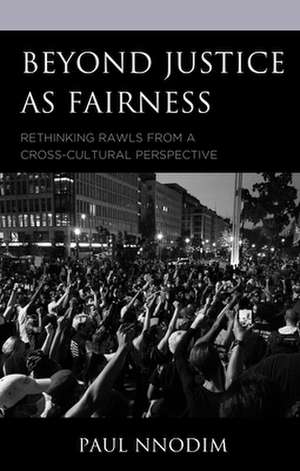
Beyond Justice as Fairness: Rethinking Rawls from a Cross-Cultural Perspective
Autor Paul Nnodimen Limba Engleză Hardback – 21 oct 2020
Preț: 550.25 lei
Preț vechi: 815.82 lei
-33%
Puncte Express: 825
Carte tipărită la comandă
Livrare economică 23 noiembrie-07 decembrie
Livrare prin curier în România Termenul estimat este afișat lângă disponibilitate.
Transport gratuit pentru acest produs Plată online sau ramburs, în funcție de opțiunile comenzii.
Retur gratuit în 14 zile Comandă securizată și suport în română.
Specificații
ISBN-13: 9781498558068
ISBN-10: 1498558062
Pagini: 210
Dimensiuni: 162 x 227 x 20 mm
Greutate: 0.45 kg
Editura: Bloomsbury Publishing
Colecția Lexington Books
Locul publicării:New York, United States
ISBN-10: 1498558062
Pagini: 210
Dimensiuni: 162 x 227 x 20 mm
Greutate: 0.45 kg
Editura: Bloomsbury Publishing
Colecția Lexington Books
Locul publicării:New York, United States
Cuprins
Contents
Acknowledgments
Introduction
Part I Social Justice
Chapter 1: The Question of Justice
Chapter 2: Why Utilitarianism is not the Best Option
Part II Pluralism, Public Reason, and Political Stability
Chapter 3: The Departure from Classical Liberalism
Chapter 4: Justice as Fairness: A Re-Interpretation
Chapter 5: Why Public Reason is not the "Public Use of Reason"
Chapter 6: Rawls's Idea of a Well-Ordered Society
Part III Rawls's Global Justice and the Non-Western World
Chapter 7: Human Rights in The Law of Peoples
Chapter 8: Liberal Individualism and the Concept of the Person in African Philosophy: Implications for Rawls's Basic Human Rights
Epilogue
Notes
Bibliography
Acknowledgments
Introduction
Part I Social Justice
Chapter 1: The Question of Justice
Chapter 2: Why Utilitarianism is not the Best Option
Part II Pluralism, Public Reason, and Political Stability
Chapter 3: The Departure from Classical Liberalism
Chapter 4: Justice as Fairness: A Re-Interpretation
Chapter 5: Why Public Reason is not the "Public Use of Reason"
Chapter 6: Rawls's Idea of a Well-Ordered Society
Part III Rawls's Global Justice and the Non-Western World
Chapter 7: Human Rights in The Law of Peoples
Chapter 8: Liberal Individualism and the Concept of the Person in African Philosophy: Implications for Rawls's Basic Human Rights
Epilogue
Notes
Bibliography
Recenzii
Beyond Justice as Fairness is a pedagogical gem. Nnodim articulates the key ideas of John Rawls's theory of justice in an accessible way that all readers will appreciate. Nnodim identifies the nuances and trajectories of those ideas throughout Rawls's major works and gives attention to the ways in which themes of justice, freedom, and equality are contrasted in classical liberalism and the Rawlsian model. Noting how Rawls's political liberalism differs from comprehensive liberalism, the author navigates the dilemmas of multiculturalism and the plurality of values by focusing on humans' shared political endeavors. Among Nnodim's noteworthy contributions is his application of Rawls's notion of justice as fairness in contexts Rawls may not have foreseen. The final chapter offers a cross-cultural, philosophical analysis of justice and its relation to personhood in Igbo culture. This rich book will be valuable to those interested in human rights and global justice, democracy and citizenship, and individualism and social justice. Those studying philosophy, political science, peace and justice studies, or Africana studies will want this volume. Essential.
Beyond Justice as Fairness serves as a helpful introduction to Rawls's complicated thought for those who want to see the forest in the midst of Rawls's very difficult trees. Nnodim emphasizes the fact that Rawlsian political liberalism is a type of multiculturalism and also fosters a multireligious society. There is much on the positive side to recommend this book, including a discussion of the role of natural rights and duties in Rawls's view, in addition to the more famous treatment of social contract theory.
"This book is a brilliant achievement on several levels: a crystal-clear exposition of Rawls's theories of justice, a generous critique and reinterpretation that helps us understand the latent assumptions animating 'justice as fairness,' and, finally, an original and imaginative bridging of the gap between Rawls's thesis and non-Western conceptions of personhood. This book will be invaluable to students trying to understand Rawls as well as to scholars concerned with the scope and coherence of his arguments."
"Lucid, clear, and accessible, this book is a tour de force. Not only does Nnodim make a complex philosopher legible to both specialized and lay readers, but his rereading of Rawlsian philosophy is both original and transformative. Nnodim points out the limitations of Rawls's ideas about the incompatibility of 'non-Western concepts of personhood' with 'liberal individualism and democratic citizenship.' Nnodim draws on Igbo notions of personhood to demonstrate how Rawls's idea of justice as fairness has applications beyond the borders of the Western world. Nnodim's book presents a strikingly original take on Rawls and his philosophy beyond its predominantly Western-centric interpretations. This bookis a must-read for anyone seeking to understand Rawls's relevance in contexts other than the United States and Europe."
"Cross-cultural study of philosophy is gradually gaining interest, but it has yet to command attention in academia. By engaging Rawls from the perspective of Igbo indigenous thought and culture, Nnodim demonstrates his mastery of Rawlsian 'justice as fairness' beyond the pages of Rawls's writing to understanding the broader convergence of thought patterns and worldviews and the implications of Rawls's theory for the organization of human society. This is an important work that points to a new direction in philosophy."
"This book isa lucid and engaging exposé, as well as a credible extension of Rawls's Theory of Justice. It's a great pedagogical resource."
Beyond Justice as Fairness serves as a helpful introduction to Rawls's complicated thought for those who want to see the forest in the midst of Rawls's very difficult trees. Nnodim emphasizes the fact that Rawlsian political liberalism is a type of multiculturalism and also fosters a multireligious society. There is much on the positive side to recommend this book, including a discussion of the role of natural rights and duties in Rawls's view, in addition to the more famous treatment of social contract theory.
"This book is a brilliant achievement on several levels: a crystal-clear exposition of Rawls's theories of justice, a generous critique and reinterpretation that helps us understand the latent assumptions animating 'justice as fairness,' and, finally, an original and imaginative bridging of the gap between Rawls's thesis and non-Western conceptions of personhood. This book will be invaluable to students trying to understand Rawls as well as to scholars concerned with the scope and coherence of his arguments."
"Lucid, clear, and accessible, this book is a tour de force. Not only does Nnodim make a complex philosopher legible to both specialized and lay readers, but his rereading of Rawlsian philosophy is both original and transformative. Nnodim points out the limitations of Rawls's ideas about the incompatibility of 'non-Western concepts of personhood' with 'liberal individualism and democratic citizenship.' Nnodim draws on Igbo notions of personhood to demonstrate how Rawls's idea of justice as fairness has applications beyond the borders of the Western world. Nnodim's book presents a strikingly original take on Rawls and his philosophy beyond its predominantly Western-centric interpretations. This bookis a must-read for anyone seeking to understand Rawls's relevance in contexts other than the United States and Europe."
"Cross-cultural study of philosophy is gradually gaining interest, but it has yet to command attention in academia. By engaging Rawls from the perspective of Igbo indigenous thought and culture, Nnodim demonstrates his mastery of Rawlsian 'justice as fairness' beyond the pages of Rawls's writing to understanding the broader convergence of thought patterns and worldviews and the implications of Rawls's theory for the organization of human society. This is an important work that points to a new direction in philosophy."
"This book isa lucid and engaging exposé, as well as a credible extension of Rawls's Theory of Justice. It's a great pedagogical resource."