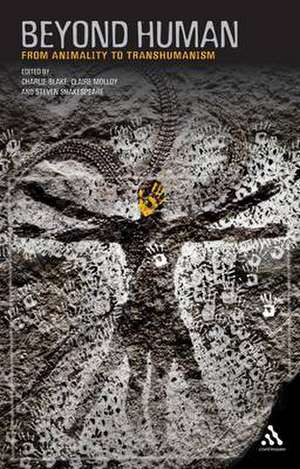
Beyond Human: From Animality to Transhumanism
Editat de Dr Charlie Blake, Dr Claire Molloy, Rev'd Dr Steven Shakespeareen Limba Engleză Paperback – 8 mar 2012
Preț: 263.98 lei
Preț vechi: 341.42 lei
-23%
Puncte Express: 396
Carte disponibilă
Livrare economică 16-30 noiembrie
Livrare prin curier în România Termenul estimat este afișat lângă disponibilitate.
Transport gratuit de la 400.00 lei Plată online sau ramburs, în funcție de opțiunile comenzii.
Retur gratuit în 14 zile Comandă securizată și suport în română.
Specificații
ISBN-13: 9781441150110
ISBN-10: 1441150110
Pagini: 312
Ilustrații: 10
Dimensiuni: 138 x 214 x 18 mm
Greutate: 0.4 kg
Editura: Bloomsbury Publishing
Colecția Continuum
Locul publicării:London, United Kingdom
ISBN-10: 1441150110
Pagini: 312
Ilustrații: 10
Dimensiuni: 138 x 214 x 18 mm
Greutate: 0.4 kg
Editura: Bloomsbury Publishing
Colecția Continuum
Locul publicării:London, United Kingdom
V-ar putea interesa
-
 -19%Preț: 103.72 lei127.96 lei
 -
 Motive and RightnessSteven Sverdlik-31%Preț: 577.09 lei830.37 lei
 -
 Well-Being and DeathBen Bradley-10%Preț: 368.13 lei411.14 lei
 -
 Killing in WarJeff McMahan-15%Preț: 170.60 lei200.79 lei
 -
 -19%Preț: 445.41 lei551.65 lei
 -
 -19%Preț: 372.13 lei459.32 lei
 -
 Drawing Morals: Essays in Ethical TheoryThomas Hurka-30%Preț: 611.41 lei870.62 lei
 -
 -30%Preț: 684.78 lei978.03 lei
 -
 Reconstructing RawlsRobert S. TaylorPreț: 382.94 lei
 -
 Gadamer in ConversationHans-Georg GadamerPreț: 248.03 lei
 -
 The Structural Evolution of MoralityJ. Alexander McKenziePreț: 347.12 lei
 -
 An Anthropology of EthicsJames D. FaubionPreț: 247.25 lei
 -
 Practical EthicsPeter SingerPreț: 295.15 lei
 -
 Ecological EthicsPatrick CurryPreț: 291.01 lei
 -
 Ethics: Key Concepts in PhilosophyDr Dwight Furrow-17%Preț: 156.37 lei187.91 lei
Cuprins
List of figures \ Contributors \ Preface Sean Cubitt \ Acknowledgements \ Introduction Steven Shakespeare, Claire Molloy and Charlie Blake \ Part I: Animality: Boundaries and Definitions \ 1. Incidents in the Animal Revolution Ron Broglio \ 2.Being a Known Animal Claire Molloy \ 3. Beyond the Pain Principle Giovanni Aloi \ Part II: Representing Animality \ 4. What We Can Do: Art Methodologies and Parities in Meeting Bryndis Snæbjornsdóttir and Mark Wilson \ 5. Horse-Crazy Girls: Alternative Embodiments and Socialities Natalie Corinne Hansen \ 6. Writing Relations: the Lobster, the Orchid, the Primrose, You, Me, Chaos and Literature Lucile Desblache \ Part III: Thinking Beyond the Divide \ 7. Affective Animal: Bataille, Lascaux and the Mediatization of the Sacred Felicity Colman \ 8. Levinas, Bataille and the Theology of Animal Life Donald L. Turner \ 9. Degrees of 'Freedom': Humans as Primates in Dialogue with Hans urs von Balthasar Celia Deane-Drummond \ Part IV: Animal- Human- Machine- God \ 10. Inhuman Geometries: Aurochs and Angels and The Refuge of Art Charlie Blake \ 11. Articulating the Inhuman: God, Animal, Machine Steven Shakespeare \ 12. Transforming the Human Body Gareth Jones and Maja Whitaker \ Index
Recenzii
This fascinating collection of essays is often challenging and always engaging.Drawing on an astonishing breadth of approaches this book offers a stimulating exploration of what it means to be both embodied human and animal in an increasingly post-human world. From the opening chapter with its provocative idea of handing animals tools for their own, much needed, revolution through to the final chapter which unsettlingly forces the reader to consider human-technological melding, this book will force to you see - and think about the world - differently.
The chapters in this incisive collection offer important challenges to anthropocentric prejudices - just as the title promises, readers are taken "beyond human." Vivid, passionate, ethically-charged critical writing embodies resistance to fixed ideas that diminish other animals. Boundaries are contested and conventions are transgressed as these writers celebrate a consciousness that displaces man as the measure of all things. This memorable and important compilation of scholarship creatively advances the agenda of human-animal studies.
This is a fascinating collection of thoughtfully subversive essays, which range over art and philosophy, science and literature, evolution and ethics, the sacred and the divine. Bringing into creative contact the pressing questions of, on the one hand, animals and animality and, on the other, technology and transhumanism, they urge the reader to move beyond humanist hang-ups, beyond anthroponormative assumptions, indeed, beyond the human.
Taken together, the essays in this collection offer a persuasive argument for what should count in crafting a politics for transitional animals and their reciprocal others.
This wide-ranging volume explores the historical and futural limits of the human subject: its constitutive animality and its technological transformation . [T]he collection's distinctiveness is in the way it combines the earthly concerns of "the animal turn" with more otherworldly discourses, such as the oft-ignored reflections of theologians, and the technoscientific fantasies and realities of transhumanists . Alongside its intersection of themes and multidisciplinarity, a distinguishing strength of the book is that it does not shirk the question of human distinctiveness . Ultimately, it collects a series of intriguing and provocative forays that suggest and mark out new terrains for scholarship in the theoretical humanities.
The chapters in this incisive collection offer important challenges to anthropocentric prejudices - just as the title promises, readers are taken "beyond human." Vivid, passionate, ethically-charged critical writing embodies resistance to fixed ideas that diminish other animals. Boundaries are contested and conventions are transgressed as these writers celebrate a consciousness that displaces man as the measure of all things. This memorable and important compilation of scholarship creatively advances the agenda of human-animal studies.
This is a fascinating collection of thoughtfully subversive essays, which range over art and philosophy, science and literature, evolution and ethics, the sacred and the divine. Bringing into creative contact the pressing questions of, on the one hand, animals and animality and, on the other, technology and transhumanism, they urge the reader to move beyond humanist hang-ups, beyond anthroponormative assumptions, indeed, beyond the human.
Taken together, the essays in this collection offer a persuasive argument for what should count in crafting a politics for transitional animals and their reciprocal others.
This wide-ranging volume explores the historical and futural limits of the human subject: its constitutive animality and its technological transformation . [T]he collection's distinctiveness is in the way it combines the earthly concerns of "the animal turn" with more otherworldly discourses, such as the oft-ignored reflections of theologians, and the technoscientific fantasies and realities of transhumanists . Alongside its intersection of themes and multidisciplinarity, a distinguishing strength of the book is that it does not shirk the question of human distinctiveness . Ultimately, it collects a series of intriguing and provocative forays that suggest and mark out new terrains for scholarship in the theoretical humanities.