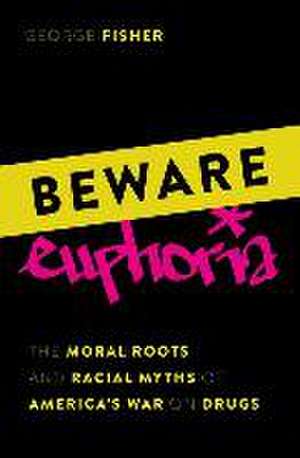
Beware Euphoria: The Moral Roots and Racial Myths of America's War on Drugs
Autor George Fisheren Limba Engleză Hardback – 22 mar 2024
Preț: 287.86 lei
Preț vechi: 361.99 lei
-20%
Puncte Express: 432
Carte disponibilă
Livrare economică 29 octombrie-04 noiembrie
Livrare express 13-17 octombrie pentru 126.27 lei
Livrare prin curier în România Termenul estimat este afișat lângă disponibilitate.
Transport gratuit de la 400.00 lei Plată online sau ramburs, în funcție de opțiunile comenzii.
Retur gratuit în 14 zile Comandă securizată și suport în română.
Specificații
ISBN-13: 9780197688489
ISBN-10: 0197688489
Pagini: 504
Ilustrații: 21 figures & 11 maps
Dimensiuni: 221 x 165 x 46 mm
Greutate: 0.84 kg
Editura: Oxford University Press
Colecția OUP USA
Locul publicării:New York, United States
ISBN-10: 0197688489
Pagini: 504
Ilustrații: 21 figures & 11 maps
Dimensiuni: 221 x 165 x 46 mm
Greutate: 0.84 kg
Editura: Oxford University Press
Colecția OUP USA
Locul publicării:New York, United States
V-ar putea interesa
-
 The Constitution of the War on DrugsDavid PozenPreț: 147.80 lei
 -
 -15%Preț: 171.58 lei202.67 lei
 -
 Waiting to InhaleAkwasi Owusu-BempahPreț: 125.95 lei
 -
 Locking Up Our Own: Winner of the Pulitzer PrizeJames Forman, Jr.-27%Preț: 67.14 lei91.74 lei
 -
 Locking Up Our OwnJames FormanPreț: 95.96 lei
 -
 Should All Drugs Be Legalized? (the Big Idea Series)Mattha Busby-18%Preț: 76.04 lei93.03 lei
 -
 Human History on DrugsSam KellyPreț: 120.01 lei
 -
 The Suburban Crisis - White America and the War on DrugsMatthew D. LassiterPreț: 308.57 lei
 -
 Our Right to DrugsThomas SzaszPreț: 112.44 lei
 -
 Drugs in AmericaH Wayne Morgan-5%Preț: 140.10 lei147.47 lei
 -
 A Brief History of DrugsAntonio EscohotadoPreț: 81.63 lei
 -
 -19%Preț: 80.83 lei100.18 lei
 -
 CrackDavid FarberPreț: 110.67 lei
 -
 Drug Decriminalization and LegalizationAharon W Zorea-44%Preț: 298.48 lei535.34 lei
 -
 One Nation Under the InfluenceKevin A SabetPreț: 170.25 lei
 -
 -36%Preț: 58.73 lei92.41 lei
 -
 Opium's OrphansP E CaquetPreț: 262.66 lei
 -
 Dope GirlsMarek KohnPreț: 78.47 lei
 -
 Pills, Powder, and SmokeAntony LoewensteinPreț: 121.88 lei
Recenzii
In this polemical work Fisher takes exception to the view that the societal banning of opiates, psychedelics, and other drugs despite the acceptance of alcohol use is rooted in racism against Chinese, Mexican, and Black Americans...this well-written and well-argued book makes a strong case in favor of the author's position.
Fisher challenges claims that early antidrug laws in the U.S. arose from racialanimus, arguing instead that they trace to early Christian sexual strictures andtraditional moral censure of intoxication and perceived threats to respectablewhite women and youth. He finds that today's drug war's racial dynamic differsgreatly, as harsher penalties swell prisons with mostly non-white dealers.
Beware Euphoria^r makes a useful addition to histories of the Drug War, particularly in the attention it pays to moral normativity. Fisher's careful attention to detail also means Beware Euphoria explains some individuals' roles who do not always get close attention (William Boos, Henry Finger, etc.) It makes a provocative argument for why alcohol survived while other intoxicants were banned. Overall this is good work that will benefit scholars interested in the War on Drugs.
Fisher challenges claims that early antidrug laws in the U.S. arose from racialanimus, arguing instead that they trace to early Christian sexual strictures andtraditional moral censure of intoxication and perceived threats to respectablewhite women and youth. He finds that today's drug war's racial dynamic differsgreatly, as harsher penalties swell prisons with mostly non-white dealers.
Beware Euphoria^r makes a useful addition to histories of the Drug War, particularly in the attention it pays to moral normativity. Fisher's careful attention to detail also means Beware Euphoria explains some individuals' roles who do not always get close attention (William Boos, Henry Finger, etc.) It makes a provocative argument for why alcohol survived while other intoxicants were banned. Overall this is good work that will benefit scholars interested in the War on Drugs.
Notă biografică
George Fisher is the Judge John Crown Professor of Law at Stanford Law School, where he has been teaching evidence, prosecution practice, and criminal legal history since 1995. He began practice as a Massachusetts prosecutor and later taught at Boston College Law School, Harvard Law School, and Yale Law School.
Cuprins
- List of Illustrations and Tables
- Prologue
- Introduction: Monogamy's Paradox
- PART I: MORAL ROOTS
- Chapter One: Sex, Drunkenness, and the Euphoria Taboo
- Chapter Two: The Gin Crisis
- Chapter Three: Prohibition's Rise, Its Fall, and the Reign of Social Drinking
- Chapter Four: Medical Drug Use Versus Recreational Abuse
- PART II: RACIAL MYTHS
- Chapter Five: Race in the Dens and Miscegenation Myths
- Chapter Six: Crazed Racial Coke Fiends
- Chapter Seven: Marijuana: Assassin of Youth
- Chapter Eight: Monogamy's Demise?